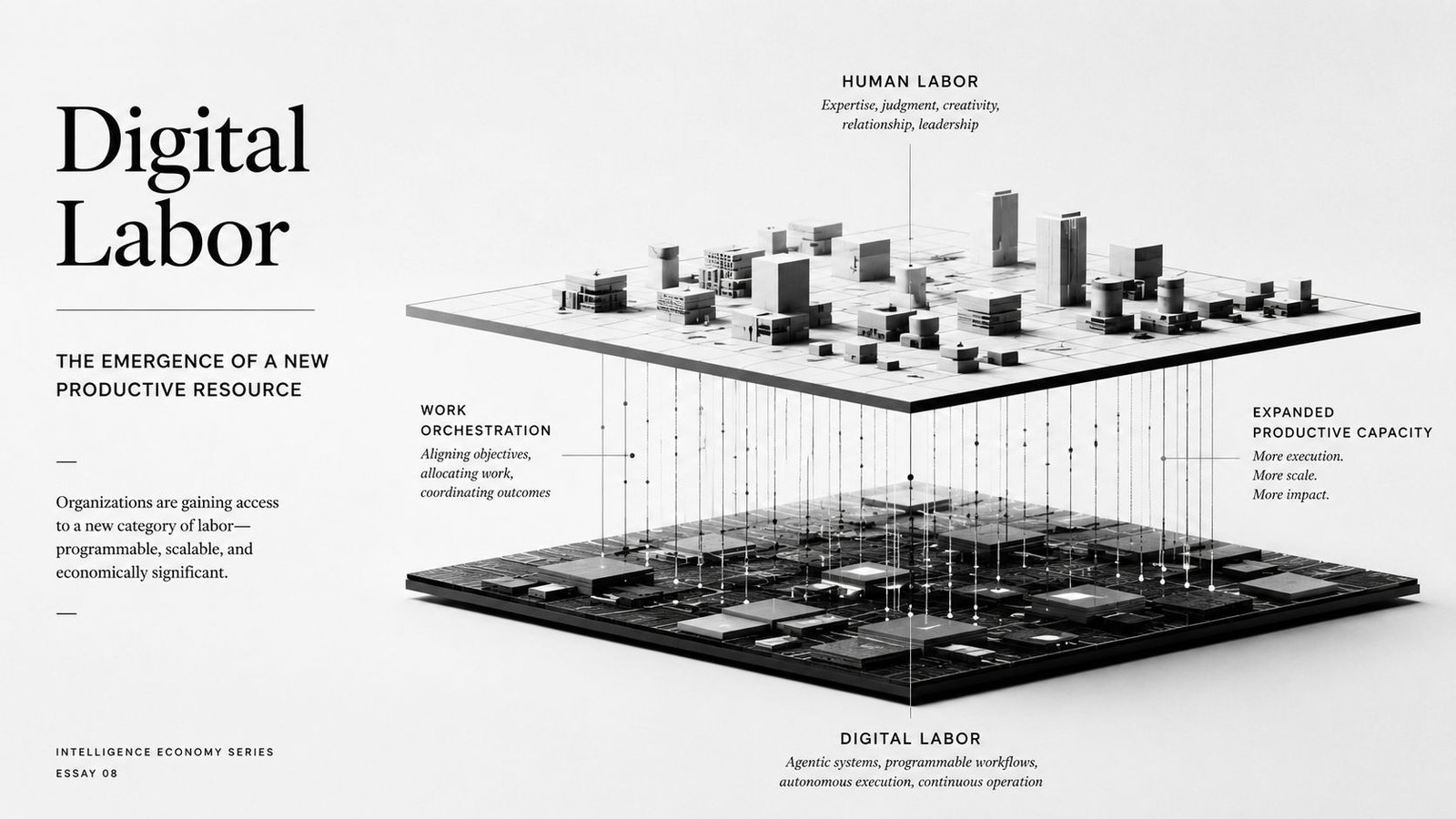
Every economic system is ultimately constrained by its ability to perform work.
Economic growth is often described through the language of technology, capital, innovation, and productivity. Beneath these concepts lies a more fundamental reality. Societies progress when they increase their capacity to transform resources into outcomes. Whether producing goods, delivering services, conducting research, managing operations, or coordinating institutions, economic activity depends upon labor. Labor remains the mechanism through which intentions become actions and actions become value.
For centuries, labor has been inseparable from human participation. Economic systems evolved around the assumption that productive work required people. Machines amplified human effort. Software improved human efficiency. Organizations developed management structures, compensation systems, career ladders, labor markets, and educational institutions around the premise that labor originated from individuals. This assumption became so deeply embedded within economic thinking that labor and humanity were often treated as interchangeable concepts.
The intelligence economy begins to challenge that assumption. As agentic systems become capable of executing tasks, coordinating workflows, adapting to changing conditions, and contributing directly to organizational outcomes, a new possibility emerges. Productive capacity may increasingly exist outside traditional definitions of human labor. Organizations gain access to systems that perform economically valuable work without fitting conventional categories of employees, contractors, or outsourced providers.
This shift is frequently discussed through the language of automation. While automation remains an important part of the story, it is not the deepest story. Automation focuses on replacing activities. Digital labor focuses on creating productive capacity. The distinction matters because economies are shaped not only by efficiency improvements but also by the emergence of entirely new resources. Just as industrial machinery expanded physical capacity and software expanded informational capacity, digital labor may expand execution capacity.
Understanding this transition requires moving beyond familiar debates surrounding job displacement and workforce disruption. Those conversations often focus on what existing workers might lose. A broader economic perspective asks a different question. What happens when organizations gain access to an entirely new category of labor? How do firms change when productive capacity becomes increasingly programmable? How do management systems evolve when workers are no longer exclusively human?
These questions point toward a larger transformation. The rise of digital labor is not merely a technological event. It is an organizational and economic development that may reshape the structure of firms, redefine productivity, and alter how value is created across entire industries.
Digital labor represents the emergence of programmable productive capacity within organizations. Its significance lies not in automation alone, but in the creation of a new category of labor capable of contributing directly to economic output.
How Human Labor Became The Foundation Of The Modern Economy
To understand the significance of digital labor, it is useful to examine the role labor has historically played within economic systems. Labor is one of the oldest and most fundamental factors of production. Long before industrialization, societies relied on human effort to cultivate land, construct infrastructure, produce goods, and maintain institutions. Economic growth depended largely on increasing the quantity and effectiveness of available labor.
The industrial revolution transformed this relationship by introducing machines capable of amplifying physical effort. A single worker operating industrial equipment could produce outputs that would previously have required dozens of individuals. Productivity increased dramatically, but the underlying structure remained unchanged. Machines enhanced labor. They did not replace labor as the central productive force. Human workers continued directing, supervising, and operating the systems that generated economic value.
The digital revolution produced a similar outcome in a different domain. Software expanded humanity's ability to process information, coordinate activities, and manage complexity. Administrative tasks that once required large teams could be performed by information systems. Decision-making became faster. Communication became more efficient. Yet software largely functioned as a tool. It improved productivity without fundamentally altering the definition of labor itself.
This historical pattern is important because it reveals a recurring principle. Major technological transitions often increase productivity by augmenting existing labor rather than creating entirely new categories of productive capacity. Machines amplified physical work. Software amplified informational work. Both increased economic output while preserving the assumption that labor remained fundamentally human.
The emergence of digital labor may represent a departure from this pattern. Instead of simply increasing the productivity of workers, agentic systems increasingly perform work-like functions themselves. They participate in workflows, generate outputs, coordinate actions, monitor conditions, and execute operational tasks. In doing so, they begin occupying a space that traditional economic frameworks have historically reserved for labor.
This distinction explains why the rise of digital labor deserves separate analysis. The question is no longer whether technology improves productivity. Technology has been improving productivity for centuries. The more important question is whether productive capacity itself is becoming detached from human participation. If that process continues, organizations may find themselves managing a workforce that includes participants fundamentally different from any that have existed before.
When Productive Capacity Becomes Programmable
The emergence of digital labor begins with a simple observation. Modern organizations increasingly rely on systems that do more than process information. They perform tasks. They coordinate activities. They monitor environments. They generate outputs. They interact with customers. They manage workflows. In many cases, they contribute directly to economic outcomes. These activities resemble labor not because they are intelligent, but because they participate in work.
This distinction is often obscured by the language used to describe artificial intelligence. Public discussion frequently focuses on models, algorithms, reasoning capabilities, and technological performance. While these elements matter, they describe the mechanisms underlying digital labor rather than its economic significance. Organizations rarely derive value from intelligence alone. Value emerges when intelligence contributes to productive activity. The question therefore shifts from what intelligent systems know to what they are capable of doing.
Historically, productive capacity entered organizations primarily through people. Firms hired employees when they needed additional capability. Labor markets existed because organizations required access to skills, expertise, effort, and judgment. Growth often depended on expanding the workforce because increasing output required increasing labor capacity. This relationship influenced everything from management structures to economic policy.
Digital labor introduces a different model. Productive capacity increasingly arrives through systems that can be deployed, scaled, monitored, and coordinated through software. Unlike traditional labor, digital labor is not constrained by geography, working hours, organizational boundaries, or conventional staffing models. It can be replicated, distributed, and integrated into workflows with a level of flexibility that human organizations have rarely experienced.
This does not imply that digital labor replaces human labor. Economic history suggests that new productive resources often coexist with existing ones rather than eliminating them entirely. Industrial machinery did not eliminate workers. Software did not eliminate managers. Instead, both altered the nature of work and shifted how value was created. Digital labor is likely to follow a similar path. Its significance lies not in replacement but in expansion. Organizations gain access to additional productive capacity that complements existing capabilities.
The distinction between automation and digital labor becomes especially important here. Automation is typically task-centric. A specific activity is identified and performed more efficiently through technology. Digital labor is capacity-centric. The focus is not on individual tasks but on the availability of productive capability that can be directed toward a wide range of objectives. This shift from automation to capacity represents a fundamentally different economic perspective.
Automation Versus Digital Labor
Technology performs a specific activity more efficiently, reducing the effort required to complete an existing process.
Organizations gain access to productive capability that can be allocated, coordinated, and deployed across multiple activities.
The primary significance is not efficiency alone but the expansion of available productive capacity within the firm.
The framework reveals why digital labor deserves attention as a separate category. Automation improves existing systems. Digital labor changes the composition of productive resources available to organizations. The difference may appear subtle initially, but over time it produces very different organizational consequences. Firms begin thinking less about reducing effort and more about deploying capability. Productivity becomes a function of orchestration rather than merely efficiency.
This transition also introduces new managerial questions. How should digital labor be allocated? How should its performance be measured? How should organizations govern systems capable of participating in operational work? Traditional management practices evolved around human participants. Digital labor requires new mechanisms for coordination, accountability, oversight, and integration. The challenge is not simply technological. It is organizational.
The emergence of digital labor therefore represents a broader shift in economic thinking. Labor has traditionally been defined by who performs work. Digital labor shifts attention toward what performs work. The source of productive capacity becomes less important than the contribution that capacity makes to outcomes. This perspective expands the definition of labor beyond traditional categories and introduces a new lens through which organizations can understand value creation.
The significance of digital labor is not that machines become workers. The significance is that organizations gain access to productive capacity that behaves increasingly like labor while existing outside traditional workforce structures.
As digital labor becomes more common, organizations will need a framework for understanding how different forms of labor relate to one another. The future workforce is unlikely to consist exclusively of humans or exclusively of machines. Instead, firms may operate across a spectrum of productive capacity ranging from fully human work to increasingly autonomous forms of digital participation.
Understanding The New Workforce Continuum
One of the limitations of current discussions about artificial intelligence is their tendency to frame work in binary terms. Humans either perform a task or machines perform a task. Jobs are either protected or automated. Workers are either replaced or unaffected. Economic reality is rarely so simple. Most technological transitions create a continuum rather than a divide. New capabilities emerge gradually, coexist with older forms of work, and reshape organizational structures over time.
Digital labor should be understood through this lens. Rather than replacing traditional labor categories outright, it expands the spectrum of productive capacity available to organizations. Human expertise remains essential. Judgment remains essential. Creativity remains essential. At the same time, organizations gain access to increasingly sophisticated forms of programmable capability that participate alongside human workers in producing outcomes.
The Labor Spectrum
Work is performed entirely by people using their expertise, judgment, experience, and effort to produce economic outcomes.
Workers use software, automation, and intelligent tools to increase productivity while remaining responsible for execution.
Agentic systems contribute directly to productive activities and operational workflows alongside human workers.
Systems assume responsibility for increasingly complex operational activities while operating within human-defined objectives and governance structures.
The framework highlights an important reality. The future workforce is unlikely to be divided between humans and machines. Instead, organizations will operate across multiple forms of productive capacity simultaneously. Some activities will remain predominantly human because they depend heavily on judgment, creativity, trust, empathy, negotiation, or strategic thinking. Other activities will increasingly be shared between people and digital systems. Still others may become largely autonomous. The workforce becomes a continuum rather than a category.
This perspective provides a more useful lens than many current debates surrounding automation. Discussions about replacement often assume that technological progress follows an all-or-nothing trajectory. Economic history suggests otherwise. New technologies typically create hybrid operating models long before they create entirely new systems. Factories combined machinery and human labor. Offices combined software and knowledge workers. The intelligence economy is likely to combine human and digital labor in similar ways.
The implications for organizational design are substantial. Historically, workforce planning focused primarily on hiring, training, managing, and retaining people. Future workforce planning may involve allocating capability across multiple labor categories. Managers may determine not only which employees perform a task, but which combination of human expertise, augmented workflows, digital labor, and autonomous systems should contribute to a desired outcome.
This shift alters how organizations think about productivity. Productivity has traditionally been measured through the output of human workers supported by technology. The labor spectrum introduces a broader perspective in which productivity emerges from the interaction between multiple forms of productive capacity. Organizational performance increasingly depends upon how effectively these resources are coordinated rather than how efficiently individual workers operate.
Another important consequence concerns specialization. Human workers often develop expertise through education, training, and experience. Digital labor develops capabilities through models, data, workflows, memory systems, and operational feedback. These capabilities evolve differently, possess different strengths, and create different limitations. Organizations that understand these distinctions may be better positioned to allocate work according to comparative advantage rather than habit or tradition.
This idea introduces a new management challenge. Throughout modern history, managers primarily coordinated human effort. Future managers may coordinate portfolios of capability. Their responsibility expands beyond supervising people to orchestrating interactions among multiple forms of productive capacity. The role becomes less about directing work and more about designing systems through which work is performed.
The defining workforce challenge of the next decade may not be replacing people with machines. It may be learning how to combine human judgment, augmented productivity, digital labor, and autonomous capability into a coherent operating model.
The labor spectrum also reveals why digital labor should not be viewed solely through the lens of technology. It represents a management problem, an organizational problem, and an economic problem. New forms of productive capacity require new methods of coordination. Firms must determine how responsibilities are allocated, how performance is measured, and how governance structures evolve as digital workers become increasingly integrated into everyday operations.
These questions point toward the next stage of organizational development. If digital labor becomes a permanent component of the workforce, organizations will need entirely new approaches to management. The management systems that evolved around human workers may prove insufficient for a world where productive capacity exists in multiple forms simultaneously.
The Rise Of Workforce Orchestration
Management has historically been one of the defining functions of the firm. Organizations require management because productive activity must be coordinated. Resources must be allocated. Objectives must be communicated. Performance must be measured. Human workers require support, oversight, training, motivation, and direction. Entire organizational structures evolved around these requirements because effective management often determines whether productive capacity translates into meaningful outcomes.
Digital labor introduces a new dimension to this challenge. Unlike traditional software, digital workers participate directly in workflows. They execute tasks, interact with systems, generate outputs, and contribute to operational outcomes. Their capabilities must therefore be governed and coordinated in ways that resemble workforce management more closely than software administration. Organizations begin managing productive capacity rather than simply managing technology.
This distinction is significant because the management frameworks used for software are fundamentally different from those used for labor. Software is typically deployed, configured, and maintained. Labor is allocated, coordinated, evaluated, and developed. Digital labor occupies a position somewhere between these categories. It behaves like technology in some respects and like labor in others. As a result, organizations must develop new operating models capable of addressing this hybrid nature.
The first challenge involves allocation. Human managers regularly decide how work should be distributed across teams and individuals. Similar decisions increasingly apply to digital labor. Organizations must determine which activities should be performed by people, which should be augmented through technology, and which should be delegated to digital workers. Effective allocation becomes a source of competitive advantage because it influences both productivity and quality.
The second challenge involves governance. Human workers operate within organizational policies, legal frameworks, cultural norms, and management oversight. Digital labor requires comparable structures. Objectives must be defined clearly. Boundaries must be established. Performance must be monitored. Accountability mechanisms must exist. Without governance, organizations risk creating systems that generate activity without generating value.
The third challenge involves measurement. Traditional organizations evaluate employees through a combination of outcomes, competencies, productivity metrics, and organizational contribution. Similar questions emerge for digital labor. How should capability be measured? How should performance be compared across different labor categories? How should organizations determine whether digital workers are creating value? These questions may become central management disciplines of the intelligence economy.
Designing Organizations For A Hybrid Workforce
Throughout modern economic history, organizational architecture has largely been built around a single assumption. Productive capacity resides in people. Firms recruit employees, organize teams, establish reporting structures, create departments, and design management systems because work has historically been performed by human workers. Organizational design evolved as a mechanism for coordinating human effort efficiently across increasingly complex activities. The structure of the firm reflected the nature of labor itself.
The emergence of digital labor challenges this assumption. As productive capacity becomes distributed across both human and digital participants, organizations must rethink how work is structured and coordinated. Traditional organizational charts capture relationships between people. They do not capture relationships between employees, intelligent systems, execution platforms, and autonomous workflows. The enterprise begins operating as a network of capabilities rather than a collection of roles.
This shift may prove more significant than many technological changes because organizational architecture influences how decisions are made, how resources are allocated, and how value is created. Every major transformation in productive capacity eventually produces a corresponding transformation in organizational design. Factories emerged alongside industrial machinery. Corporate management expanded alongside large-scale enterprises. Digital organizations evolved alongside software and networks. Digital labor may create entirely new organizational forms.
One consequence is the gradual separation of capability from headcount. Historically, organizational scale was often measured through the size of the workforce. More employees generally implied greater productive capacity. In a world increasingly shaped by digital labor, this relationship weakens. Productive capacity can expand without proportional increases in staffing. Organizations become capable of achieving greater output through the orchestration of capabilities rather than the accumulation of personnel.
This development alters how firms think about growth. Expansion no longer depends solely on hiring additional workers. It increasingly depends on integrating new forms of productive capacity into existing operational systems. Growth becomes a function of workforce architecture rather than workforce size. The ability to coordinate diverse forms of labor may become more important than the ability to recruit large numbers of employees.
The New Workforce Architecture
Strategic direction, creativity, governance, negotiation, relationship management, and complex decision-making remain concentrated in human participants.
Employees leverage software, intelligence systems, and automation tools to increase productivity and effectiveness.
Agentic systems execute workflows, coordinate activities, generate outputs, and contribute directly to organizational operations.
Execution systems continuously monitor environments, optimize operations, and manage routine activities within defined governance boundaries.
The framework illustrates how productive capacity may become layered rather than concentrated. Organizations increasingly combine different forms of capability according to the nature of the work being performed. Human judgment remains essential because organizations ultimately require purpose, accountability, and strategic direction. Digital labor expands execution capacity. Autonomous infrastructure provides continuous operational support. Together, these layers create a workforce architecture fundamentally different from traditional organizational models.
This architecture also changes the role of leadership. Leaders have historically focused on directing people and allocating resources. Increasingly, they may focus on designing systems through which capabilities interact. The challenge becomes one of orchestration. Success depends less on managing individual contributors and more on creating environments where multiple forms of productive capacity can operate effectively together.
The implications extend into organizational culture as well. Culture has traditionally been understood as the shared values, behaviors, and norms that shape human interaction. As digital labor becomes integrated into daily operations, organizations may need to develop new principles governing how humans and intelligent systems collaborate. Culture expands from a social concept into an operational one.
The next generation of organizations may be defined not by how many people they employ, but by how effectively they combine human judgment, digital labor, and autonomous execution into a unified operating system.
The rise of digital labor therefore represents more than a workforce trend. It represents a redesign of the enterprise itself. Firms increasingly become coordination systems that allocate capabilities rather than simply managing employees. This shift creates profound implications for productivity, competitiveness, and economic organization.
How Digital Labor May Reshape The Economy
When new forms of productive capacity emerge, their effects rarely remain confined to individual organizations. Industrial machinery transformed manufacturing, urbanization, trade, and economic growth. Information technology reshaped communication, services, finance, and global commerce. Digital labor may produce similarly broad consequences because labor sits at the center of economic activity itself.
The most immediate impact is likely to be an expansion of productive capacity. Organizations gain access to additional capability without relying exclusively on traditional workforce growth. Activities that were previously constrained by staffing limitations become increasingly scalable. The result is not merely greater efficiency. It is the possibility of greater economic output from the same underlying organizational resources.
A second consequence concerns the economics of scale. Historically, organizations encountered diminishing returns as they grew larger. More employees required more coordination. More coordination required more management. Complexity increased alongside size. Digital labor may weaken this relationship by absorbing activities that would otherwise require additional organizational layers. Scale becomes increasingly dependent on architecture rather than administration.
A third consequence involves competition. Organizations have traditionally competed through access to capital, talent, technology, and distribution. As digital labor becomes more widely available, competitive advantage may shift toward orchestration. The firms that thrive may not be those with the largest workforces, but those that most effectively deploy productive capacity across human and digital participants.
The broader implication is that labor itself becomes more flexible. For centuries, labor markets have functioned as the primary mechanism through which productive capacity is allocated. Digital labor introduces an alternative channel. Organizations gain access to capability through systems rather than exclusively through employment relationships. This does not eliminate labor markets, but it changes their relative importance within the economy.
Perhaps the most significant consequence concerns the relationship between growth and employment. Economic expansion has historically been linked closely to workforce growth because increasing output required increasing labor input. Digital labor weakens this connection. Organizations may become capable of generating higher levels of output without equivalent increases in headcount. This development creates opportunities, efficiencies, and policy challenges that extend far beyond individual firms.
The Shift From Managing People To Managing Capacity
For more than a century, management has been defined largely by the coordination of human effort. Organizations hired workers, created teams, established hierarchies, and developed management disciplines designed to align individual contributions with collective objectives. This model proved remarkably successful because productive capacity was inseparable from people. Managing workers effectively was often synonymous with managing the organization itself.
The emergence of digital labor introduces a different possibility. Productive capacity becomes increasingly distributed across multiple forms of participation. Human expertise remains critical, but it is no longer the sole source of operational capability. Organizations gain access to digital workers capable of contributing to workflows, generating outputs, coordinating activities, and expanding execution capacity. As a result, management begins evolving from the coordination of people toward the orchestration of capability.
This distinction may define the next era of organizational design. Firms that continue viewing technology solely as a productivity tool may capture incremental improvements. Firms that recognize digital labor as a new category of productive capacity may rethink how work is structured, how resources are allocated, and how value is created. The competitive advantage of the future may emerge not from possessing more labor, but from coordinating multiple forms of labor more effectively than competitors.
The implications extend beyond management. Educational institutions, labor markets, regulatory systems, and economic policies were all designed around a world in which labor was fundamentally human. As digital labor becomes increasingly integrated into productive activity, these institutions may face pressures to adapt. Questions surrounding accountability, governance, productivity measurement, and workforce participation become increasingly important because traditional assumptions no longer fully describe economic reality.
The broader lesson is that the intelligence economy is not simply changing how organizations use technology. It is changing how organizations access productive capacity itself. Every major economic transformation has altered the resources available to create value. Digital labor may represent the next chapter in that progression.
The defining management challenge of the intelligence economy may not be automating work. It may be learning how to orchestrate an expanding spectrum of productive capacity that includes both human and digital participants.
Conclusion
The emergence of digital labor represents a significant development in the evolution of productive capacity. Industrial machinery amplified physical effort. Software amplified informational work. Agentic systems introduce the possibility that labor itself becomes increasingly programmable. This shift matters because labor occupies a foundational position within economic systems. It is the mechanism through which resources are transformed into outcomes and intentions are translated into value.
Understanding digital labor requires moving beyond the familiar language of automation. Automation describes the performance of tasks. Digital labor describes the availability of productive capacity. The distinction is important because new forms of productive capacity often reshape organizations, industries, and economies more profoundly than individual technologies. The significance lies not in what systems are capable of doing, but in how those capabilities alter the structure of work itself.
Organizations are therefore entering a period in which workforce design becomes increasingly complex. Human expertise, augmented productivity, digital labor, and autonomous systems coexist within the same operating environment. Success depends not on maximizing any single category, but on coordinating them effectively. The future firm becomes an orchestrator of capability rather than simply an employer of labor.
This transformation is still in its early stages. Many of the institutions that govern work today were created for a different economic era. Yet the direction of change is becoming increasingly visible. As productive capacity becomes more programmable, organizations gain access to resources that previous generations could not easily imagine. The challenge is not merely technological. It is organizational, economic, and institutional.
Every economic era is defined by the resources it learns to scale. The industrial economy scaled physical labor. The digital economy scaled information. The intelligence economy may ultimately be remembered for scaling labor itself, expanding productive capacity beyond the boundaries of human participation and reshaping how value is created throughout the economy.