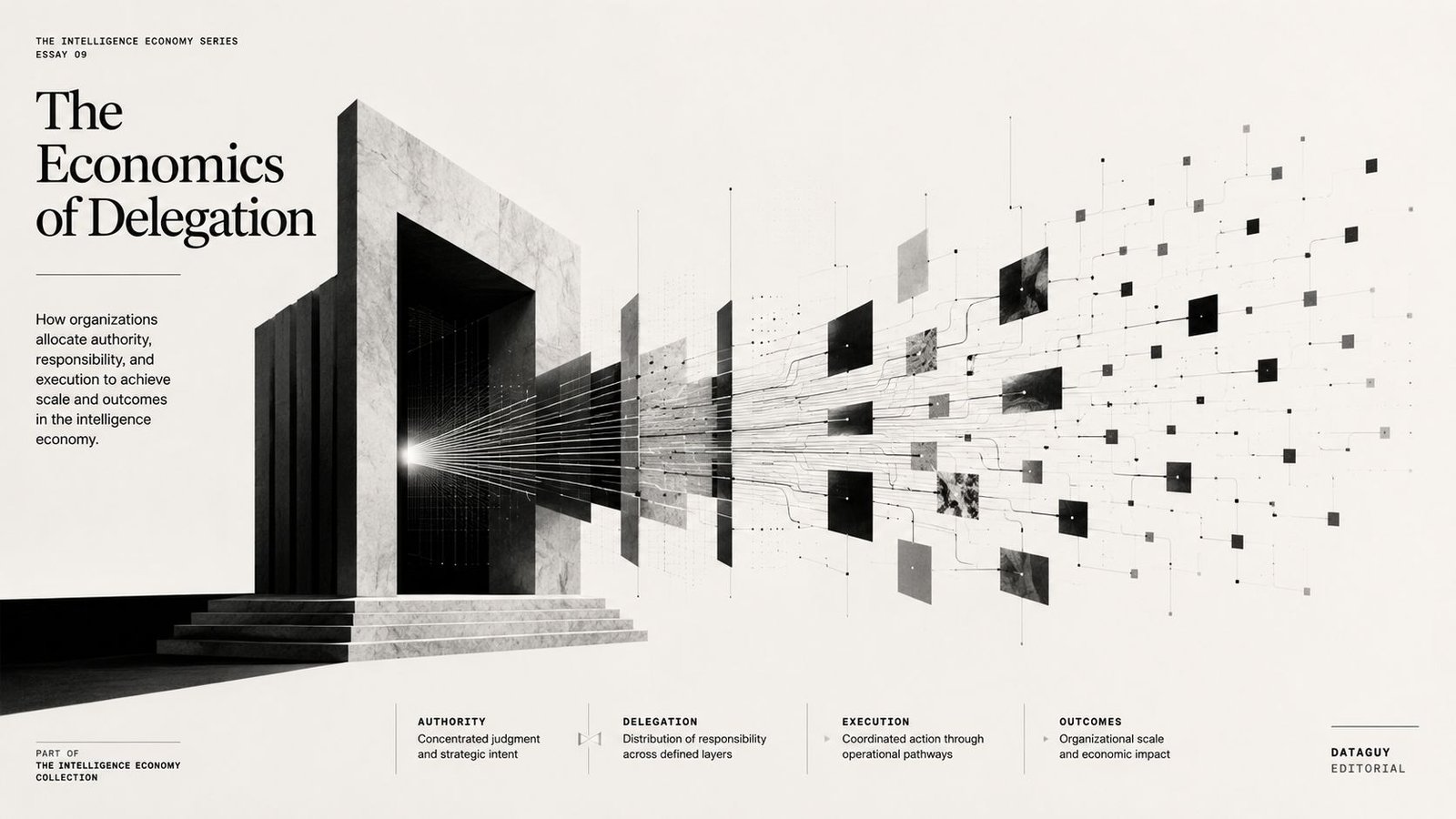
Every organization is a delegation system.
At first glance, organizations appear to be collections of people pursuing shared objectives. A deeper examination reveals a different reality. Organizations are mechanisms for distributing responsibility. Executives delegate authority to managers. Managers delegate tasks to teams. Teams distribute work among specialists. Institutions allocate responsibilities across departments, processes, and operational structures. The purpose of organizational design has always been to determine who does what, under what conditions, and with what degree of authority.
This perspective helps explain why delegation occupies such a central role within economic systems. Individuals possess limited time, limited attention, and limited capacity. Organizations overcome these constraints by distributing responsibility across larger groups. Delegation enables scale because it allows productive activity to expand beyond the capabilities of any single participant. Without delegation, large enterprises would be impossible. Governments would be unmanageable. Markets would struggle to coordinate complex activity. Modern economic systems are built upon the assumption that work can be distributed effectively.
For centuries, delegation followed a relatively stable pattern. Responsibility flowed between humans. Authority was transferred from one person to another person. Organizations developed management structures, reporting hierarchies, incentive systems, and governance mechanisms to support this process. Even as technology transformed industries, delegation itself remained fundamentally human. Machines performed tasks. Software processed information. People retained responsibility for assigning work, making decisions, and directing execution.
The intelligence economy introduces a new possibility. Organizations increasingly gain access to systems capable of participating directly in productive activity. Digital labor performs tasks. Agentic systems coordinate workflows. Execution systems contribute to outcomes. As these capabilities expand, delegation evolves beyond its traditional boundaries. Organizations begin allocating responsibility across a broader spectrum of participants that includes both human and digital contributors.
This transition represents a significant shift because delegation determines how productive capacity is utilized. Access to digital labor alone does not create value. Value emerges when organizations allocate responsibilities effectively, establish appropriate levels of authority, and create mechanisms for coordination and accountability. The challenge is no longer simply managing people. The challenge becomes designing systems of delegation capable of orchestrating increasingly diverse forms of productive capacity.
Much of the current discussion surrounding artificial intelligence focuses on automation, productivity, and technological capability. These topics are important, but they often overlook the deeper organizational transformation taking place. The most consequential question may not be what intelligent systems can do. The more important question is what organizations choose to delegate to them.
The answer carries implications far beyond operational efficiency. Delegation shapes management, governance, accountability, organizational architecture, and economic scale. As intelligent systems become increasingly capable participants within productive activity, the economics of delegation may emerge as one of the defining disciplines of the intelligence era.
The intelligence economy transforms delegation from a managerial activity into a strategic capability. Organizations increasingly compete through their ability to allocate responsibility, authority, and execution across networks of human and digital participants.
How Organizations Learned To Scale Human Capacity
Delegation is one of the oldest organizational innovations in human history. Long before corporations, governments, or digital systems existed, societies relied upon delegation to coordinate collective activity. Leaders delegated authority to administrators. Administrators delegated responsibilities to local officials. Military commanders delegated operational decisions to subordinate officers. Religious institutions delegated responsibilities across complex networks of authority. Delegation emerged because no individual could personally manage every aspect of increasingly complex systems.
As economies expanded, delegation became even more important. Industrialization created enterprises that employed thousands of workers and operated across multiple locations. Direct supervision became impossible. Organizations responded by building hierarchical management structures designed to distribute decision-making authority while maintaining coordination. The modern corporation emerged largely as a response to the challenge of delegation at scale.
This evolution produced many of the management principles that continue to shape organizations today. Reporting structures, chains of command, performance management systems, operating procedures, and governance frameworks all serve a common purpose. They determine how responsibility moves through the organization. Effective delegation enables growth. Poor delegation creates confusion, inefficiency, bottlenecks, and risk.
The relationship between delegation and scale is particularly important. Every organization eventually encounters limits imposed by human attention. A founder can personally oversee a small team. Larger organizations require managers. Even larger organizations require divisions, business units, and complex governance systems. Delegation functions as the mechanism through which limited human capacity is transformed into organizational capacity.
Historically, however, delegation remained constrained by the capabilities of human participants. Every transfer of responsibility introduced communication challenges, coordination costs, information delays, and managerial overhead. Organizations accepted these limitations because there were few alternatives. Human labor was the only form of productive capacity capable of exercising judgment, adapting to change, and executing complex activities.
The emergence of digital labor begins altering this historical relationship. For the first time, organizations can delegate certain forms of work, analysis, coordination, and execution to systems capable of participating directly in operational activity. This development does not eliminate traditional delegation structures, but it expands them. Delegation becomes a broader economic mechanism for allocating productive capacity wherever that capacity exists.
Understanding this transition requires viewing delegation not merely as a management technique, but as an economic system. Organizations do not delegate because they prefer distributed work. They delegate because delegation enables productive capacity to scale. The intelligence economy changes the resources available within that system and therefore changes the economics that govern it.
How Organizations Allocate Productive Capacity
Delegation is often viewed as a management practice, but its economic significance runs much deeper. At its core, delegation is a mechanism for allocating productive capacity. Organizations possess objectives that exceed the capabilities of any individual participant. To achieve those objectives, responsibility must be distributed across people, teams, systems, and processes capable of contributing to desired outcomes. Delegation determines how that distribution occurs.
This perspective reveals why delegation appears repeatedly throughout economic history. Every major expansion in productive capacity has been accompanied by new forms of delegation. Agricultural societies delegated responsibilities across families and communities. Industrial enterprises delegated operational control through management hierarchies. Digital organizations delegated information processing to software systems. As productive resources expanded, delegation systems evolved to coordinate them effectively.
The intelligence economy introduces a new phase in this progression. Organizations now gain access to forms of productive capacity that exist outside traditional workforce structures. Digital labor can perform tasks. Agentic systems can coordinate activities. Execution systems can contribute directly to outcomes. Delegation therefore becomes more complex because organizations must determine not only who performs work, but what type of capability is most appropriate for a given responsibility.
Viewed through an economic lens, delegation functions similarly to resource allocation. Capital is allocated to investments. Labor is allocated to activities. Information is allocated to decisions. Delegation allocates responsibility. The effectiveness of this allocation influences productivity, organizational performance, and economic value creation. Poor allocation creates bottlenecks and inefficiencies. Effective allocation expands the capacity of the organization to achieve outcomes.
This distinction becomes increasingly important as productive capacity becomes more diverse. Traditional organizations allocated responsibilities almost exclusively among people. Future organizations may allocate responsibilities across a spectrum of human expertise, augmented workflows, digital labor, and autonomous systems. Delegation evolves from a human management function into a broader capability orchestration system.
The implications extend beyond operational efficiency. Delegation influences organizational agility, decision quality, innovation capacity, and strategic adaptability. Every responsibility assigned to a participant determines how quickly information moves, how effectively decisions are executed, and how resources are utilized. Delegation therefore shapes the overall performance characteristics of the enterprise.
Delegation As Resource Allocation
Organizations determine where financial resources should be deployed to maximize future returns.
Organizations determine which participants should perform specific activities and responsibilities.
Organizations determine where responsibility, decision-making, and execution authority should reside.
The framework highlights a critical shift. Historically, delegation focused primarily on distributing work. Increasingly, delegation focuses on distributing authority. Organizations must decide not only who performs activities, but who possesses the ability to initiate actions, make decisions, and influence outcomes. As digital participants become more capable, these questions become strategically significant.
The relationship between delegation and productivity is particularly important. Productivity improvements are often attributed to technology, processes, or management techniques. Yet many productivity gains ultimately result from more effective delegation. When responsibilities are assigned to participants best positioned to execute them, organizations reduce delays, improve coordination, and increase throughput. Delegation acts as a multiplier on productive capacity.
This observation helps explain why some organizations adapt more effectively to technological change than others. Access to advanced systems does not automatically generate value. Organizations must redesign how authority and responsibility flow through the enterprise. The firms that benefit most from digital labor may not be those with the most sophisticated technology. They may be those with the most effective delegation architectures.
Organizations scale not because they possess more resources, but because they learn how to distribute responsibility effectively. Delegation transforms individual capacity into organizational capacity.
As delegation expands beyond traditional workforce structures, organizations require a framework for understanding exactly what is being delegated. Not every responsibility carries the same level of risk, authority, or strategic importance. Some activities involve information. Others involve recommendations. Still others involve decisions, actions, and outcomes. Understanding these distinctions becomes essential for designing effective delegation systems.
The Layers Of Responsibility In The Intelligence Economy
One of the most common mistakes organizations make when discussing artificial intelligence is treating delegation as a binary decision. Work is either delegated or it is not. Systems are either autonomous or controlled. Humans either remain responsible or they do not. In practice, delegation exists across multiple layers of responsibility, each carrying different implications for risk, accountability, governance, and value creation.
Historically, most organizations delegated entire roles or tasks. Managers assigned responsibilities to employees who retained substantial discretion over how work was performed. The intelligence economy introduces a more granular model. Organizations can increasingly delegate specific components of the work process while retaining control over others. Information gathering may be delegated without delegating decision-making. Execution may be delegated without delegating strategic intent.
This distinction is important because not all forms of delegation are equal. Delegating access to information is fundamentally different from delegating authority to act. The risks, benefits, governance requirements, and organizational consequences vary significantly depending on which layer of responsibility is transferred. Understanding these layers is therefore essential for building effective delegation systems.
The Delegation Ladder
Systems gather, organize, monitor, and present information while humans retain full responsibility for interpretation and action.
Systems provide suggestions, predictions, and proposed actions while humans remain responsible for final decisions.
Systems participate directly in decision-making within defined parameters while humans oversee governance and exceptions.
Systems execute activities, coordinate workflows, and perform operational tasks with increasing levels of autonomy.
Systems assume responsibility for achieving predefined objectives while operating within established governance boundaries.
The Delegation Ladder provides a more useful framework than traditional discussions about automation because it recognizes that delegation occurs incrementally. Most organizations do not move directly from human control to autonomous operation. Instead, they gradually transfer responsibilities across different layers of the work process. Information is delegated first. Recommendations follow. Decisions become partially distributed. Actions become increasingly automated. Only then do organizations begin delegating responsibility for outcomes themselves.
This progression mirrors the historical evolution of technology within organizations. Early information systems focused primarily on record keeping and reporting. Decision-support systems expanded analytical capabilities. Automation platforms assumed responsibility for repetitive activities. Agentic systems now participate in execution. Each transition represents a movement upward along the Delegation Ladder, gradually increasing the scope of responsibility assigned to non-human participants.
The framework also highlights why delegation is fundamentally an economic decision rather than merely a technological one. Every level involves trade-offs between control, speed, scalability, cost, adaptability, and risk. Delegating information processing may increase efficiency with relatively low risk. Delegating decision-making introduces greater complexity because errors may carry significant consequences. Delegating outcomes requires confidence not only in system performance but also in governance mechanisms capable of maintaining accountability.
Organizations therefore face a new strategic challenge. The question is no longer whether delegation should occur. Delegation is inevitable in complex systems. The more important question is where delegation should stop. Different activities require different levels of human involvement. Some responsibilities benefit from automation and scale. Others depend heavily on judgment, ethics, creativity, trust, or contextual understanding. Determining the appropriate boundary becomes a central management discipline.
This boundary is not static. As systems improve, organizations become comfortable delegating increasingly sophisticated responsibilities. Activities that once required extensive human oversight gradually become routine. Responsibilities that initially seem unsuitable for delegation may eventually become candidates for automation. The Delegation Ladder therefore functions not only as a framework for understanding current capabilities but also as a map of organizational evolution.
Another important implication concerns accountability. Delegation does not eliminate responsibility. It redistributes it. Even when organizations delegate actions or decisions, accountability ultimately remains within governance structures established by humans. This distinction becomes increasingly important as delegation expands because authority without accountability creates systemic risk. Effective delegation requires both capability and oversight.
The defining management question of the intelligence economy may not be what systems can do. It may be determining which responsibilities should remain human and which can be delegated without compromising judgment, accountability, or trust.
The Delegation Ladder reveals that the future organization is unlikely to be fully human or fully autonomous. Instead, it will operate across multiple layers of responsibility simultaneously. Humans, digital labor, agentic systems, and execution platforms will each occupy different positions within the delegation architecture. The challenge is designing those architectures intentionally rather than allowing them to emerge accidentally.
As delegation becomes increasingly sophisticated, organizations require new methods for structuring authority itself. Traditional hierarchies were designed around human supervision. Future enterprises may need entirely new architectures capable of coordinating authority across a mixture of human and digital participants.
From Management Hierarchies To Capability Networks
The modern organization was designed around a relatively straightforward principle. Authority flows downward through a hierarchy while information flows upward through reporting structures. Managers supervise employees. Departments coordinate activities. Responsibilities are distributed according to roles and reporting relationships. This model proved effective because productive capacity resided almost entirely within people. Organizational architecture evolved to manage human effort at scale.
The emergence of digital labor complicates this arrangement. Productive capacity no longer exists exclusively within employees. Agentic systems perform tasks. Execution platforms coordinate workflows. Intelligent systems contribute directly to operational activity. As a result, authority and responsibility begin flowing across a wider network of participants. Traditional hierarchies remain important, but they become only one component of a broader delegation architecture.
This shift transforms how organizations think about structure. Historically, organizational charts described who reported to whom. Future delegation architectures may focus instead on who is responsible for what. Responsibility becomes distributed across interconnected networks of human expertise, digital labor, decision systems, and execution infrastructure. The enterprise begins functioning less like a hierarchy and more like a capability network.
Capability networks differ from traditional hierarchies because they emphasize outcomes rather than reporting relationships. Their purpose is not simply to establish authority. Their purpose is to allocate responsibility to the participants best positioned to create value. In some situations, that participant may be a human specialist. In others, it may be an execution system capable of operating continuously and at scale. Effective organizations learn how to coordinate both.
The implications for organizational design are substantial. Delegation architecture becomes a strategic asset. Firms must determine how authority is distributed, how responsibilities are assigned, how exceptions are managed, and how accountability is maintained. The quality of these decisions influences productivity, adaptability, and organizational resilience.
Perhaps most importantly, delegation architecture influences scale. Historically, organizational growth required additional management layers because larger workforces generated greater coordination complexity. Effective delegation systems may weaken this relationship. Organizations can scale productive capacity without proportional increases in supervision by allocating responsibilities more intelligently across capability networks.
Managing Delegation Rather Than Managing Work
Management emerged as a response to the challenges of coordination. As organizations grew larger and more complex, individual leaders could no longer oversee every activity directly. Managers became responsible for allocating resources, supervising work, resolving conflicts, monitoring performance, and ensuring that organizational objectives were translated into operational outcomes. For more than a century, management was fundamentally concerned with directing human effort.
The intelligence economy introduces a subtle but important shift. As digital labor becomes integrated into organizational activity, management increasingly focuses less on performing supervision and more on designing systems of delegation. The objective is no longer simply ensuring that work gets done. The objective becomes determining how responsibility should be distributed across a growing spectrum of productive capacity.
This distinction matters because delegation influences almost every aspect of organizational performance. It determines how quickly decisions are made, how efficiently resources are allocated, how effectively opportunities are pursued, and how resilient organizations remain under changing conditions. Poor delegation creates bottlenecks. Excessive centralization slows execution. Excessive decentralization creates inconsistency and risk. Effective delegation balances autonomy with accountability.
Historically, managers spent much of their time directly coordinating people. Meetings aligned teams. Reporting structures distributed information. Approval processes governed decisions. These mechanisms existed because organizations lacked alternative methods for maintaining coordination at scale. As digital systems assume greater responsibility for information processing, workflow management, and execution, many traditional management activities become increasingly automated.
This does not diminish the importance of management. In many respects, it increases it. Managers become architects of organizational capability. Their responsibility shifts from directing individual activities toward designing the conditions under which productive capacity operates effectively. The challenge becomes determining where authority resides, how responsibilities are allocated, and how governance structures maintain alignment across increasingly complex systems.
The transition resembles earlier shifts in economic history. Industrial managers focused on coordinating physical production. Knowledge-era managers focused on coordinating information and expertise. Managers in the intelligence economy may increasingly focus on coordinating delegation itself. Their primary task becomes designing systems that allocate responsibility to the participants best positioned to create value.
The Three Eras Of Management
Management focused on coordinating physical labor, standardizing processes, and maximizing operational efficiency.
Management focused on aligning knowledge workers, information flows, and organizational expertise.
Management increasingly focuses on distributing authority, responsibility, and execution across human and digital participants.
The framework illustrates a broader evolution in the nature of managerial work. Each era introduces new forms of productive capacity and therefore new coordination challenges. Industrial firms required supervision because physical labor dominated economic activity. Information-era firms required coordination because knowledge became increasingly important. Intelligence-era firms require delegation design because productive capacity exists across multiple forms simultaneously.
This shift creates new competencies for leaders. Understanding technology remains important, but technological literacy alone is insufficient. Managers must understand governance, accountability, decision rights, organizational architecture, and capability allocation. They must determine not only what work should be performed, but who or what should perform it. Delegation becomes a strategic design discipline rather than an administrative activity.
The implications for leadership are equally significant. Leaders increasingly define objectives, constraints, and operating principles rather than directing every action. Their role becomes one of institutional design. Successful organizations establish delegation systems capable of scaling execution while preserving accountability and strategic coherence. Leadership therefore shifts from operational control toward organizational architecture.
The central question facing managers is no longer how to supervise work effectively. It is how to distribute responsibility effectively across an expanding network of human expertise, digital labor, and autonomous capability.
As organizations improve their ability to design delegation systems, another consequence begins to emerge. The relationship between delegation and organizational scale changes. Firms can grow larger, move faster, and coordinate more complex activities without relying exclusively on traditional management structures. Delegation becomes a source of scalability in its own right.
Why Delegation Determines The Size And Speed Of Organizations
Every organization encounters limits. These limits are rarely defined by ambition, opportunity, or strategic vision. More often, they emerge from coordination. Growth creates complexity. Complexity increases communication requirements. Communication consumes attention. Attention becomes scarce. As organizations expand, their ability to coordinate productive activity often becomes the primary constraint on further growth.
Delegation has historically served as the mechanism through which organizations overcome this constraint. Responsibility is distributed across managers, teams, business units, and operating structures capable of making decisions closer to the point of action. Effective delegation reduces bottlenecks and enables larger systems to function without overwhelming centralized leadership. In this sense, delegation has always been a technology for scale.
The intelligence economy amplifies this principle. Digital labor expands productive capacity. Agentic systems increase execution capability. Intelligent workflows reduce coordination friction. Yet these benefits materialize only when organizations allocate authority effectively. Access to capability does not create scale on its own. Delegation determines whether capability can be deployed productively.
This observation helps explain why some organizations grow rapidly while others struggle despite possessing similar resources. Scale is not merely a function of capital, talent, or technology. It is a function of delegation architecture. Organizations capable of distributing responsibility efficiently can coordinate larger volumes of activity with fewer bottlenecks. They transform productive capacity into organizational capacity more effectively than their competitors.
As delegation systems improve, firms gain the ability to separate growth from managerial complexity. Historically, larger organizations required more supervision because every additional layer of activity generated new coordination demands. Intelligent delegation systems weaken this relationship by allowing responsibility to flow through distributed networks rather than accumulating at centralized points of control.
The result is a new form of organizational scalability. Firms become capable of expanding operational capacity without proportional increases in bureaucracy. Execution accelerates because decisions occur closer to the point of action. Adaptability improves because authority is distributed rather than concentrated. Organizational resilience increases because productive capacity is no longer dependent upon a small number of decision-makers.
Delegation therefore occupies a unique position within the intelligence economy. It connects productivity, management, governance, and scale. Organizations that master delegation gain advantages that compound over time because every improvement in delegation increases the effectiveness of all other productive resources.
The Future Belongs To Organizations That Delegate Well
Every major economic transformation changes the nature of organizational advantage. Industrial firms gained scale through machinery and physical infrastructure. Digital firms gained scale through software and information networks. The intelligence economy introduces a different source of advantage. Organizations increasingly compete through their ability to allocate responsibility effectively across a growing spectrum of productive capacity.
This shift may appear subtle at first, but its implications are profound. Access to intelligence is becoming increasingly widespread. Access to digital labor is expanding rapidly. Execution capabilities are becoming more scalable. As these resources become more abundant, competitive advantage shifts elsewhere. The critical question becomes how organizations deploy these capabilities. Delegation emerges as the mechanism through which intelligence is converted into economic value.
The organizations that thrive in this environment are unlikely to be those that simply adopt new technologies. Technological adoption alone rarely creates durable advantages because competitors can often acquire similar tools. The more significant differentiator lies in organizational design. Firms that learn how to structure authority, distribute responsibility, and coordinate execution across human and digital participants may develop capabilities that are difficult to replicate.
This observation also explains why delegation should be viewed as a strategic capability rather than an operational process. Effective delegation influences every layer of organizational performance. It affects speed, adaptability, scalability, governance, and resilience. It determines how quickly opportunities can be pursued and how effectively risks can be managed. In an economy increasingly defined by intelligence, delegation becomes one of the primary mechanisms through which organizations express strategy.
The broader implications extend beyond individual firms. Educational systems, management practices, governance frameworks, and institutional structures were all designed around organizations composed almost entirely of human workers. As digital labor becomes more common, these systems may require adaptation. The challenge is not simply technological. It is organizational and institutional. Society must learn how to govern increasingly complex systems of delegation.
The defining competitive advantage of the intelligence economy may not be intelligence itself. It may be the ability to delegate intelligence effectively across an expanding network of human and digital capability.
Conclusion
Delegation has always occupied a central position within economic systems. It is the mechanism through which limited individual capacity becomes collective organizational capacity. Every large institution, every successful enterprise, and every complex economy depends upon the ability to distribute responsibility effectively across participants capable of contributing to shared objectives.
For most of history, delegation occurred exclusively between people. Organizations developed management structures, governance systems, and operational processes around this assumption. The intelligence economy expands the boundaries of delegation by introducing new forms of productive capacity capable of participating directly in work. Digital labor, agentic systems, and execution platforms become additional recipients of delegated responsibility.
This development changes the economics of organizations. The challenge is no longer simply coordinating human effort. The challenge becomes designing systems capable of allocating responsibility across multiple forms of capability. Decisions must be made regarding what should be delegated, to whom it should be delegated, and under what conditions delegation remains appropriate. These questions increasingly influence productivity, scalability, and organizational effectiveness.
The most important consequence is that delegation evolves from a management technique into a strategic discipline. Organizations gain access to new forms of capability, but those capabilities create value only when they are integrated into coherent systems of authority, accountability, and execution. The future enterprise therefore depends not only on intelligence, but on the architecture through which intelligence is delegated.
As organizations continue expanding the scope of delegation, they move closer to a new operating model. Authority becomes increasingly distributed. Decisions occur closer to execution. Workflows become more adaptive. Responsibility flows through networks rather than rigid hierarchies. The enterprise begins evolving toward a form that would have been difficult to imagine in earlier economic eras.
Economic progress often depends upon finding new ways to distribute productive capacity. The intelligence economy extends this principle by expanding who and what can receive delegated responsibility. As delegation evolves, organizations gain the ability to scale not only labor and information, but decision-making and execution themselves.