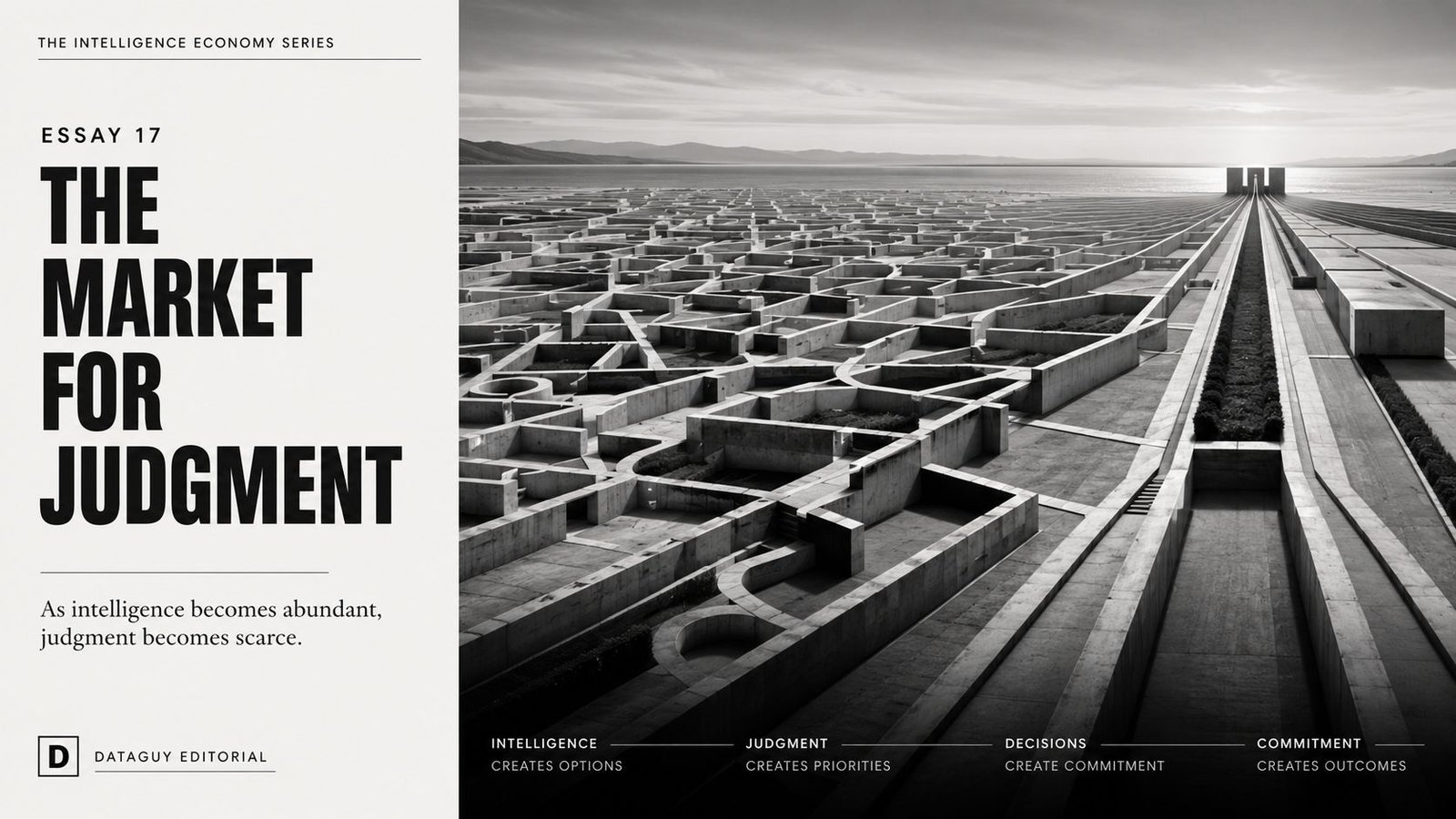
Every economic era is ultimately defined by what remains scarce.
Scarcity has always shaped economic value. Agricultural economies were constrained by land. Industrial economies were constrained by capital and labor. Information economies were constrained by access to information. The intelligence economy introduces a different dynamic. For the first time, intelligence itself becomes increasingly abundant. Organizations gain access to vast quantities of analysis, forecasts, recommendations, simulations, and decision support. Yet abundance rarely eliminates economic constraints. Instead, it shifts them elsewhere.
This shift becomes visible whenever organizations attempt to convert intelligence into action. Intelligence can identify possibilities. It can model outcomes. It can surface patterns and generate recommendations. Yet intelligence alone does not determine what should be done. Decisions still require prioritization, trade-offs, commitment, and accountability. Organizations must decide which signals matter, which opportunities deserve investment, which risks are acceptable, and which actions justify execution. These choices depend upon judgment.
Historically, judgment often remained difficult to distinguish from intelligence because both were relatively scarce. Expertise was limited. Information moved slowly. Analysis required significant effort. The same individuals frequently possessed both intelligence and judgment. As intelligence becomes increasingly available through digital systems, however, the distinction becomes more visible. Intelligence can be distributed. Judgment remains tied to decision-making under uncertainty.
This distinction has important economic consequences. Organizations frequently assume that better intelligence automatically produces better decisions. In practice, intelligence expands the range of available options while simultaneously increasing the complexity of selection. More intelligence often creates more competing interpretations, more potential actions, and more uncertainty regarding which path to pursue. The challenge therefore shifts from generating intelligence to choosing among alternatives.
Viewed through this lens, the intelligence marketplace described in the previous essay creates an unexpected outcome. As intelligence becomes easier to acquire, the relative value of judgment increases. Intelligence helps organizations understand what is possible. Judgment determines what is preferable. Intelligence expands choice. Judgment enables commitment.
This dynamic explains why some organizations consistently outperform others despite having access to similar information, similar technologies, and increasingly similar intelligence systems. Their advantage often emerges from superior judgment. They allocate resources more effectively. They recognize risks more clearly. They identify opportunities earlier. They make decisions that prove more resilient over time.
The intelligence economy therefore introduces a paradox. The more intelligence becomes available, the more important judgment becomes. Abundance increases the value of selection. Access increases the value of discernment. As intelligence scales throughout the economy, judgment increasingly emerges as the scarce capability that determines how value is ultimately created.
The intelligence marketplace makes intelligence increasingly abundant. As abundance expands, value shifts toward the capability that determines which intelligence to trust, which decisions to make, and which actions to pursue. In the intelligence economy, judgment becomes the scarce resource.
Why Scarcity Never Disappears
Economic history is often described as a process of overcoming scarcity. Advances in agriculture reduced food scarcity. Industrialization reduced scarcity in manufactured goods. Digital networks reduced scarcity in information. Yet scarcity itself never disappears. It migrates. As one constraint becomes easier to overcome, another emerges to replace it. The source of economic value shifts accordingly.
This pattern explains why technological progress rarely eliminates competition. New technologies often make previously scarce resources abundant, reducing their economic value while increasing the importance of complementary capabilities. The widespread availability of information did not eliminate the need for expertise. It increased the value of interpretation. Cloud computing reduced infrastructure constraints but increased the importance of software architecture. Abundance in one domain frequently creates scarcity in another.
The intelligence economy follows the same trajectory. Advances in machine intelligence dramatically increase the supply of analytical capability available throughout the economy. Organizations can generate reports, forecasts, recommendations, simulations, and strategic insights at scales that were previously impossible. Intelligence becomes easier to access, easier to distribute, and easier to consume.
Yet the availability of intelligence does not eliminate uncertainty. Organizations still operate in environments characterized by incomplete information, changing incentives, competing objectives, and unpredictable outcomes. Intelligence may reduce uncertainty, but it cannot remove it entirely. Decisions must still be made before outcomes are known. Risk remains unavoidable.
This distinction is crucial because judgment emerges precisely where certainty ends. Intelligence can identify possible futures. Judgment determines which future is most plausible. Intelligence can reveal opportunities. Judgment decides which opportunities deserve commitment. Intelligence expands understanding. Judgment converts understanding into action.
Many organizations underestimate this distinction because intelligence and judgment often appear inseparable. In reality, they perform different economic functions. Intelligence generates options. Judgment allocates resources among those options. Intelligence broadens possibility. Judgment imposes constraint. Without judgment, intelligence remains informational. With judgment, intelligence becomes consequential.
The result is a shift in the location of scarcity. During the information economy, access to information created advantage because information itself was limited. During the intelligence economy, access becomes increasingly commoditized. What differentiates organizations is their ability to determine which intelligence matters, which recommendations should be ignored, and which actions deserve execution.
Viewed through this lens, judgment functions as a filtering mechanism for abundance. The greater the volume of available intelligence, the more valuable the capability that separates signal from noise. Scarcity therefore reappears not in intelligence itself, but in the ability to use intelligence effectively.
Understanding this migration of scarcity helps explain why judgment increasingly behaves like an economic resource. Like capital, expertise, or trust, judgment becomes a capability that organizations must cultivate, allocate, and protect. Its value rises precisely because intelligence becomes more widely available.
Technology rarely eliminates scarcity. It relocates it. As intelligence becomes abundant, scarcity shifts toward the capability that determines how intelligence is interpreted, prioritized, and acted upon. That capability is judgment.
The Limits Of Intelligence
The growing availability of intelligence has encouraged a common assumption: better intelligence automatically produces better decisions. While intuitively appealing, this assumption overlooks a fundamental characteristic of decision-making. Intelligence informs decisions. It does not make them. Organizations continue to operate in environments where uncertainty, ambiguity, competing incentives, and incomplete information remain unavoidable.
This distinction becomes clearer when examining the role intelligence plays inside institutions. Intelligence helps organizations understand the environment in which decisions occur. It identifies patterns, evaluates scenarios, estimates probabilities, and surfaces potential consequences. Yet intelligence rarely determines a single correct course of action. More often, it presents multiple plausible paths, each involving different risks, costs, and opportunities.
In many situations, the challenge is not a lack of intelligence but an excess of competing intelligence. Organizations routinely encounter forecasts that disagree, analyses that conflict, and recommendations that point toward different outcomes. As intelligence becomes easier to generate, these situations become more common rather than less. Abundance increases optionality. Optionality increases complexity.
This creates an important distinction between knowing and deciding. Knowing involves understanding possibilities. Deciding involves committing to one possibility at the expense of others. Intelligence contributes to the former. Judgment governs the latter. No amount of intelligence can entirely eliminate the need for commitment because decisions inherently involve trade-offs that cannot be resolved through analysis alone.
Financial markets provide a useful illustration. Investors often have access to similar information, research, forecasts, and analytical tools. Yet outcomes vary significantly. The difference rarely lies in access to intelligence. It lies in how participants interpret uncertainty, evaluate risk, and allocate resources under conditions where certainty remains impossible. Judgment determines how intelligence is converted into action.
The same principle applies across organizations. Strategic decisions involve assumptions about future conditions that cannot be fully known. Product decisions require balancing competing priorities. Capital allocation decisions require selecting among uncertain opportunities. Hiring decisions require assessing future performance before evidence exists. In each case, intelligence improves understanding but does not remove uncertainty.
This reality becomes more important as intelligence systems improve. Counterintuitively, better intelligence often reveals additional complexity rather than reducing it. Organizations gain visibility into more variables, more scenarios, and more potential outcomes. Understanding expands. Certainty does not necessarily follow. The decision-maker must still determine which possibilities deserve attention and which can be safely ignored.
Viewed from this perspective, intelligence and judgment are complementary rather than interchangeable. Intelligence expands awareness. Judgment imposes direction. Intelligence broadens the range of available options. Judgment narrows that range into a specific course of action. One generates possibilities. The other creates commitment.
The consequence is that intelligence abundance may actually increase the economic importance of judgment. The more options organizations possess, the more valuable selection becomes. The more intelligence becomes available, the more critical it becomes to determine which intelligence should influence decisions. Judgment emerges not as a substitute for intelligence, but as the capability that transforms intelligence into action.
Better intelligence reduces uncertainty at the margins. It does not eliminate uncertainty altogether. As intelligence becomes more abundant, the value of judgment increases because organizations must choose among a growing number of plausible alternatives.
When Judgment Becomes Economic Infrastructure
Markets emerge whenever scarce resources create economic value. Capital markets exist because capital is limited. Labor markets exist because skilled labor is scarce. Information markets emerged because access to information once created significant competitive advantages. The intelligence economy introduces a new possibility. As intelligence becomes increasingly abundant, judgment begins to behave like the scarce resource around which entirely new forms of economic activity emerge.
This development is subtle because judgment is rarely traded in the same way as traditional economic resources. Organizations do not purchase judgment directly. Instead, they seek access to individuals, institutions, systems, and processes capable of producing superior judgment. Boards recruit experienced executives. Investors seek trusted allocators of capital. Governments rely on advisory institutions. Enterprises pay premiums for strategic expertise. In each case, the underlying asset is not information. It is judgment.
The distinction becomes more visible as intelligence abundance expands. Historically, expertise often combined intelligence generation and judgment into a single capability. The same individual gathered information, analyzed it, interpreted its significance, and made recommendations. The intelligence economy increasingly separates these functions. Intelligence generation becomes scalable. Judgment remains constrained by experience, accountability, context, and consequence.
This separation creates a market dynamic. As intelligence becomes easier to obtain, organizations increasingly differentiate between intelligence providers and judgment providers. One category produces understanding. The other determines what should be done with that understanding. The economic value of the latter grows as the supply of the former increases.
Financial markets provide a useful example. Investors can access unprecedented quantities of information, research, and analysis. Yet the most successful investors continue to command significant premiums. Their value rarely comes from possessing unique information. It comes from making superior judgments about uncertainty, risk, timing, and allocation. The market rewards judgment because judgment remains scarce.
The same pattern increasingly appears across industries. Organizations compete in environments where access to intelligence becomes progressively less differentiated. Competitors often possess similar information, comparable analytical tools, and increasingly similar intelligence systems. What varies is the quality of the judgments that transform intelligence into decisions. Competitive advantage shifts from access to interpretation and commitment.
This transition changes how organizations think about talent, leadership, and institutional design. Historically, firms invested heavily in acquiring information and building analytical capabilities. Those investments remain important. Yet as intelligence becomes abundant, organizations increasingly invest in mechanisms that improve judgment quality. Governance systems, decision frameworks, accountability structures, institutional memory, and leadership capabilities become more valuable because they influence judgment.
Viewed from this perspective, judgment begins functioning as a form of economic infrastructure. It enables intelligence to create value. Without judgment, intelligence remains potential. With judgment, intelligence becomes action. The quality of economic outcomes increasingly depends not on the availability of intelligence but on the systems that convert intelligence into decisions.
This explains why judgment may become one of the most valuable capabilities in the intelligence economy. Intelligence abundance creates more options. More options increase the importance of selection. The ability to consistently make superior selections becomes a source of enduring competitive advantage.
As intelligence becomes abundant, organizations pay increasing premiums for the capability that transforms intelligence into decisions. The market may not reward intelligence itself. It rewards the judgment that determines how intelligence is used.
How Judgment Creates Value
If intelligence explains what is possible, judgment determines what becomes real. The distinction is important because organizations rarely create value through intelligence alone. Value emerges when intelligence influences decisions, decisions shape actions, and actions produce outcomes. Judgment operates at each stage of this process, transforming understanding into commitment.
One way to understand this relationship is through what might be called the Judgment Stack. Intelligence occupies only the first layer. Organizations must then interpret intelligence, determine its significance, decide how to respond, commit resources to a course of action, and ultimately accept accountability for the consequences. Each layer introduces forms of uncertainty that intelligence alone cannot resolve.
Intelligence
The first layer involves generating awareness. Intelligence identifies patterns, surfaces opportunities, evaluates risks, and expands understanding. This layer becomes increasingly abundant throughout the intelligence economy. Organizations gain access to more information, more analysis, and more decision-support capabilities than at any point in history.
Interpretation
The second layer concerns meaning. Organizations must determine which signals deserve attention and which can be ignored. Two institutions may possess identical intelligence yet arrive at very different interpretations of its significance. Interpretation requires context, experience, and an understanding of institutional priorities.
Decision
The third layer involves selection. Intelligence often presents multiple plausible alternatives. Decision-making requires choosing among them. Every decision excludes other possibilities and creates opportunity costs. This act of selection represents one of the most important functions of judgment because intelligence rarely identifies a single objectively correct path.
Commitment
The fourth layer transforms decisions into action. Organizations must allocate resources, coordinate stakeholders, and execute against chosen objectives. Commitment introduces risk because actions occur before outcomes are known. Intelligence may inform commitment, but commitment ultimately requires confidence under uncertainty.
Accountability
The final layer concerns consequence. Decisions generate outcomes that affect organizations, investors, employees, customers, and society. Accountability cannot be delegated entirely to intelligence systems because responsibility remains attached to institutions and individuals. The greater the consequence, the greater the importance of judgment.
The significance of the Judgment Stack lies in where scarcity resides. Intelligence increasingly scales across organizations. Interpretation remains more limited. Decision-making remains constrained. Commitment remains difficult. Accountability remains unavoidable. As organizations move down the stack, judgment becomes increasingly important.
This framework also explains why judgment retains economic value even as intelligence improves. Intelligence can support every layer of the stack. Yet the burden of selecting, committing, and accepting consequences remains. Judgment therefore acts as the mechanism through which intelligence acquires economic relevance.
Organizations that consistently outperform competitors often excel not because they possess more intelligence, but because they navigate the Judgment Stack more effectively. They interpret signals more accurately, make better decisions, commit resources more confidently, and learn from outcomes more systematically. Their advantage emerges from judgment quality rather than intelligence volume.
Intelligence creates awareness. Interpretation creates meaning. Decision creates direction. Commitment creates action. Accountability creates consequence. Judgment operates across every layer, transforming intelligence from possibility into economic value.
Designing Institutions For Better Judgment
If judgment becomes a strategic resource, organizations must begin treating it as a capability that can be designed, developed, and improved. Many institutions invest heavily in information systems, analytics platforms, reporting structures, and intelligence generation. Far fewer invest with equal rigor in the mechanisms through which judgments are formed. Yet as intelligence becomes increasingly abundant, judgment quality may become one of the most important determinants of organizational performance.
This shift requires a different perspective on organizational design. Historically, firms focused on improving access to information because information was scarce. The intelligence economy changes the problem. Most organizations already possess more intelligence than they can effectively utilize. The challenge is not access. The challenge is deciding which intelligence deserves attention and how that intelligence should influence action.
One implication is that decision quality becomes increasingly important. Organizations often evaluate outcomes while paying less attention to the quality of the decisions that produced those outcomes. Yet outcomes are frequently influenced by factors beyond managerial control. Strong institutions therefore focus not only on results but also on improving the processes through which judgments are made.
Governance becomes particularly significant in this environment. Effective governance structures create mechanisms for challenging assumptions, evaluating alternatives, incorporating diverse perspectives, and reducing the influence of cognitive biases. These systems do not eliminate uncertainty. They improve the quality of judgments made under uncertainty.
Institutional memory also acquires greater value. Judgment improves when organizations can learn systematically from previous decisions. Many firms accumulate vast amounts of information but struggle to capture the reasoning behind important choices. As intelligence becomes more abundant, preserving decision context becomes increasingly important because it enables future decision-makers to understand not only what happened, but why particular judgments were made.
Leadership likewise evolves. Traditional management often emphasized control, oversight, and resource allocation. Intelligence-rich environments place greater emphasis on judgment architecture. Leaders increasingly function as designers of decision systems, creating conditions under which high-quality judgments can emerge throughout the organization rather than concentrating judgment within a small group of individuals.
This shift also changes how organizations evaluate talent. Technical expertise remains important, but expertise alone is insufficient. Institutions increasingly seek individuals capable of making sound judgments in situations characterized by ambiguity, competing objectives, and incomplete information. The capacity to navigate uncertainty becomes a valuable organizational asset.
Viewed more broadly, the organizations best positioned for the intelligence economy may not be those that possess the most intelligence. They may be those that build the strongest judgment systems. Intelligence provides options. Judgment determines which options become reality. Competitive advantage increasingly depends upon the quality of that selection process.
The long-term consequence is that judgment becomes institutionalized. Rather than relying solely on individual expertise, organizations develop structures, processes, governance systems, and cultural norms that improve judgment quality across the enterprise. Judgment becomes an organizational capability rather than merely an individual trait.
The defining institutions of the intelligence economy may not be those that generate the most intelligence. They may be those that build the most effective systems for transforming intelligence into high-quality judgments.
The Future Of Competitive Advantage
Competitive advantage has historically been shaped by access to scarce resources. Land created advantage in agricultural economies. Capital created advantage in industrial economies. Information created advantage in digital economies. The intelligence economy alters this pattern by making intelligence itself increasingly accessible. As intelligence becomes abundant, organizations must identify new sources of differentiation.
Judgment increasingly emerges as one of those sources. Organizations operating within the same markets often possess access to similar information, comparable technologies, and increasingly similar intelligence systems. Yet their outcomes differ significantly. Some identify opportunities earlier. Some allocate resources more effectively. Some adapt more quickly to changing conditions. These differences frequently originate not from intelligence itself, but from the quality of the judgments that intelligence informs.
This distinction becomes more important as intelligence systems continue to improve. Better intelligence reduces informational disadvantages across industries. The resulting environment becomes more competitive because access to understanding becomes more widely distributed. In such environments, organizations gain less advantage from possessing intelligence and more advantage from applying intelligence effectively.
The consequences extend beyond individual firms. Entire industries may begin competing on judgment quality. Investors increasingly evaluate capital allocators rather than information providers. Enterprises increasingly differentiate through decision quality rather than data acquisition. Governments increasingly compete through policy judgment rather than information access. The locus of value creation gradually shifts toward institutions capable of making superior decisions under uncertainty.
This transition may also reshape the economics of expertise. Historically, experts derived value from possessing specialized knowledge that others lacked. As intelligence becomes easier to access, expertise increasingly depends upon the ability to interpret complexity, evaluate trade-offs, and exercise sound judgment. Knowledge remains important. Judgment becomes decisive.
Viewed through this lens, judgment behaves less like a managerial skill and more like strategic infrastructure. It influences how resources are allocated, how risks are managed, how opportunities are pursued, and how organizations respond to uncertainty. Institutions with stronger judgment systems may consistently outperform institutions with equivalent intelligence resources because judgment determines how intelligence is converted into outcomes.
The broader implication is that the intelligence economy does not eliminate human contribution. It changes where human contribution creates value. Intelligence generation becomes increasingly scalable. Judgment remains constrained by context, consequence, accountability, and experience. The scarcer capability therefore becomes the more valuable one.
This dynamic suggests a different way of understanding the future of competition. Organizations will continue investing in intelligence because intelligence expands awareness and improves understanding. Yet the greatest returns may come from investing in the systems that determine how intelligence influences decisions. The strategic asset of the intelligence economy may not be intelligence itself. It may be judgment.
The institutions that recognize this shift earliest may gain enduring advantages. They will treat judgment not as an individual characteristic but as an organizational capability. They will design systems that improve judgment quality, preserve decision context, strengthen accountability, and accelerate learning. In doing so, they will build advantages that become more valuable as intelligence becomes more abundant.
Intelligence expands what organizations can know. Judgment determines what organizations choose to do. As intelligence becomes abundant, judgment increasingly becomes the strategic asset that separates understanding from advantage.
Conclusion
The intelligence economy changes the economics of scarcity. Intelligence, once difficult to produce and distribute, becomes increasingly abundant. Organizations gain access to unprecedented analytical capabilities, decision support systems, forecasts, recommendations, and forms of institutional understanding. Yet abundance does not eliminate constraints. It simply shifts them elsewhere.
Judgment emerges as the capability that remains scarce because judgment operates where uncertainty persists. Intelligence can reveal possibilities, model outcomes, and expand understanding. It cannot eliminate trade-offs, remove risk, or assume responsibility for consequences. Organizations must still determine which opportunities deserve commitment, which risks are acceptable, and which actions justify execution.
This distinction has significant economic implications. As intelligence becomes more widely available, competitive advantage increasingly shifts toward the institutions capable of making superior judgments. The value of intelligence remains substantial, but its value increasingly depends upon the quality of the judgments that guide its application.
The market for judgment therefore represents more than a labor market, a talent market, or an advisory market. It reflects a broader shift in how value is created throughout the intelligence economy. The scarce resource is no longer access to intelligence. The scarce resource is the ability to determine which intelligence matters and what should be done with it.
Viewed from this perspective, the intelligence economy may ultimately reward institutions not for what they know, but for how they decide. As intelligence scales throughout the economy, judgment becomes the capability that transforms understanding into action and action into advantage.
Every economic era creates abundance in one domain and scarcity in another. The intelligence economy makes intelligence abundant. In doing so, it increases the value of the capability that determines how intelligence is used. The future may belong not to those who possess the most intelligence, but to those who exercise the best judgment.