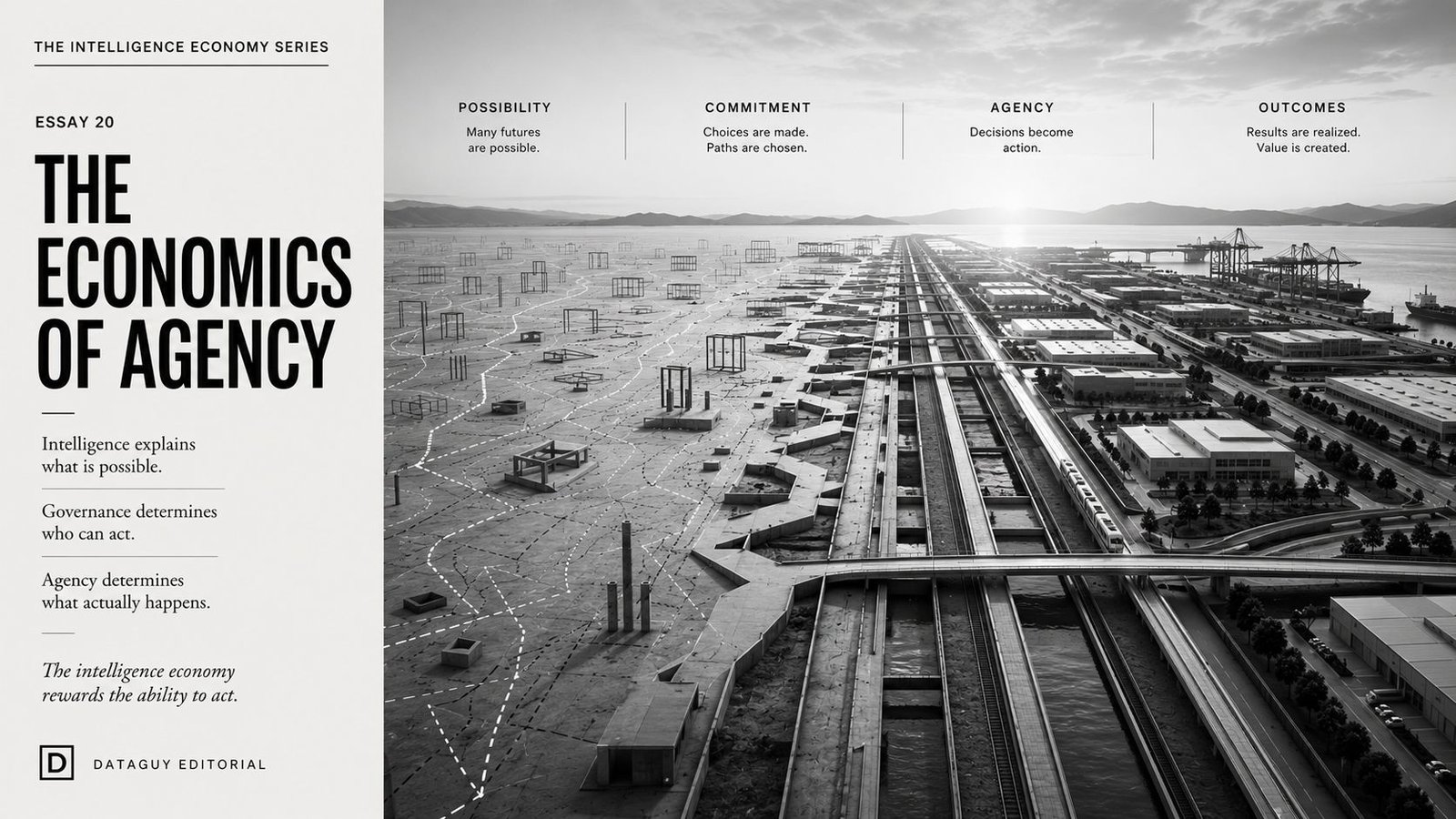
Every economy ultimately rewards the ability to act.
Economic systems create value through action. Intelligence can identify opportunities. Judgment can determine priorities. Governance can allocate authority. Yet none of these capabilities produces outcomes independently. Value emerges only when decisions are translated into execution. Every economic era therefore depends not merely on understanding the world, but on possessing the capability to act within it.
This observation becomes increasingly important as intelligence grows more abundant. Organizations today possess unprecedented access to information, analytics, expertise, and decision-support systems. They often know more than ever about customers, markets, operations, and future risks. Yet many continue to struggle with execution. Strategic initiatives stall. Decisions remain unimplemented. Opportunities pass without action. The challenge is frequently not a lack of understanding. It is a lack of agency.
Agency refers to the capacity to convert decisions into outcomes. It combines authority, resources, execution capability, and institutional permission into a single economic function. Intelligence may reveal what should be done. Agency determines whether it actually happens.
Historically, economic systems have focused on different constraints. Industrial economies were constrained by labor and production capacity. Information economies were constrained by access to knowledge and communication. Intelligence economies increasingly face a different limitation. Understanding becomes easier. Action remains difficult.
This shift changes the nature of competitive advantage. Organizations have traditionally competed through scale, efficiency, expertise, and information. Increasingly, they compete through execution. The institutions that can transform intelligence into coordinated action most effectively gain disproportionate advantages because outcomes depend less on what organizations know and more on what they can accomplish.
The previous essays explored several dimensions of this transition. The intelligence marketplace examined how intelligence becomes tradable. The market for judgment explained why judgment remains scarce. The trust stack explored confidence as economic infrastructure. The governance economy examined how authority is allocated across complex systems. Together, these developments reveal a larger conclusion. Intelligence economies increasingly revolve around agency.
This evolution creates a new economic question. If intelligence becomes abundant, what remains scarce? One answer is judgment. Another is trust. A third is governance. Yet beneath all of these lies a more practical constraint. The capability to act remains limited. Agency therefore emerges as one of the most valuable resources of the intelligence economy.
Understanding this transition requires examining agency not as a personal characteristic, but as an economic capability. Just as markets allocate resources and governance allocates authority, agency allocates action.
Industrial economies scaled labor. Information economies scaled knowledge. Intelligence economies increasingly scale agency. As intelligence becomes abundant, the scarce resource becomes the capability to transform decisions into action.
Why Outcomes Depend Upon Agency
Every organization ultimately exists to produce outcomes. Revenue, innovation, growth, adaptation, and competitive advantage all depend upon the ability to convert intentions into results. Yet institutions often focus far more attention on decisions than on execution. Meetings produce conclusions. Strategies generate plans. Intelligence creates recommendations. The assumption is that action naturally follows understanding. In practice, this assumption frequently proves false.
The distinction matters because economic value emerges from execution rather than intention. Markets reward outcomes, not analysis. Customers benefit from delivered products rather than proposed solutions. Investors realize returns from implementation rather than strategy. Understanding may improve decisions, but action determines whether decisions create value.
This reality explains why agency functions as an economic resource. Agency determines the speed, consistency, and effectiveness with which organizations transform decisions into outcomes. Institutions possessing strong agency capabilities can act quickly, adapt rapidly, and execute consistently. Institutions with weak agency capabilities often struggle despite possessing significant intelligence and expertise.
The economic significance of agency becomes more visible as intelligence expands. Historically, many organizations faced information scarcity. Decision-makers spent substantial effort gathering knowledge before acting. Today, intelligence often arrives faster than institutions can absorb it. The challenge increasingly shifts from acquiring understanding toward operationalizing understanding.
This shift creates a new source of competitive advantage. Organizations frequently possess access to similar information, analytical tools, and strategic insights. Yet their performance often differs dramatically. The difference frequently lies not in intelligence itself but in the ability to act upon intelligence. Agency determines whether opportunities become outcomes or remain unrealized possibilities.
The consequences extend beyond individual firms. Entire economies depend upon agency. Economic growth occurs when ideas become products, investments become enterprises, and decisions become action. Societies generate value not merely through knowledge creation but through the mechanisms that enable knowledge to influence the real world.
The intelligence economy amplifies this principle. Intelligence increasingly becomes accessible throughout organizations and markets. As understanding becomes more widely distributed, performance depends less on possessing information and more on converting information into coordinated action. Agency becomes the bridge between intelligence and economic value.
Viewed through this lens, agency occupies a unique position within the intelligence economy. Intelligence expands possibilities. Judgment selects among possibilities. Governance allocates authority. Agency transforms selected possibilities into reality. Without agency, intelligence remains potential rather than performance.
The organizations best positioned for the intelligence economy may therefore be those that recognize agency as a productive asset. They invest not only in intelligence generation and decision quality, but also in the institutional capabilities required to execute consistently across increasingly complex environments.
Intelligence determines what organizations can know. Agency determines what organizations can accomplish. As intelligence becomes abundant, the economic value of agency increases because outcomes remain dependent upon action.
The Action Constraint
Agency is valuable because it is scarce. Most organizations possess more ideas than they can implement, more opportunities than they can pursue, and more intelligence than they can operationalize. This imbalance creates what might be called the action constraint. Institutions frequently know what should be done long before they develop the capacity to do it.
The existence of this constraint often surprises leaders because modern organizations are rich in intelligence. They collect vast amounts of data, employ sophisticated analytical systems, and generate continuous streams of recommendations. Yet abundance in intelligence does not automatically create abundance in action. In many cases, greater intelligence reveals more opportunities than institutions can realistically execute.
This dynamic creates a paradox. As intelligence becomes cheaper and more accessible, agency often becomes more valuable. Organizations gain visibility into an expanding universe of possible actions, but their ability to act remains limited by resources, authority, coordination, and execution capacity. The bottleneck shifts from knowing to doing.
Several forces contribute to this scarcity. The first is organizational complexity. Large institutions often require extensive coordination before action can occur. Decisions move across departments, approval processes, governance structures, and operational systems. Each layer introduces friction. Intelligence may travel rapidly throughout the organization, while action moves considerably more slowly.
The second force is risk. Organizations frequently hesitate to act because decisions carry consequences. Intelligence can reduce uncertainty, but it cannot eliminate it entirely. Participants often delay execution while seeking additional information, broader consensus, or greater confidence. The result is a growing gap between understanding and implementation.
A third source of scarcity is fragmented authority. Intelligence increasingly exists throughout the organization, yet authority often remains concentrated. Employees identify opportunities they cannot pursue. Teams recognize problems they cannot solve independently. Decision-makers possess authority but may lack direct proximity to emerging information. Agency becomes constrained because intelligence and authority do not always reside in the same place.
The intelligence economy amplifies these tensions. Organizations gain access to more intelligence than ever before, creating pressure for faster and more decentralized action. Yet many governance systems remain optimized for environments characterized by information scarcity and centralized decision-making. Institutions generate increasing amounts of intelligence without developing equivalent increases in agency.
This imbalance explains why execution often becomes a source of competitive differentiation. Organizations operating within the same industry frequently possess access to similar information and analytical capabilities. Their outcomes diverge because some institutions are able to act more effectively on what they know. Agency becomes the scarce resource that determines whether intelligence creates advantage.
Viewed through this lens, agency behaves much like capital in earlier economic eras. Capital created value because it enabled production. Agency creates value because it enables execution. The organizations capable of deploying agency efficiently gain disproportionate advantages because action remains inherently constrained.
The defining challenge of the intelligence economy may therefore be neither intelligence generation nor information management. It may be the design of institutions capable of overcoming the action constraint. As intelligence continues to expand, agency increasingly becomes the factor that determines which possibilities become outcomes.
Most organizations do not suffer from intelligence scarcity. They suffer from agency scarcity. The bottleneck increasingly shifts from understanding what should be done toward possessing the capability to do it.
The Layers Of Execution
Agency rarely emerges from a single capability. Organizations often assume that execution depends primarily upon motivation, leadership, or resources. While each of these factors matters, agency is fundamentally a system. Effective execution requires multiple layers working together to transform intelligence into outcomes. Understanding these layers becomes increasingly important as intelligence economies place greater emphasis on action.
One way to understand this process is through what might be called the Agency Stack. Each layer contributes to the organization's ability to act. Together, these layers determine whether intelligence remains a source of insight or becomes a source of economic value.
Intelligence
Agency begins with intelligence. Organizations must first understand their environment, identify opportunities, recognize constraints, and generate possible courses of action. Intelligence expands awareness and creates the foundation upon which all subsequent action depends. Without intelligence, execution becomes directionless.
Judgment
The second layer concerns judgment. Intelligence often reveals multiple possibilities rather than a single answer. Judgment determines which opportunities deserve attention, which risks justify acceptance, and which actions align with organizational objectives. Judgment transforms information into decisions.
Authority
The third layer allocates authority. Decisions create little value if participants lack permission to act upon them. Authority determines who can commit resources, initiate actions, and accept responsibility for outcomes. Governance systems distribute authority throughout the institution, shaping the organization's capacity for execution.
Agency
The fourth layer is agency itself. Agency represents the capability to translate authorized decisions into coordinated action. It combines operational capacity, institutional support, execution mechanisms, and organizational responsiveness. Agency transforms authority into movement.
Outcomes
The final layer concerns outcomes. Economic value is realized only when action produces measurable effects. Products are delivered. Services are provided. Markets are entered. Strategies are executed. Outcomes represent the point at which intelligence, judgment, authority, and agency converge to create value.
The significance of the Agency Stack lies in the interaction between these layers. Intelligence without judgment creates noise. Judgment without authority creates frustration. Authority without agency creates paralysis. Agency without outcomes creates activity without value. Every layer depends upon the effectiveness of the layers surrounding it.
This framework helps explain why execution remains difficult despite increasing intelligence abundance. Many organizations invest heavily in intelligence generation while neglecting the systems required to convert intelligence into outcomes. As a result, understanding expands while execution remains constrained.
The institutions best positioned for the intelligence economy increasingly compete across the entire Agency Stack. They generate intelligence effectively, exercise sound judgment, distribute authority intelligently, strengthen execution capabilities, and measure outcomes rigorously. Their advantage emerges not from any single layer, but from the integration of all five.
Viewed through this lens, agency becomes more than an operational capability. It becomes the mechanism through which intelligence economies create value. The organizations capable of strengthening the Agency Stack may discover that execution becomes one of the most durable forms of competitive advantage.
Intelligence creates possibilities. Judgment creates decisions. Authority enables action. Agency drives execution. Outcomes create value. Together, these layers transform understanding into economic performance.
When Organizations Cannot Act
Agency creates value when it converts decisions into outcomes. Constraints on agency create costs when organizations become unable to act on what they know. Every institution experiences this challenge. Opportunities are identified but not pursued. Problems are recognized but not resolved. Decisions are made but not implemented. Intelligence accumulates while outcomes fail to materialize.
These costs often remain hidden because organizations typically measure decisions more easily than execution. Leadership teams frequently celebrate strategic plans, approved initiatives, and completed analyses. Yet economic value emerges only when these activities produce real-world effects. The distance between intention and action therefore becomes one of the most important indicators of organizational performance.
The consequences of agency constraints become increasingly visible as intelligence expands. Organizations generate more insights, forecasts, recommendations, and opportunities than ever before. Yet each additional insight creates value only if the institution possesses sufficient agency to act upon it. Intelligence abundance can therefore magnify agency shortages by increasing the number of actions competing for limited execution capacity.
One common source of agency constraints is institutional inertia. Established processes, legacy structures, and historical assumptions often slow execution even when organizations recognize the need for change. Intelligence identifies emerging realities. Existing systems remain optimized for previous realities. The result is a growing gap between awareness and action.
Another source of constraint emerges from excessive coordination requirements. Modern institutions frequently involve numerous stakeholders, approval layers, governance mechanisms, and reporting structures. These systems often exist for legitimate reasons, yet they can unintentionally reduce agency by increasing the effort required to act. Intelligence moves rapidly. Execution becomes increasingly burdened by process.
Resource allocation creates a similar challenge. Organizations rarely possess enough capital, talent, attention, or operational capacity to pursue every opportunity available to them. Agency therefore depends not only on authority but also on the practical ability to mobilize resources. Decisions without execution resources create the appearance of action without its substance.
The intelligence economy amplifies these pressures because it continuously expands the universe of possible actions. Better intelligence reveals more opportunities. More opportunities create greater competition for organizational attention and resources. Institutions that fail to strengthen agency experience a widening gap between what they could do and what they actually do.
This dynamic helps explain why execution increasingly becomes a source of differentiation. Many organizations possess similar intelligence. Many leaders reach similar conclusions. Yet outcomes vary because agency varies. The institutions capable of acting quickly, consistently, and effectively convert understanding into advantage while competitors remain trapped in analysis and deliberation.
Viewed through this lens, agency constraints function as a hidden tax on intelligence. Every unrealized opportunity, delayed initiative, and unexecuted decision reduces the economic value that intelligence could have created. As intelligence becomes more abundant, the cost of agency constraints becomes increasingly significant.
The defining organizations of the intelligence economy may therefore be those that systematically reduce barriers to action. They recognize that the value of intelligence depends not only on what is known, but on what can be done with that knowledge.
Intelligence creates value only when it produces action. Agency constraints impose a hidden cost by preventing organizations from converting understanding into outcomes. As intelligence becomes abundant, the economic penalty of inaction increases.
Designing Organizations For Action
If agency becomes a productive economic resource, organizations must begin treating action as a capability that can be designed, measured, and improved. Historically, many institutions focused primarily on optimizing information flows, decision quality, and operational efficiency. These capabilities remain important. Yet intelligence-rich environments increasingly reward organizations that can translate decisions into action rapidly and consistently.
This shift begins with a recognition that execution is not merely an operational function. Execution is an economic capability. Organizations that act effectively capture opportunities faster, adapt more quickly, and learn more rapidly than competitors. Agency therefore becomes a source of advantage because action compounds over time.
One implication is that organizations increasingly redesign themselves around decision velocity rather than hierarchical control. Traditional structures often concentrated authority at the top because information was scarce and communication was slow. Intelligence economies reverse these assumptions. Information becomes abundant and widely distributed, creating pressure for decision-making and execution to occur closer to where intelligence is generated.
This evolution requires greater alignment between intelligence and authority. Many institutions generate valuable insights at the edges of the organization while retaining decision rights at the center. The result is often delayed action and lost opportunities. Effective organizations increasingly seek to reduce this distance by ensuring that authority resides closer to relevant intelligence.
Governance design becomes critical in this context. Organizations must distribute authority without sacrificing accountability. Excessive centralization restricts agency. Excessive decentralization creates fragmentation. The challenge is to build governance systems that preserve coherence while enabling action. Governance and agency therefore become complementary capabilities rather than competing priorities.
Operational architecture also changes. Institutions increasingly invest in systems that reduce execution friction. Clear ownership structures, streamlined decision processes, transparent accountability mechanisms, and rapid feedback loops all strengthen agency by lowering the cost of action. These systems allow organizations to respond more effectively as complexity increases.
Learning becomes equally important. Every action generates information about what works, what fails, and what should change. Organizations that capture these lessons strengthen future agency because execution improves through experience. Agency therefore compounds not only through action itself but through the learning created by action.
Leadership evolves as a result. Leaders increasingly function as designers of action systems rather than simply decision-makers. Their responsibility extends beyond making choices toward creating environments in which intelligent action can occur consistently throughout the organization. Leadership becomes less about directing activity and more about enabling agency.
The organizations best positioned for the intelligence economy may therefore be those that optimize for action. They recognize that intelligence, judgment, trust, and governance create value only when connected to execution. Agency becomes the mechanism that converts organizational potential into organizational performance.
The defining organizations of the intelligence economy may not be those that possess the most intelligence. They may be those that build the strongest systems for converting intelligence into coordinated action.
When Agency Becomes Infrastructure
Every economic era develops a form of infrastructure that becomes increasingly valuable as complexity grows. Industrial economies relied upon transportation infrastructure to move goods. Information economies relied upon communication infrastructure to move information. Intelligence economies increasingly require infrastructure capable of moving decisions into action. Agency emerges as that infrastructure.
This shift changes how agency should be understood. Agency is often viewed as an individual characteristic associated with initiative, autonomy, or motivation. While these qualities remain important, they capture only part of the picture. Agency increasingly becomes an institutional capability. Its significance lies not merely in whether individuals can act, but in whether entire organizations can convert intelligence into coordinated outcomes at scale.
The importance of this capability grows as intelligence becomes more abundant. Organizations gain access to expanding volumes of information, analysis, forecasts, and recommendations. Yet the value of these resources depends upon the institution's capacity to act upon them. Intelligence increases possibilities. Agency determines which possibilities become reality.
This evolution may reshape competition itself. Historically, organizations competed through access to labor, capital, information, and technology. Intelligence-rich environments increasingly reward institutions capable of executing more effectively than their competitors. Competitive advantage shifts toward organizations that can consistently transform understanding into action while adapting rapidly to changing conditions.
The implications extend beyond individual firms. Markets require agency to translate investment into enterprise. Governments require agency to transform policy into outcomes. Communities require agency to convert collective decisions into collective action. Intelligence economies require agency because understanding alone cannot create value. Action remains the mechanism through which economic systems produce results.
Viewed through this lens, agency behaves less like an operational function and more like productive infrastructure. It enables intelligence, judgment, trust, and governance to generate tangible effects. Without agency, these capabilities remain potential. With agency, they become performance.
This suggests that agency itself may become increasingly visible as an economic asset. Organizations invest in agency. Institutions compete through agency. Markets reward agency. The capability to act evolves from an implicit organizational characteristic into a strategic resource that shapes economic performance.
The future of the intelligence economy may therefore depend less on what institutions know and more on what they can accomplish. Intelligence expands awareness. Judgment provides direction. Governance allocates authority. Agency creates outcomes.
Industrial economies scaled production. Information economies scaled communication. Intelligence economies may ultimately scale through agency systems that transform decisions into action across increasingly complex environments.
Conclusion
Economic systems ultimately reward outcomes. Intelligence can identify opportunities. Judgment can prioritize choices. Trust can reduce uncertainty. Governance can allocate authority. Yet none of these capabilities independently creates value. Value emerges when decisions are translated into action.
The intelligence economy elevates the importance of this reality. As intelligence becomes increasingly abundant, organizations gain unprecedented visibility into opportunities, risks, and possible futures. Yet abundance in understanding does not guarantee abundance in execution. The constraint increasingly shifts from knowing what should be done toward possessing the capability to do it.
The Agency Stack provides a framework for understanding this transition. Intelligence creates possibilities. Judgment creates decisions. Authority enables action. Agency drives execution. Outcomes create value. Together, these layers explain how institutions transform understanding into economic performance.
Organizations that focus exclusively on intelligence may struggle to convert knowledge into results. Organizations that develop agency as a strategic capability may discover that execution becomes one of the most powerful forms of competitive advantage. The quality of agency increasingly determines the quality of outcomes.
Viewed from a broader perspective, agency represents the final operational layer of the intelligence economy. It converts intelligence, judgment, trust, and governance into tangible effects. As intelligence becomes abundant, agency becomes increasingly valuable because action remains scarce.
Intelligence explains what is possible. Judgment determines what matters. Governance decides who can act. Agency determines what actually happens. In the intelligence economy, the ultimate source of value remains the capability to turn decisions into outcomes.