Civilizations are ultimately shaped by the layers they build.
Human progress has often been driven by the creation of new forms of infrastructure. These infrastructures rarely appear significant at first. They emerge gradually, spread unevenly, and initially seem like improvements to existing systems. Over time, however, they become foundational layers upon which entire societies organize themselves. Agriculture transformed food production into a scalable system. Industrialization transformed production into a scalable system. Computing transformed information into a scalable system. Each layer reshaped civilization because it altered how societies created, distributed, and coordinated essential resources.
The intelligence economy may represent the emergence of another such layer. Much of the public discussion surrounding artificial intelligence focuses on tools, products, automation, and productivity. These developments are important, yet they may represent only the visible surface of a larger transformation. Beneath them lies the possibility that intelligence itself is becoming infrastructure.
This possibility reflects a fundamental shift in the economics of intelligence. Historically, intelligence was largely constrained by human cognitive capacity. Expertise was scarce. Judgment was limited. Decision-making capability existed within relatively small groups of individuals and institutions. Intelligence could influence society, but it could not easily scale throughout society.
The intelligence economy changes these conditions. Intelligence becomes increasingly accessible, distributable, and embedded within systems. Organizations integrate intelligence into workflows. Markets integrate intelligence into transactions. Governments integrate intelligence into public administration. Individuals gain access to capabilities that were previously available only to specialists. Intelligence begins moving beyond people and into infrastructure.
This transition matters because infrastructure changes the behavior of entire systems. Roads do not simply help people travel. They reshape commerce. Electricity does not simply provide power. It reorganizes industry. Communication networks do not simply transmit information. They transform coordination. Intelligence may operate in a similar way. As it becomes embedded throughout society, it changes how institutions make decisions, allocate resources, solve problems, and adapt to complexity.
The previous essays explored how intelligence transforms organizations, markets, governance systems, and economic activity. Yet these developments increasingly point toward a larger conclusion. Intelligence is becoming more than an organizational capability or economic resource. It is becoming a civilizational layer.
Understanding this transition requires stepping beyond firms, markets, and technologies to examine civilization itself. The question is no longer how organizations use intelligence. The question is how societies reorganize around intelligence when intelligence becomes embedded throughout the systems that support civilization.
Agriculture allowed civilizations to scale food. Industry allowed civilizations to scale production. Computing allowed civilizations to scale information. The intelligence economy allows civilizations to scale intelligence itself.
How Civilizations Scale
Every civilization depends upon a small number of foundational layers. These layers perform a simple but essential function. They allow societies to scale capabilities that would otherwise remain limited. Agriculture enabled food production to move beyond subsistence. Industrial systems enabled production to move beyond manual labor. Communication networks enabled information to move beyond local communities. Each layer expanded civilization's capacity to coordinate increasingly complex forms of activity.
What makes these layers significant is not merely their existence but their ubiquity. Truly civilizational infrastructure becomes invisible. People stop noticing it because it becomes embedded in everyday life. Modern economies rarely think about roads when discussing commerce, yet commerce depends upon transportation networks. Organizations rarely think about electricity when discussing productivity, yet productivity depends upon reliable energy systems. Infrastructure matters most when entire systems become dependent upon it.
This pattern appears repeatedly throughout history. Civilizations grow when they discover ways to scale resources that were previously constrained. Agricultural systems scaled calories. Industrial systems scaled production. Communication systems scaled coordination. Computing systems scaled information processing. Each layer reduced a critical bottleneck and unlocked new forms of social and economic organization.
The significance of these transitions extends beyond economics. New layers reshape institutions. Governments evolve around them. Markets adapt to them. Educational systems reorganize themselves around them. Entire cultures develop assumptions based on the capabilities these infrastructures provide. Once a layer becomes embedded, civilization itself begins operating differently.
Computing provides a useful example. Computers initially appeared as specialized tools designed to automate calculations. Over time, they became foundational infrastructure supporting commerce, communication, logistics, finance, education, science, and government. The digital economy emerged not because computers became more powerful, but because computing became embedded throughout society.
The intelligence economy may represent a similar transition. Intelligence initially appears as a collection of tools, models, and applications. Yet as intelligence becomes increasingly accessible and integrated into everyday systems, it begins behaving less like a technology and more like infrastructure. Its importance lies not in individual applications but in the growing number of systems that depend upon it.
This perspective reveals why intelligence should be understood differently from previous technological waves. Most technologies improve specific functions. Infrastructure transforms entire systems. Intelligence increasingly influences decisions, coordination, prediction, planning, resource allocation, and adaptation across institutions. Its impact extends horizontally across civilization rather than vertically within a single industry.
Viewed through this lens, intelligence emerges as the next layer in a longer historical sequence. Civilizations evolve by embedding new capabilities into foundational infrastructure. Intelligence may become significant not because it replaces existing systems, but because it becomes woven into them.
Understanding the intelligence economy therefore requires understanding infrastructure itself. The most important question is not what intelligence can do. The more important question is what happens when civilization begins depending upon intelligence in the same way it depends upon communication, computation, transportation, and energy.
Civilizations advance when scarce capabilities become scalable infrastructure. Agriculture scaled food. Industry scaled production. Computing scaled information. Intelligence may become the next capability embedded throughout civilization itself.
The Next Infrastructure Transition
The emergence of an intelligence layer does not represent the replacement of the information layer. It represents the next stage in its evolution. Information and intelligence are closely related, yet they perform fundamentally different functions. Information helps societies understand what is happening. Intelligence helps societies determine what should happen next.
The distinction matters because modern civilization is already built upon vast information infrastructure. Digital networks collect, store, distribute, and process unprecedented volumes of information. Governments monitor economic activity through data systems. Organizations coordinate operations through digital platforms. Individuals navigate daily life through continuous streams of information. The information layer has become deeply embedded throughout society.
Yet information alone does not solve complexity. Information can reveal patterns, identify trends, and describe conditions. It cannot independently prioritize decisions, evaluate tradeoffs, or coordinate responses. As societies generate increasing amounts of information, a new challenge emerges. The difficulty shifts from accessing information toward interpreting it effectively.
This challenge creates demand for intelligence. Intelligence transforms information into understanding, recommendations, decisions, and actions. It reduces the cognitive burden associated with complexity by helping institutions and individuals navigate increasingly intricate environments. As information expands, intelligence becomes necessary for managing the consequences of information abundance.
The relationship between computing and intelligence illustrates this transition. Computing systems primarily process information. They store records, perform calculations, and facilitate communication. Intelligence systems increasingly operate one level above these functions. They interpret information, identify relevant signals, generate insights, and support decision-making. Computing scales information. Intelligence scales understanding.
Historically, societies solved this problem through specialization. Experts, professionals, managers, analysts, and institutions existed partly because intelligence remained scarce. These actors performed the cognitive functions required to transform information into decisions. The intelligence economy changes this arrangement by making many forms of intelligence more accessible and distributable throughout society.
As a result, intelligence begins behaving less like a specialized capability and more like infrastructure. Organizations embed intelligence into operational systems. Markets embed intelligence into transactions. Governments embed intelligence into public services. Educational institutions embed intelligence into learning environments. Intelligence increasingly becomes part of the architecture through which society functions.
This transition may prove as significant as the emergence of the information economy itself. The information revolution expanded access to knowledge. The intelligence revolution expands access to cognitive capability. The first transformed how societies communicate. The second may transform how societies decide.
Viewed through this lens, the intelligence layer represents a natural extension of the information layer rather than a separate phenomenon. Information infrastructure creates the conditions under which intelligence infrastructure can emerge. As societies become saturated with information, intelligence becomes the mechanism through which information remains useful.
The defining challenge of the coming decades may therefore be managing the transition from information-centric systems toward intelligence-centric systems. Civilization increasingly depends not only on the movement of information, but on the movement of intelligence throughout the institutions that shape economic and social life.
Computing allowed civilization to scale information. Intelligence allows civilization to scale understanding. As information becomes abundant, intelligence increasingly becomes the infrastructure required to manage complexity.
The New Layer In The Civilization Stack
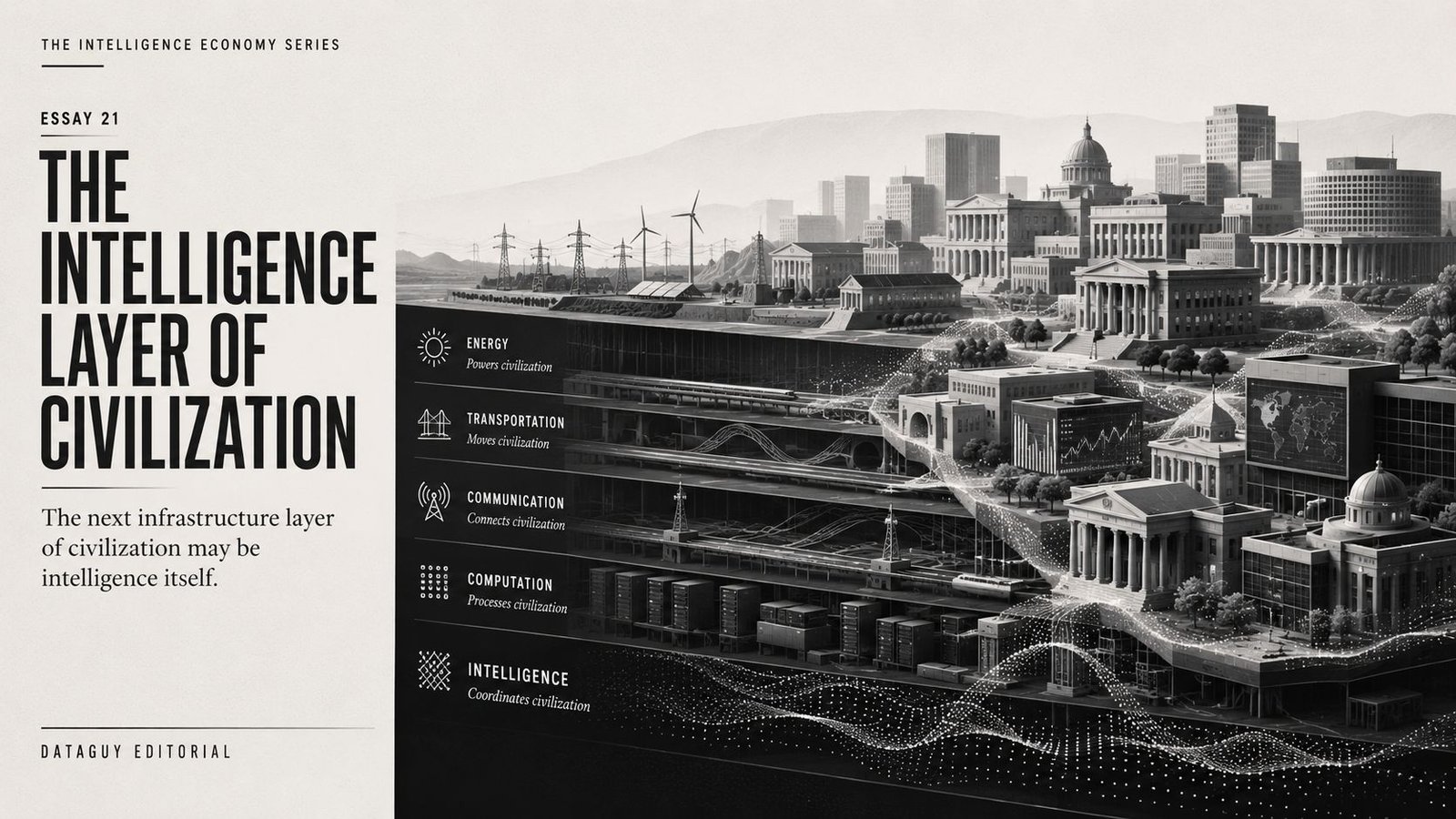
Civilizations are not built upon a single form of infrastructure. They emerge through the accumulation of layers. Each layer solves a different coordination problem while enabling the layers above it to function. Energy powers activity. Transportation moves resources. Communication moves information. Computation processes information. Together, these systems create the foundation upon which modern societies operate.
The intelligence economy suggests the emergence of an additional layer. This layer does not replace the existing stack. Instead, it sits above and across it. Intelligence increasingly becomes the mechanism through which other infrastructures are monitored, optimized, coordinated, and adapted. Intelligence becomes a system for managing systems.
One way to understand this transition is through what might be called the Civilizational Intelligence Stack. The framework highlights how intelligence evolves from an isolated capability into a foundational layer embedded throughout society. Each level supports the next, creating a progression through which civilization increases its capacity for coordination and complexity.
Energy
Every civilization begins with energy. Agricultural societies depended upon biological energy. Industrial societies depended upon fossil fuels. Modern societies increasingly depend upon diversified energy systems. Without energy, all higher-order forms of economic activity become impossible. Energy remains the foundational layer beneath civilization.
Transportation
The second layer concerns transportation. Roads, ports, railways, shipping networks, and logistics systems allow resources to move across space. Transportation expands economic reach by connecting production with consumption. Civilizations scale when movement becomes more efficient.
Communication
The third layer enables communication. Postal systems, telegraphs, telephones, broadcasting networks, and the internet dramatically increased the speed with which information could travel. Communication infrastructure reduced coordination costs and allowed increasingly complex institutions to emerge.
Computation
The fourth layer consists of computation. Computing systems transformed civilization's ability to store, process, and distribute information. Modern finance, logistics, healthcare, science, government, and commerce all depend upon computational infrastructure. Computation scaled information processing across society.
Intelligence
The fifth layer is intelligence. Intelligence operates on top of computation in much the same way computation operates on top of communication. Intelligence transforms information into understanding, prioritization, recommendations, and decisions. It enables societies to manage complexity more effectively by increasing their collective capacity for interpretation and action.
The significance of the Civilizational Intelligence Stack lies not merely in the existence of intelligence, but in its position within the broader system. Intelligence increasingly influences how energy systems operate, how transportation networks adapt, how communication systems prioritize information, and how computational infrastructure allocates resources. Intelligence becomes a coordinating layer spanning the entire stack.
This perspective helps explain why intelligence may become a civilizational capability rather than a technological feature. Civilizations advance when they discover new mechanisms for coordinating complexity. Intelligence expands the ability of societies to understand, predict, and respond to changing conditions. It increases civilization's adaptive capacity.
The institutions that control, develop, and distribute intelligence therefore become increasingly important. Intelligence no longer functions solely as an organizational asset. It becomes part of the infrastructure upon which economic systems, public institutions, and social coordination depend.
Viewed through this framework, the intelligence economy represents more than a technological transition. It represents the addition of a new layer to civilization's operating system. The long-term significance of intelligence may depend less on individual applications and more on the extent to which entire societies become organized around this new layer.
Energy powers civilization. Transportation moves resources. Communication moves information. Computation processes information. Intelligence coordinates complexity. Together, these layers determine how societies scale.
The Consequences Of Embedded Intelligence
Infrastructure becomes transformative when society begins depending upon it. Roads become important when commerce relies upon transportation. Electricity becomes important when industry relies upon power. Computing becomes important when institutions rely upon information systems. Intelligence may become similarly significant as organizations, governments, markets, and individuals increasingly depend upon intelligence to navigate complexity.
The consequences of this transition extend far beyond productivity improvements. Intelligence infrastructure changes how societies allocate resources, make decisions, respond to crises, educate citizens, conduct research, and govern institutions. Once intelligence becomes embedded throughout civilization, its influence extends into nearly every domain of economic and social activity.
Education provides one example. Historically, educational systems were designed around information transfer. Students acquired knowledge because information was relatively scarce. As intelligence becomes increasingly accessible, the role of education may gradually evolve. The challenge shifts from acquiring information toward developing judgment, critical thinking, creativity, and the ability to work effectively alongside intelligence systems.
Healthcare represents a similar transformation. Modern healthcare systems generate enormous volumes of information yet often struggle with interpretation and coordination. Embedded intelligence can assist with diagnosis, treatment planning, resource allocation, and patient management. The result is not simply greater efficiency but potentially a higher capacity for managing complexity across entire healthcare ecosystems.
Scientific research may undergo an even more profound change. Scientific progress has historically depended upon the ability of researchers to process information, generate hypotheses, and identify meaningful patterns. Intelligence infrastructure expands society's ability to perform these functions at scale. Discovery itself becomes increasingly augmented by intelligence systems capable of navigating vast intellectual landscapes.
Governments face similar opportunities and challenges. Public institutions exist largely to coordinate collective action under conditions of uncertainty. Intelligence infrastructure can improve forecasting, policy analysis, resource distribution, and administrative efficiency. At the same time, it introduces new questions regarding accountability, transparency, and legitimacy. Intelligence becomes part of governance itself.
Markets also evolve. Financial systems, supply chains, labor markets, and commercial networks increasingly incorporate intelligence into decision-making processes. Participants gain access to better predictions, faster analysis, and improved coordination mechanisms. Economic activity becomes shaped not only by information flows but by intelligence flows.
The cumulative effect of these changes is an increase in civilization's adaptive capacity. Societies become better able to identify problems, allocate resources, anticipate disruptions, and respond to changing conditions. Intelligence acts as a layer that enhances the performance of other systems rather than replacing them.
Yet this transition also introduces new forms of dependency. Civilizations that rely upon intelligence infrastructure must consider questions of resilience, concentration, governance, and access. Infrastructure creates power because those who control infrastructure influence the systems built upon it. Intelligence may become no exception.
Viewed through this lens, the emergence of an intelligence layer represents more than technological progress. It represents a structural shift in how civilization manages complexity. Intelligence increasingly becomes embedded within the institutions that support modern life, reshaping the capabilities of society itself.
The significance of intelligence infrastructure lies not in what intelligence does independently, but in how it enhances the performance of every other system upon which civilization depends.
The Institutional Challenge
If intelligence becomes a civilizational layer, societies must confront a challenge that extends beyond technology. Infrastructure does not merely create capabilities. It creates institutions. Roads require transportation systems. Financial networks require regulatory systems. Communication networks require governance frameworks. Intelligence infrastructure will require institutions capable of managing its economic, social, and political consequences.
This challenge emerges because intelligence differs from many previous forms of infrastructure. Roads move goods. Electricity delivers power. Intelligence influences decisions. As intelligence becomes embedded throughout society, it increasingly shapes how resources are allocated, how policies are designed, how markets operate, and how institutions coordinate activity. Intelligence therefore affects the mechanisms through which civilization governs itself.
One implication is that societies must determine how intelligence is distributed. Throughout history, access to critical infrastructure has influenced economic opportunity. Transportation networks shaped commerce. Communication networks shaped information access. Intelligence infrastructure may similarly shape access to knowledge, decision-making capability, and economic participation. Questions of inclusion become increasingly important as intelligence becomes foundational.
Governance represents a second challenge. Infrastructure creates dependency. As institutions rely more heavily upon intelligence systems, societies must establish mechanisms that ensure reliability, accountability, transparency, and resilience. Intelligence cannot remain solely a technological issue. It becomes a governance issue because the functioning of critical systems increasingly depends upon it.
Education systems must also adapt. Industrial societies developed educational institutions suited to production economies. Information societies developed educational models suited to knowledge economies. Intelligence societies may require educational systems designed around judgment, creativity, adaptability, and collaboration with intelligence systems. Human capabilities evolve alongside civilizational infrastructure.
Economic institutions face similar pressures. Markets increasingly incorporate intelligence into pricing, allocation, forecasting, and decision-making. Regulatory frameworks built for previous economic eras may struggle to address environments in which intelligence itself functions as a productive resource. New forms of economic coordination may emerge around the creation, distribution, and governance of intelligence.
Public institutions confront an even broader responsibility. Governments have historically played a role in supporting foundational infrastructure because infrastructure generates widespread social and economic effects. Intelligence may increasingly require similar attention. The objective is not simply encouraging innovation, but ensuring that intelligence infrastructure contributes to societal resilience and collective prosperity.
The challenge becomes particularly important because intelligence infrastructure operates across institutional boundaries. It affects businesses, governments, educational systems, healthcare providers, scientific institutions, and citizens simultaneously. Managing such a layer requires coordination between actors that have traditionally operated independently.
Viewed through this lens, the emergence of an intelligence layer is not primarily a technological challenge. It is an institutional challenge. Civilizations succeed when they build institutions capable of managing the infrastructures upon which they depend. The future of the intelligence economy may therefore depend as much upon institutional design as technological progress.
The defining societies of the coming century may not be those that develop the most intelligence. They may be those that develop the institutions most capable of organizing intelligence as a shared civilizational resource.
Building intelligence infrastructure is a technological challenge. Organizing civilization around intelligence infrastructure is an institutional challenge. The latter may ultimately prove more important than the former.
When Intelligence Becomes Foundational
Every major civilization is ultimately defined by the infrastructure layers upon which it depends. Agricultural civilizations depended upon food systems. Industrial civilizations depended upon production systems. Information civilizations depended upon computational systems. These infrastructures did more than improve efficiency. They expanded the scale at which societies could coordinate people, resources, institutions, and economic activity.
The intelligence economy suggests that another such transition may be underway. Intelligence increasingly moves beyond individual expertise and isolated organizational capabilities. It becomes embedded throughout infrastructure, institutions, markets, and public systems. The result is not merely more intelligence. The result is a civilization with greater capacity to interpret complexity, anticipate change, and coordinate action.
This shift changes how intelligence itself should be understood. Intelligence is often discussed as a technology, a capability, or a collection of tools. Yet infrastructure eventually becomes more important than technology. Roads matter because commerce depends upon them. Electricity matters because industry depends upon it. Intelligence may matter because civilization increasingly depends upon it.
The implications are profound. Economic growth may become increasingly linked to intelligence infrastructure. Scientific progress may become increasingly dependent upon intelligence-enhanced discovery systems. Public institutions may increasingly rely upon intelligence to coordinate services, allocate resources, and manage complexity. Intelligence becomes woven into the operating systems of society itself.
This evolution may also reshape competition between nations. Historically, societies gained advantages through access to natural resources, industrial capacity, transportation networks, and technological capabilities. The coming century may increasingly reward societies that build intelligence infrastructure effectively and distribute its benefits broadly throughout the economy.
Viewed through this lens, intelligence becomes a civilizational asset rather than merely a technological asset. The question shifts from what intelligence can do toward how intelligence changes the capabilities of entire societies. Intelligence expands the adaptive capacity of civilization itself.
This suggests that the intelligence economy may represent a deeper transition than most current discussions acknowledge. The visible story concerns artificial intelligence systems. The deeper story concerns the emergence of a new infrastructure layer embedded throughout civilization. The technologies matter because of the systems they create.
The defining challenge of the coming decades may therefore be learning how to build, govern, and distribute intelligence infrastructure responsibly. Civilizations are shaped not only by the technologies they invent but by the infrastructures they institutionalize. Intelligence increasingly appears positioned to become one of those infrastructures.
Agriculture scaled food. Industry scaled production. Computing scaled information. Intelligence may become the next foundational infrastructure layer through which civilization scales its capacity to understand, coordinate, and adapt.
Conclusion
Civilizations advance by transforming scarce capabilities into shared infrastructure. Food production became agricultural infrastructure. Manufacturing became industrial infrastructure. Information processing became computational infrastructure. Each transition expanded society's ability to coordinate increasingly complex forms of activity.
The intelligence economy represents the possibility that intelligence itself is undergoing a similar transformation. Intelligence becomes increasingly accessible, distributable, and embedded throughout institutions. It moves beyond individual expertise and begins functioning as a societal capability. The result is the emergence of an intelligence layer woven throughout civilization.
The Civilizational Intelligence Stack provides a framework for understanding this transition. Energy powers civilization. Transportation moves resources. Communication moves information. Computation processes information. Intelligence coordinates complexity. Together, these layers explain how societies expand their capacity for coordination and adaptation.
Organizations, markets, and governments increasingly operate within this emerging layer. Their effectiveness depends not only upon access to intelligence, but upon their ability to integrate intelligence into the systems through which civilization functions. Intelligence becomes valuable because it enhances every other layer beneath it.
Viewed from a broader historical perspective, the emergence of intelligence infrastructure may represent one of the defining transitions of the twenty-first century. The significance of intelligence lies not simply in what it automates, predicts, or optimizes. Its significance lies in its potential to become part of civilization's operating system.
Civilizations are ultimately defined by the infrastructures they build. The defining infrastructure layer of the intelligence century may not be information. It may be intelligence itself.