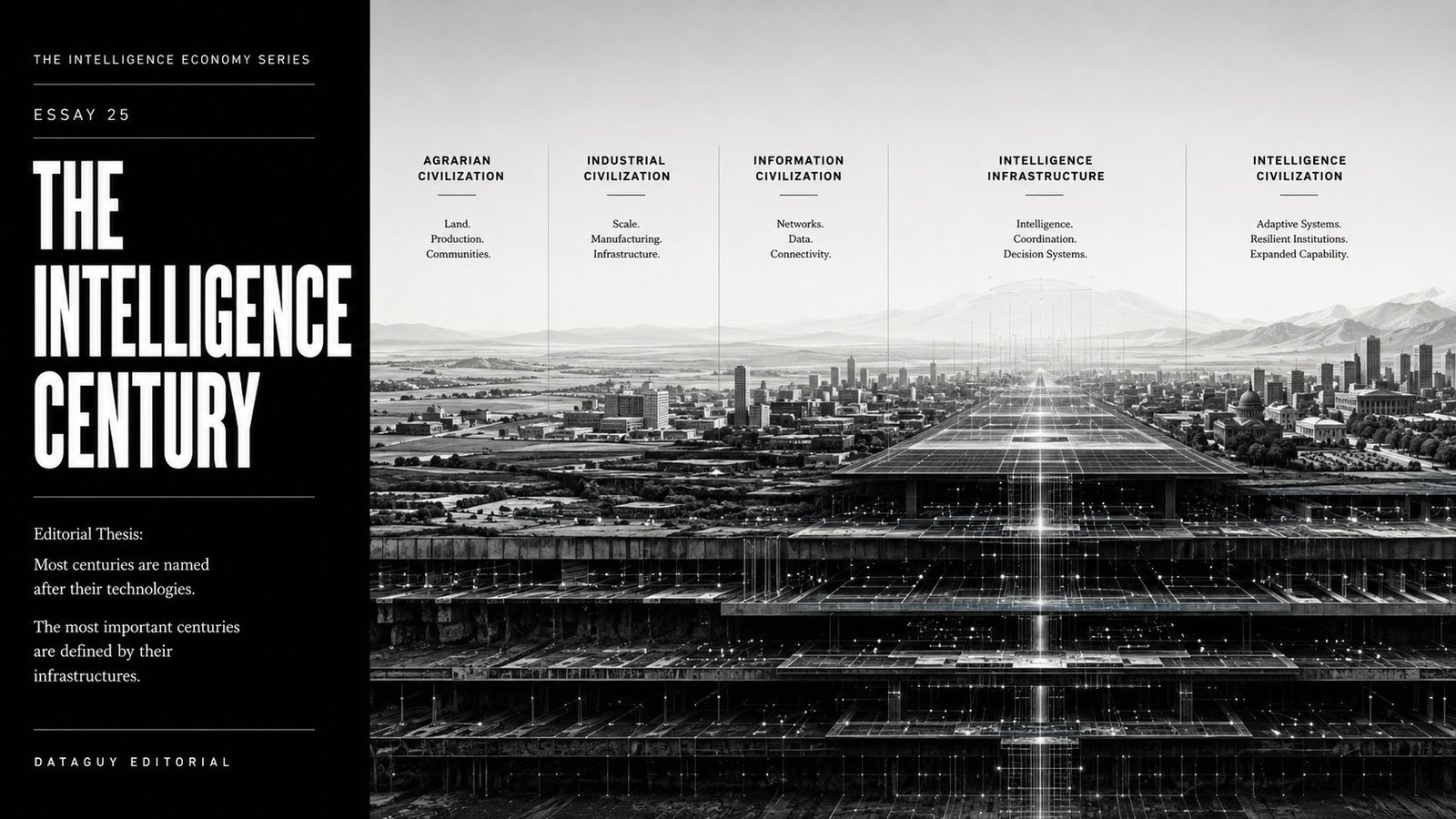
Most centuries are named after their technologies. The most important centuries are defined by their infrastructures.
History is often narrated through inventions. The steam engine symbolizes industrialization. The computer symbolizes the digital era. Artificial intelligence increasingly symbolizes the present moment. Yet civilizations are not ultimately transformed by inventions alone. They are transformed when technologies become infrastructures upon which entire societies depend.
Agriculture was once an innovation. Over time, it became the foundation of settled civilization. Industrial machinery began as a collection of inventions before evolving into the infrastructure that enabled modern economies. Computing followed a similar path. What began as specialized technology gradually became embedded throughout organizations, markets, institutions, and daily life.
The same process may now be occurring with intelligence. Intelligence has historically been a scarce resource concentrated within individuals and institutions. Today, intelligence is becoming increasingly accessible through technological systems. The significance of this transition lies not merely in the capabilities of those systems but in the possibility that intelligence itself becomes infrastructure.
This distinction changes the scope of the conversation. Discussions about artificial intelligence often focus on models, applications, or technological capabilities. Yet infrastructure operates at a different level. Infrastructure shapes the environment within which organizations function, markets operate, governments govern, and societies coordinate activity.
Throughout this series, we have examined intelligence as labor, capital, infrastructure, organizational capability, market resource, governance challenge, geographic asset, and national capability. Each perspective points toward a larger conclusion. Intelligence is no longer simply a technology category. It is becoming a foundational layer of economic and institutional life.
The implications extend beyond firms, industries, or governments. When foundational infrastructures change, civilizations change. New forms of production emerge. New institutions develop. New markets appear. New distributions of power take shape. The structures of society gradually reorganize around new capabilities.
The twenty-first century may therefore be remembered not because intelligent systems became possible, but because intelligence itself became infrastructure.
The intelligence economy is not primarily a technology story. It is a civilization story. When intelligence becomes infrastructure, every institution built upon intelligence begins to change.
What Civilizations Are Built Upon
Civilizations are not defined solely by ideas, technologies, or institutions. They are defined by the infrastructures that enable societies to organize complexity at scale. Throughout history, moments of civilizational transformation have often occurred when a new foundational layer expanded humanity's capacity to produce, coordinate, and adapt.
Agriculture represents perhaps the earliest example. Before agriculture, human societies remained limited by mobility and subsistence constraints. Agriculture enabled settlement, specialization, surplus production, and long-term institutional development. Cities emerged. Governments emerged. Economic systems expanded. Civilization itself became possible because a new productive infrastructure altered the boundaries of what societies could sustain.
Industry created a second transformation. Mechanized production dramatically expanded economic output and reduced the constraints imposed by human and animal labor. Industrial infrastructure enabled larger populations, larger organizations, larger markets, and larger states. The scale of civilization increased because the productive capacity of civilization increased.
Electricity introduced another foundational layer. Unlike earlier infrastructures tied to specific sectors, electricity became a general-purpose capability embedded throughout society. Factories depended upon it. Homes depended upon it. Transportation systems depended upon it. Economic growth increasingly depended upon universal access to electrical infrastructure.
Computing extended this pattern into the information age. Information could now be stored, processed, transmitted, and analyzed at unprecedented scale. Organizations became more complex. Markets became more interconnected. Scientific research accelerated. Governments expanded their administrative capabilities. Computing became the cognitive infrastructure of the digital economy.
What makes these infrastructures significant is not their technical characteristics but their societal effects. Each expanded humanity's ability to coordinate complexity. Agriculture coordinated food production. Industry coordinated physical production. Electricity coordinated energy. Computing coordinated information. Every infrastructure increased the capacity of civilization to organize itself more effectively.
Viewed through this historical lens, intelligence appears less like a discrete technology and more like the next stage in a recurring pattern. Intelligence may become a general-purpose capability embedded throughout organizations, institutions, markets, governments, and scientific systems. Its significance lies not in individual applications but in its ability to enhance the decision-making capacity of civilization itself.
This possibility distinguishes intelligence from many previous technological innovations. Technologies often improve specific activities. Foundational infrastructures reshape the environment within which all activities occur. The critical question is therefore not what intelligence can do. The critical question is whether intelligence becomes infrastructure.
If it does, the implications extend far beyond technology. They reach into the foundations of how societies organize production, governance, coordination, and progress.
The intelligence century begins not when intelligent systems emerge, but when intelligence becomes one of the infrastructures upon which civilization depends.
Agriculture expanded production. Industry expanded scale. Electricity expanded energy access. Computing expanded information processing. Intelligence may expand civilization's capacity to make decisions.
From Capability To Foundation
The most important infrastructures often begin as specialized capabilities. Agriculture initially increased food production. Electricity initially powered machinery. Computing initially served scientific and military applications. In each case, the technology became transformative only when it evolved beyond its original use cases and became embedded throughout society.
Intelligence may now be undergoing a similar transition. For much of modern history, intelligence remained constrained by human limitations. Organizations could only make as many decisions as their managers could process. Governments could only analyze as much information as their institutions could absorb. Scientific progress depended upon the pace at which researchers could generate and evaluate new knowledge. Intelligence functioned as a scarce resource embedded within individuals and organizations.
The intelligence economy changes this equation. Intelligence increasingly becomes available through systems that can be distributed, replicated, and integrated across multiple domains simultaneously. What was once limited to specific individuals gradually becomes accessible throughout broader economic and institutional environments. The significance of this shift lies not in automation alone but in the changing economics of intelligence itself.
Historically, societies invested heavily in infrastructures that reduced constraints. Transportation reduced geographic constraints. Electricity reduced energy constraints. Computing reduced information-processing constraints. Intelligence infrastructure may reduce cognitive constraints by expanding the ability of institutions to analyze, coordinate, forecast, and decide.
This helps explain why intelligence increasingly appears across domains that were once considered unrelated. Businesses deploy intelligence to improve operations and strategic planning. Governments use intelligence to support public administration and policy development. Scientific institutions use intelligence to accelerate research. Educational systems begin integrating intelligence into learning environments. The same underlying capability spreads throughout diverse institutional settings.
The transition from capability to infrastructure follows a recognizable pattern. Initially, a technology delivers localized benefits. Over time, adoption expands. Standards emerge. Costs decline. Complementary institutions develop. Eventually, the technology becomes so embedded that society no longer treats it as a distinct innovation. It becomes part of the operating environment.
Computing followed precisely this path. Early computers were specialized machines used by a limited number of organizations. Today, computing is woven throughout economic and social life to such an extent that most institutions cannot function without it. Intelligence may be approaching a similar stage of integration.
This perspective also clarifies why debates focused exclusively on artificial intelligence often miss the larger transformation. The long-term significance of intelligence does not depend solely on the capabilities of individual systems. It depends on the degree to which intelligence becomes embedded throughout the structures of civilization itself.
Infrastructure changes societies because it changes what societies can coordinate. If intelligence becomes infrastructure, the primary consequence may not be smarter machines. The primary consequence may be institutions capable of operating at levels of complexity that were previously difficult to sustain.
Viewed through this lens, intelligence should be understood less as a product and more as a layer. A layer that increasingly supports organizations, markets, governments, science, and civilization itself.
Technologies become transformative when they stop being tools and start becoming infrastructure. Intelligence may be crossing that threshold.
The Next Layer Of Civilizational Capability
Every major stage of civilization can be understood as the addition of a new foundational layer. These layers do not replace one another. Agriculture did not eliminate the need for human cooperation. Industry did not eliminate agriculture. Computing did not eliminate industry. Instead, each new layer expanded civilization's ability to coordinate complexity.
This pattern suggests a useful framework for understanding the intelligence economy. Rather than viewing intelligence as a standalone technology sector, it may be more accurate to view intelligence as the next layer within a broader civilizational stack. Each layer increases humanity's capacity to organize resources, institutions, and systems at greater scale.
Agriculture
Agriculture created the first large-scale productive infrastructure. Stable food production enabled settlement, specialization, trade, governance, and the emergence of organized societies. Civilization became possible because agriculture expanded humanity's ability to coordinate production across time.
Industry
Industry introduced mechanical scale. Human effort could now be amplified through machines, energy systems, transportation networks, and manufacturing infrastructure. Economic output expanded dramatically because societies gained the ability to coordinate physical production at unprecedented levels.
Information
Computing added an information layer to civilization. Information could be stored, transmitted, analyzed, and shared across increasingly complex networks. Organizations became larger. Markets became more interconnected. Scientific discovery accelerated. Information infrastructure expanded civilization's ability to coordinate knowledge.
Intelligence
The emerging intelligence layer builds upon everything beneath it. Intelligence affects how information is interpreted, how decisions are made, how resources are allocated, and how institutions respond to complexity. Unlike previous layers, intelligence directly influences the quality of coordination itself.
Civilizational Capability
At the top of the stack sits civilizational capability. This is not a resource but an outcome. Economic growth, scientific progress, institutional effectiveness, societal resilience, and collective problem-solving emerge from the interaction of all underlying layers. Each addition to the stack expands the range of complexity civilization can successfully manage.
The significance of the Civilization Stack lies in its explanation of why intelligence matters. Intelligence does not simply increase efficiency within existing systems. It increases the capacity of systems themselves. Better intelligence allows organizations to coordinate larger operations, governments to manage greater complexity, scientific institutions to process larger bodies of knowledge, and societies to adapt more effectively to change.
This perspective helps distinguish intelligence from narrower technological innovations. Most technologies improve specific functions. Infrastructure layers alter the operating capacity of civilization itself. The more deeply intelligence becomes embedded throughout society, the more likely it is to behave as a civilizational infrastructure rather than as a discrete technology.
The implications are profound because civilizational layers tend to persist. Agriculture remains essential. Industry remains essential. Computing remains essential. If intelligence joins this group, it may become one of the enduring foundations upon which future institutions are built.
Viewed through this lens, the intelligence economy is not merely creating new products or industries. It may be adding a new layer to the architecture of civilization.
Agriculture expanded production. Industry expanded scale. Information expanded knowledge. Intelligence may expand civilization's capacity to make decisions. Each layer increases humanity's ability to coordinate complexity.
When Every Institution Changes
Civilizations change when their foundational infrastructures change. New infrastructures alter the economics of production, the structure of institutions, and the ways societies coordinate collective activity. The effects rarely appear immediately. Instead, they emerge gradually as organizations adapt to new capabilities and redesign themselves around new constraints.
Agriculture reorganized society around settlement and surplus production. Industry reorganized society around scale and mechanization. Computing reorganized society around information. If intelligence becomes infrastructure, it may trigger a similar process of institutional reorganization across nearly every domain of civilization.
Organizations provide the most immediate example. For centuries, organizational scale was constrained by managerial capacity. Leaders could only process limited amounts of information and coordinate limited numbers of activities. Intelligence infrastructure expands the ability of organizations to analyze complexity, allocate resources, and manage increasingly sophisticated operations. The result may be entirely new forms of organizational design.
Markets may evolve in similar ways. Markets function by aggregating information, evaluating opportunities, and coordinating economic activity. Intelligence systems increasingly influence how these processes occur. Participants gain access to greater analytical capability, faster decision-making, and more sophisticated forecasting. Market structures may therefore adapt to a world in which intelligence is more widely distributed than at any previous point in history.
Governments also face transformation. Public institutions exist to coordinate complex societies, allocate resources, provide services, and manage uncertainty. Intelligence infrastructure increases the capacity of governments to process information, evaluate alternatives, and respond to changing conditions. The result may be institutions that become more adaptive, responsive, and capable of operating at greater levels of complexity.
Scientific systems represent another area of profound change. Scientific progress has always depended upon humanity's ability to generate, evaluate, and integrate knowledge. Intelligence infrastructure expands each of these capabilities simultaneously. Researchers gain access to tools that accelerate discovery, identify patterns, and navigate increasingly complex bodies of information. The pace and scale of scientific coordination may increase substantially.
Educational systems may undergo similar evolution. Historically, education focused on transmitting knowledge because knowledge itself was scarce. As intelligence becomes more accessible, educational priorities may shift toward judgment, reasoning, creativity, adaptation, and institutional understanding. The challenge becomes not accessing information but utilizing intelligence effectively.
These changes share a common characteristic. Intelligence does not replace institutions. It changes the environment within which institutions operate. Organizations remain necessary. Markets remain necessary. Governments remain necessary. Science remains necessary. Education remains necessary. Yet each begins functioning differently when intelligence becomes embedded throughout the system.
This distinction is important because infrastructure transformations rarely eliminate existing structures. They reorganize them. Railways did not eliminate commerce. Electricity did not eliminate factories. Computing did not eliminate organizations. Instead, each infrastructure changed how those systems functioned. Intelligence may follow the same pattern.
Viewed through this lens, the intelligence century is not simply about technological adoption. It is about institutional adaptation. The organizations, markets, governments, and knowledge systems that define civilization may increasingly reorganize themselves around intelligence as a foundational capability.
The intelligence economy does not replace civilization's institutions. It changes how those institutions coordinate information, decisions, resources, and complexity.
When Intelligence Becomes Abundant
Every economic era is ultimately defined by the resource that becomes abundant. Agricultural societies increased access to food. Industrial societies increased access to physical production. Information societies increased access to knowledge. The intelligence century may be defined by increasing access to intelligence itself.
Abundance changes systems in ways that are often difficult to predict in advance. When information became abundant through computing and digital networks, the most significant consequences were not simply technological. Entire industries reorganized. Business models changed. Institutions adapted. New forms of economic activity emerged. The abundance of information altered the structure of society.
Intelligence may produce a similar transformation. For most of human history, intelligence remained among the scarcest resources available to civilization. Organizations competed for skilled individuals. Governments invested heavily in expertise. Scientific institutions concentrated talent within specialized communities. Economic value often depended upon access to limited cognitive resources.
The intelligence economy begins to alter these conditions. Intelligence becomes increasingly available through infrastructure that can be distributed across organizations, institutions, and societies. Capabilities once restricted to specialized groups become more broadly accessible. Cognitive resources become less constrained by individual human limitations.
This shift does not eliminate scarcity. Scarcity moves. When intelligence becomes more abundant, other capabilities become more valuable. Judgment becomes more important than information. Governance becomes more important than access. Trust becomes more important than computation. Agency becomes more important than possibility. Throughout this series, we have repeatedly observed that abundance in one layer often creates scarcity in another.
The intelligence century may therefore not be defined by intelligence alone. It may be defined by the new bottlenecks that emerge once intelligence becomes widely available. Organizations compete for judgment. Markets compete for trust. Governments compete for institutional effectiveness. Societies compete for the ability to coordinate increasingly complex systems.
This dynamic helps explain why intelligence should not be understood as an endpoint. Intelligence infrastructure creates new capabilities, but capabilities create new challenges. Every increase in productive capacity expands the complexity that societies must manage. Civilizations become more capable and more demanding simultaneously.
The result may be a century characterized by unprecedented cognitive abundance. Organizations gain access to intelligence at scale. Scientific discovery accelerates. Economic productivity expands. Public institutions become more capable. Yet success increasingly depends upon the institutions capable of directing these capabilities toward productive outcomes.
Viewed from a broader historical perspective, the intelligence century may resemble previous civilizational transitions. The most important changes will not occur inside the technology itself. They will occur within the economic systems, institutions, governance structures, and social arrangements that emerge around it.
The defining characteristic of the intelligence century may therefore be neither artificial intelligence nor automation. It may be the reorganization of civilization around intelligence as an abundant infrastructure resource.
When intelligence becomes abundant, intelligence stops being the primary constraint. Judgment, governance, trust, coordination, and institutional capability become the scarce resources that determine outcomes.
Beyond Technology
Long-term historical transitions are rarely visible from within the moment itself. Individuals living through the rise of agriculture did not describe themselves as entering an agricultural civilization. The builders of early industrial infrastructure did not know they were laying the foundations of the industrial age. Transformations become visible only when viewed across decades and generations.
The same may prove true of intelligence. Contemporary discussions often focus on models, applications, regulations, investments, and technological capabilities. These conversations are important, but they remain close to the surface of the transformation. The deeper question concerns what happens when intelligence becomes embedded throughout civilization as a foundational infrastructure.
The answer is unlikely to be a single outcome. Civilization is not a machine that can be optimized toward a predetermined objective. It is a complex system composed of organizations, institutions, governments, markets, scientific communities, and individuals pursuing diverse goals. Intelligence will influence all of these systems, but the effects will emerge through adaptation rather than design.
Some consequences appear easier to anticipate than others. Scientific discovery may accelerate as intelligence expands humanity's ability to explore knowledge. Economic productivity may increase as organizations gain access to greater cognitive capacity. Public institutions may improve their ability to coordinate complex societies. Educational systems may evolve toward cultivating uniquely human capabilities rather than merely transmitting information.
Other consequences remain less predictable. New institutional forms may emerge. New market structures may develop. New governance models may appear. Economic and geopolitical power may reorganize around intelligence infrastructure in ways that are difficult to foresee. History suggests that foundational infrastructures often generate second-order effects more significant than their original applications.
This uncertainty should not be mistaken for ambiguity about the larger direction of change. The historical pattern remains remarkably consistent. When societies gain access to a new general-purpose capability, that capability gradually becomes embedded within institutions. Institutions adapt. Economic systems reorganize. New forms of coordination become possible. Civilization expands its operational capacity.
Intelligence appears increasingly capable of following this trajectory. Not because intelligent systems become autonomous actors, but because intelligence itself becomes more widely available as an economic and institutional resource. The defining shift is not technological. The defining shift is structural.
Viewed through this lens, the long future is less about artificial intelligence and more about institutional evolution. The question is not whether machines become intelligent. The question is how organizations, governments, markets, and societies evolve once intelligence becomes abundant.
Civilizations are ultimately shaped by the infrastructures they build beneath themselves. If intelligence joins agriculture, industry, electricity, and computing as one of those infrastructures, the twenty-first century may represent the beginning of a new civilizational era rather than simply a new technological era.
The most important consequence of intelligence may not be smarter systems. It may be more capable institutions built upon intelligence as a foundational infrastructure.
Conclusion
Most discussions about artificial intelligence begin with technology. The broader historical perspective suggests a different starting point. Civilization is shaped not by technologies alone but by the infrastructures that technologies become. Agriculture transformed civilization because it became infrastructure. Industry transformed civilization because it became infrastructure. Computing transformed civilization because it became infrastructure.
The central argument of this series has been that intelligence is undergoing the same transition. Intelligence is evolving from a scarce capability into a widely distributed economic resource. As intelligence becomes embedded throughout organizations, markets, governments, scientific institutions, and public systems, it increasingly behaves less like a product and more like infrastructure.
The Civilization Stack provides one way of understanding this transition. Agriculture expanded production. Industry expanded scale. Information expanded knowledge. Intelligence may expand civilization's capacity to make decisions. Each layer increased humanity's ability to coordinate complexity. Intelligence appears positioned to become the next layer in that progression.
This perspective reframes the intelligence economy itself. The intelligence economy is not solely a technology sector. It is a structural transformation affecting labor, organizations, markets, governance, education, science, infrastructure, geography, and state capacity simultaneously. The previous twenty-four essays explored these dimensions individually. Together they reveal a larger pattern.
That pattern is civilizational. When intelligence becomes infrastructure, every institution built upon intelligence begins to change. New forms of production emerge. New forms of governance emerge. New forms of coordination emerge. The effects accumulate gradually until entire systems reorganize around new capabilities.
The intelligence century will therefore not be defined by artificial intelligence itself. It will be defined by the institutions, markets, governments, organizations, and civilizations that emerge once intelligence becomes infrastructure.
The intelligence century does not begin when machines become intelligent. It begins when intelligence becomes infrastructure.