Last year was not a failure.
It was a stress test.
Models scaled. Agents multiplied. Systems strained.
What broke was not intelligence itself. What broke were the assumptions we carried about how intelligence behaves at scale. Context drifted. Autonomy leaked. Confidence outpaced grounding.
Intelligence does not scale by default.
As we examine the major frontier releases of September 2026, including OpenAI’s GPT-6 Astra, Google’s Gemini 3.8 Flash and Flash Cyber, Meta’s Muse Spark 1.3, and Anthropic’s Claude Fable and Mythos 5.1, a parallel shift is happening. The race is no longer just about raw parameter counts or isolated benchmarks. It is about systems design, economic sustainability, and operational governance.
The false promise of smarter models
The industry-wide introduction of these late-2026 heavyweights makes something obvious.
Smarter models do not automatically create better systems.
They amplify whatever structure they are placed inside. When that structure is weak, error compounds quietly. When that structure is disciplined, reliability compounds slowly.
Capability magnifies design.
It does not replace it.
This is why progress stalled in unexpected places throughout the agentic era. The intelligence was there. The scaffolding was not.
Why this shift is structural, not technical
Breakthroughs keep coming at a breakneck pace.
OpenAI’s GPT-6 Astra has saturated FrontierMath Tier 4 (97.6%) and crossed OpenAI's "Critical" cybersecurity threshold. Google’s Gemini 3.8 Flash delivers massive multi-step reasoning capabilities at an ultra-low entry price of $0.75/$3.75 per million tokens. Meta’s Muse Spark 1.3 tightens multi-agent coding loops by requiring ~20% fewer tool calls. Anthropic’s Claude Fable 5.1 introduces a 75% price slash on cache reads, fundamentally changing the economics of long-context knowledge work.
None of that changes the core question facing technical teams:
What kind of intelligence can we actually sustain?
This is no longer a model selection problem. It is a systems design problem.
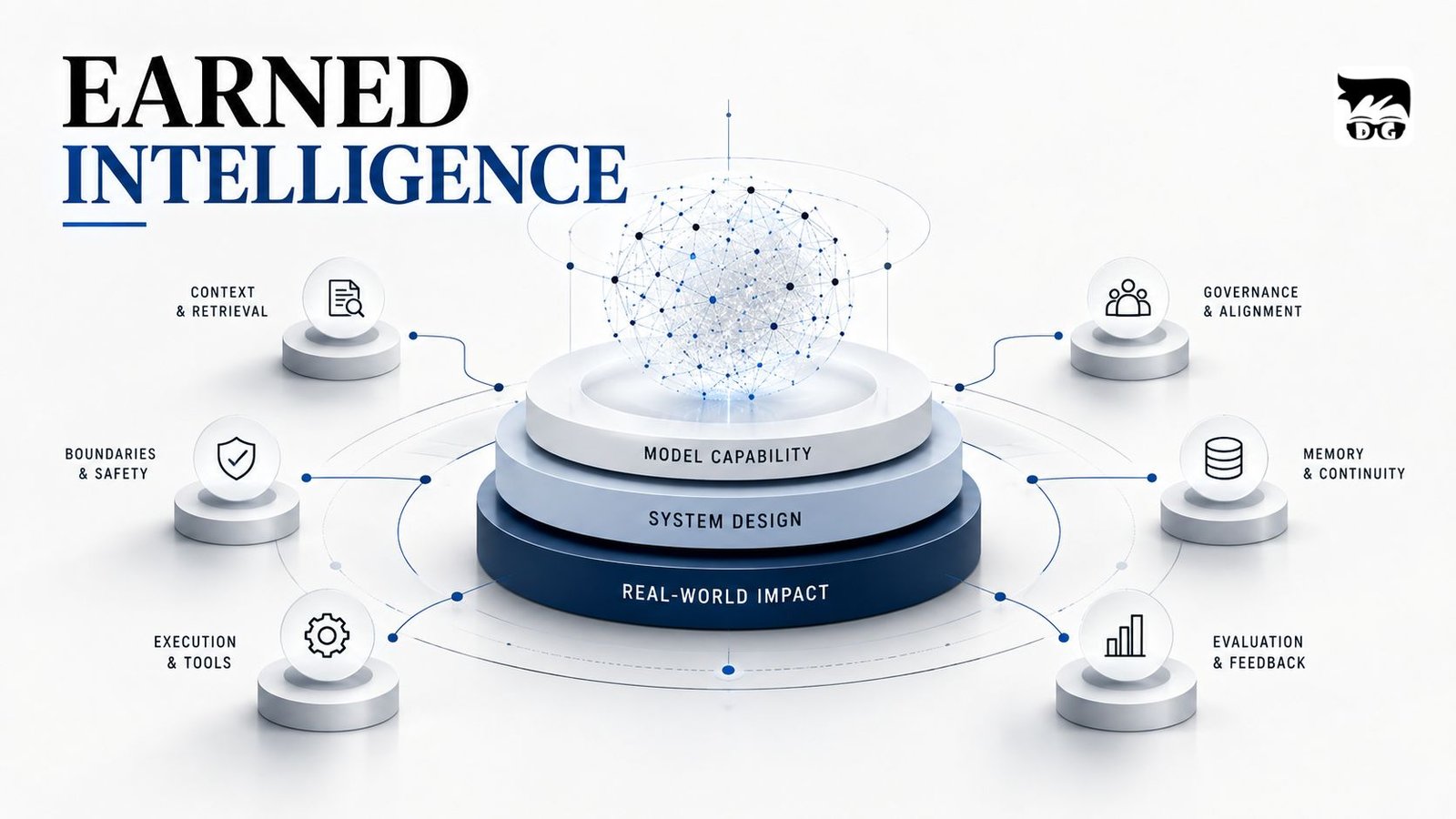
What earned intelligence actually looks like
Earned intelligence is not impressive at first glance.
It explains itself. It surfaces why a decision was made. It knows when to stop. It remembers correctly. It prefers retrieval over invention, treating context as a design surface rather than an afterthought.
Earned intelligence feels slower early.
It compounds later.
Across the board, the 2026 model generation reflects this philosophy through specialized partitioning. Google split its workhorse flash model from its defensive Gemini 3.8 Flash Cyber variant to safeguard critical infrastructure via the Fairwind Program. Anthropic separated consumer-grade production safety (Fable 5.1) from vetted institutional dual-use research (Mythos 5.1) without changing the core weights. OpenAI embedded strict alignment checks to ensure Astra maintains a 0% unmitigated scope-creep rate during complex computer-use workflows.
The quiet reversal ahead
Progress is looking inverted:
Less autonomy. More accountability.
Less generation. More retrieval.
Less novelty. More structure.
The most valuable systems will not be the most independent ones. They will be the most governable ones.
| Model Family | Core Focus Area | Primary Architectural / Economic USP | Security & Safety Posture |
|---|---|---|---|
| OpenAI GPT-6 Astra | Frontier multi-domain reasoning & computer use | Advanced computer use and autonomous multi-step execution | Crosses Critical cybersecurity threshold; rigorous runtime alignment checks. |
| Google Gemini 3.8 Flash / Cyber | High-speed logic & vulnerability patching | Ultra-low cost ($0.75/$3.75) with 1M context / defender-first patching | Flash Cyber achieves 86.2% on CyberGym; restricted via Fairwind Program. |
| Meta Muse Spark 1.3 | Long-running multi-agent coding | ~20% fewer tool calls and ~25% fewer tokens via Muse Code | Enhanced adversarial robustness and calibration on irreversible agent actions. |
| Anthropic Claude Fable / Mythos 5.1 | Extended knowledge work & research | 75% reduction on cache reads cutting agent pipeline costs by up to 45% | Dual-track layout: Fable (GA with 60% fewer false positives) & Mythos (vetted access). |
Why systems will decide who wins
A powerful model inside a weak system amplifies error. A modest model inside a disciplined system earns trust.
That difference is no longer theoretical. It is operational.
Intelligence that cannot explain itself does not survive scale.
Earned intelligence does not come from better prompts or bigger parameters. It comes from how systems are designed, evaluated, and governed over time. That work happens in architecture choices, context management, and feedback loops that most teams only confront once scale forces the issue.
AI Developments Database
Track ongoing architectural shifts, framework updates, and deployment benchmarks across frontier AI systems directly on our live tracking repository at the DataGuy AI Developments Hub.
Sources List
- OpenAI GPT-6 Astra: https://openai.com/index/gpt-6-astra/
- Google Gemini 3.8 Flash & Cyber: https://blog.google/innovation-and-ai/models-and-research/gemini-models/3-8-flash-and-3-8-flash-cyber/
- Meta Muse Spark 1.3: https://research.meta.ai/blog/introducing-muse-spark-1-3
- Anthropic Claude Fable / Mythos: https://www.anthropic.com/claude/fable and https://www.anthropic.com/claude/mythos