The previous article examined the decision primitives that System One Models can expose to software. Noul can represent a yes-or-no judgment, Choice can select from a defined set, and Score can represent a level on a scale.
That establishes what kind of decision a model can return, but it leaves another question unresolved. How should software interpret a decision when the model is not equally certain in every case?
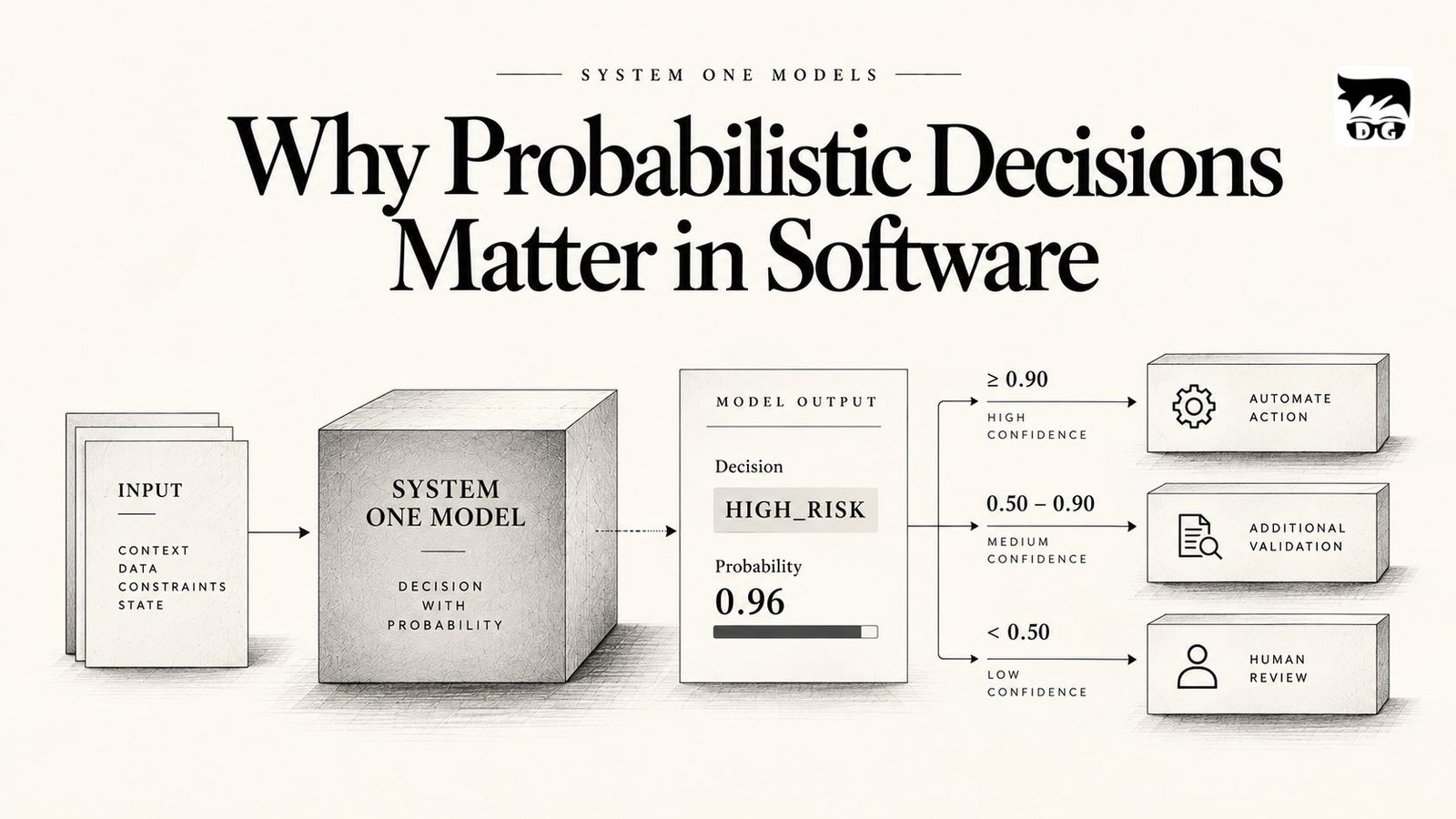
Consider a transaction screening system that receives a decision of HIGH_RISK. A conventional structured output tells the application what the model decided, but it does not necessarily tell the application how strongly the model supports that decision. A decision accompanied by a probability or confidence estimate provides another piece of information that can influence what happens next.
This is where probabilistic decisions become important. The model does not simply return an answer. It can expose an estimate of uncertainty that the surrounding software can incorporate into its execution logic.
The Problem With a Binary Answer
Software often has to turn model output into an action. A fraud screening system may approve a transaction, send it for review, or block it. A customer service system may answer automatically, request additional information, or escalate to a human. An operational system may continue a workflow or stop it.
If every model decision is treated as equally certain, the application has limited information about when those actions should be taken automatically.
Decision only:
Transaction → HIGH_RISK → Block
Adding uncertainty changes the interface.
Decision with uncertainty:
Transaction → HIGH_RISK + 0.96 probability → Apply high-risk policy
The probability does not determine the policy by itself. It gives the software another variable with which to make that policy decision.
TypeSafe describes its System One outputs as typed decisions accompanied by probabilities and confidence information. The broader idea is that uncertainty becomes part of the computational interface rather than remaining hidden inside the model.
Accuracy Is Not the Same as Calibration
Accuracy and calibration describe different properties of a predictive system.
Accuracy asks whether the system is correct. Calibration asks whether the confidence attached to its predictions corresponds meaningfully to how often those predictions are correct.
For example, suppose a system produces a large number of decisions with a confidence level around 80 percent. If the system is well calibrated, approximately 80 percent of those decisions should be correct over a sufficiently large and representative set of cases.
This distinction matters because software needs more than a ranking of likely answers. It needs an interpretable signal that can help determine whether an automated action is appropriate.
A useful probability is not simply a number attached to a prediction. It is a signal whose meaning can be evaluated against observed outcomes.
Calibration therefore changes the role of model confidence. Instead of being presented as an opaque model characteristic, it can become something the application is able to reason about.
Confidence Becomes Part of the Control Flow
Once uncertainty is available to software, it can become part of the control flow.
Example policy:
High-risk decision + confidence above threshold → automated action
High-risk decision + confidence below threshold → human review
The model estimates the decision and its uncertainty. The application determines what level of uncertainty is acceptable for a particular action.
This distinction is important because the model does not need to know every business policy surrounding its output. A payment system, a customer support workflow, and a security operation may have very different tolerance for uncertainty even when they use similar decision primitives.
TypeSafe explicitly presents calibrated confidence as something developers can use to establish thresholds for autonomous action or review. The underlying software therefore remains responsible for deciding how a probabilistic result should affect execution.
From Prediction to Policy
A probability becomes operationally useful when it participates in a policy.
Consider a customer service workflow. A model might determine whether a customer's request can be resolved automatically, whether the request requires escalation, and how strongly the system supports that judgment.
The model does not have to decide the final operational policy. The surrounding application can define different responses based on the decision and its confidence.
| Model result | Confidence | Software response |
|---|---|---|
| Resolvable automatically | High | Continue automated workflow |
| Resolvable automatically | Low | Request review |
| Requires escalation | High | Route to specialist |
| Requires escalation | Low | Apply secondary checks |
This separates two responsibilities that are often mixed together. The model supplies semantic judgment, while the application supplies operational policy.
Why Hard Thresholds Are Not Enough
A threshold can make a probabilistic system easier to implement, but the threshold itself does not make the underlying probability meaningful.
If a system labels a decision with 95 percent confidence but that confidence does not correspond reliably to observed outcomes, a rule such as confidence > 0.90 can create a false sense of precision.
The software may be deterministic while the assumption behind the decision is not.
This is why calibration matters before thresholds are introduced into production logic. A threshold is only as useful as the uncertainty signal on which it operates.
Important distinction: A deterministic software rule built on an unreliable probability does not become reliable simply because the rule itself is deterministic.
The Difference Between Confidence and Certainty
A probability should not be interpreted as a guarantee about an individual case.
A decision carrying a probability of 0.98 does not mean that the specific decision is guaranteed to be correct. Calibration is fundamentally an aggregate property. It asks whether probabilities correspond to observed frequencies across an appropriate collection of cases.
This distinction becomes especially important when the operating environment changes. A model can behave differently when the inputs, users, products, policies, or underlying data distribution differ from the conditions represented during evaluation.
Software therefore needs to treat probability as information about uncertainty rather than as certainty expressed with more precision.
Why System One Models Put This at the Center
The significance of probabilistic decisions becomes clearer when the model is designed specifically to operate inside software.
TypeSafe describes System One Models as producing structured decisions with calibrated probabilities and confidence information. It also positions Reinforcement Learning for Calibrated Decisions, or RLCD, as part of the approach used to train its models.
These are TypeSafe's descriptions of its architecture and training approach, rather than independently established conclusions about every System One Model. The more general architectural point can be separated from the vendor-specific claim.
If a model is intended to become a computational component inside a software system, then the meaning of uncertainty becomes part of the interface that component exposes.
Decision interface:
Application State → Decision Primitive → Decision + Probability → Software Policy → Action
The probability is therefore not merely an annotation attached to the answer. It can become one of the inputs used by the surrounding system.
A Decision Without Uncertainty Is Often Not Enough
A typed decision gives software structure. A meaningful uncertainty signal gives software additional information about how that decision should be used.
This does not mean that every application must expose probabilities directly to an end user. It means that the software consuming the model can have access to information that helps distinguish a strongly supported decision from a weakly supported one.
For Noul, this may mean a probability associated with a yes-or-no judgment. For Choice, it can mean a distribution across possible options. For Score, it can include information about the model's confidence in the assigned level.
The decision primitive defines what is being judged. The probability helps describe how strongly the model supports that judgment.
One Model Can Lead to Different Actions
The same model decision does not necessarily need to produce the same operational response in every application.
Consider a system that estimates whether an incoming request is safe to process automatically. One organization may require a very high confidence threshold before allowing autonomous execution. Another may accept a lower threshold because every decision is followed by a lightweight verification step.
The model output can remain the same while the software policy changes.
| Decision | Confidence | Policy A | Policy B |
|---|---|---|---|
| Safe to proceed | 98% | Automate | Automate |
| Safe to proceed | 82% | Review | Automate with verification |
| Safe to proceed | 61% | Review | Review |
This is one of the more important consequences of exposing uncertainty. Intelligence and policy do not have to be fused into the same component.
Probabilities Become More Valuable When Decisions Compose
A single model decision can be useful, but many production workflows contain a sequence of smaller judgments.
An operational workflow might first determine whether an input is relevant, then classify its type, assess a risk, determine whether additional information is required, and finally decide whether an action can proceed.
If each judgment exposes meaningful uncertainty, the surrounding program can use those signals when deciding how the workflow should continue.
Composable decision flow:
Input → Relevance → Classification → Risk → Action Eligibility → Execution
This is consistent with TypeSafe's workflow-oriented approach, where complex tasks are decomposed into narrower intelligent judgments and programmatic rules. The model handles semantic questions while conventional software coordinates the broader workflow.
The value of probability becomes more apparent as these decisions interact because uncertainty can influence whether the workflow proceeds, branches, asks for more information, or defers to another process.
What Calibration Does Not Solve
Calibration is important, but it does not solve every problem associated with model-driven software.
A calibrated model can still be wrong. A model can also encounter inputs that differ materially from the data represented in its evaluation environment. Calibration itself can change under distribution shift, and a well-calibrated probability does not determine whether a particular business policy is appropriate.
There are also questions about input quality, workflow design, threshold selection, error costs, human review, and the consequences of incorrect decisions.
This means calibration should be understood as one layer of reliability rather than a complete reliability mechanism.
What remains open: How stable are these probabilities across domains, changing input distributions, different workflows, and the specific operating conditions of production systems?
The Deeper Shift
The interesting change is not simply that a model can return a probability. Probabilistic outputs have existed in machine learning for a long time.
The more significant architectural question is what happens when probabilistic semantic decisions become a deliberate computational interface between a model and software.
In that arrangement, the responsibilities become clearer. The model provides a structured judgment and an estimate of uncertainty. The application determines what level of uncertainty is acceptable. The workflow determines what happens next.
This creates a different relationship between intelligence and execution.
The model supplies judgment. The software supplies policy.
System One Models are interesting in this context because their proposed interface is built around this relationship rather than treating structured decisions as an afterthought to language generation.
What We Still Need to Establish
The concept is clear enough to describe, but several engineering questions remain open.
- How consistently do confidence estimates remain calibrated across different domains and task types?
- How does calibration change when production inputs differ from evaluation data?
- How should thresholds be selected when the cost of false positives and false negatives is asymmetric?
- How should uncertainty propagate through a multi-step decision workflow?
- When should software defer to another model or a human rather than continue automatically?
- How much of production reliability comes from calibration itself versus the quality of the surrounding workflow?
These questions move the discussion from the model interface into system engineering. They are also where the distinction between a promising model capability and a reliable production component becomes important.
The Next Question
Once uncertainty becomes part of the interface, another question follows naturally. How does a model learn to produce decisions whose probabilities are useful enough for software to act on?
That takes the discussion from inference to training.
The next article examines Reinforcement Learning for Calibrated Decisions, or RLCD, and why training for calibrated decisions represents a different objective from simply training a model to generate better language.
AI Developments Database
This article is part of DataGuy's ongoing tracking of developments in artificial intelligence, model architectures, and machine-native intelligence. Relevant developments and source material are tracked through the AI Developments Database.
Sources
- TypeSafe: Introducing System One Models and Jev
- TypeSafe AI
- TypeSafe API Documentation
- TypeSafe Workflow Evaluations
- TypeSafe Customer Service Workflow Evaluation
Editorial note: TypeSafe-specific architectural, training, and calibration claims in this article are attributed to TypeSafe's public materials. Broader explanations of calibration, uncertainty, software policy, and workflow design are editorial analysis intended to clarify the engineering implications of the proposed System One Model interface.