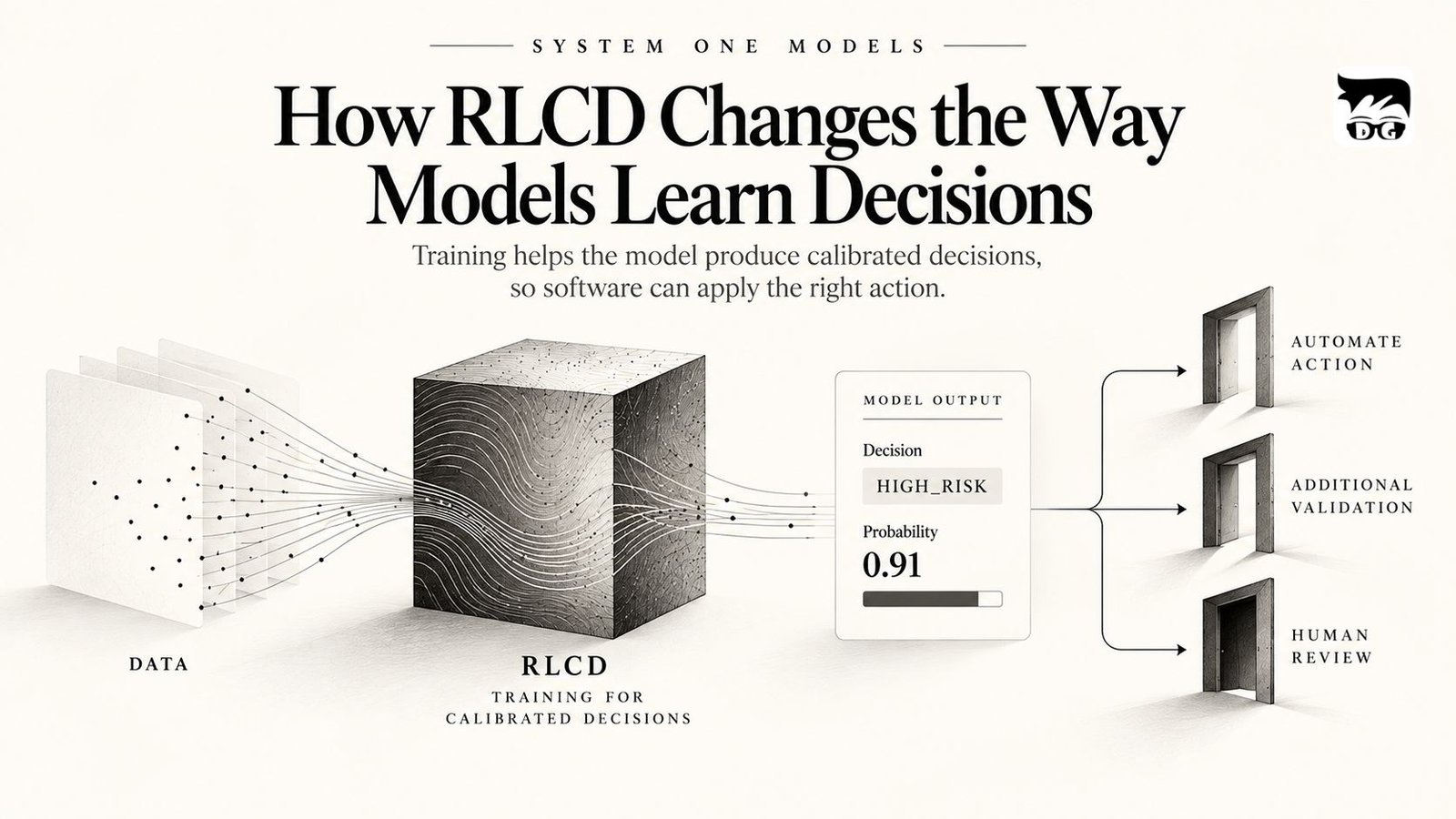
The previous article examined why probabilistic decisions matter once intelligence becomes part of software execution. A model can return a structured decision, but the surrounding application also needs some indication of how strongly that decision is supported.
That raises a deeper question. How does a model learn to produce decisions together with useful uncertainty in the first place?
Machine learning systems are shaped by what their training process rewards. The objective is not a minor implementation detail. It influences the behavior that emerges from the model.
Language models provide a familiar example. A model trained to predict the next token learns to represent and generate language. Post-training can then shape that model toward following instructions, responding helpfully, or satisfying other objectives.
The important point is that the training objective follows the job the model is expected to perform.
If the job changes from producing language for people to producing structured decisions for software, the question becomes whether the training objective should change as well.
TypeSafe's answer is a training method it calls Reinforcement Learning for Calibrated Decisions, or RLCD. TypeSafe positions RLCD alongside a new model architecture and a parallel sampler as part of its System One approach.
RLHF Was Built Around a Human-Facing Interface
Reinforcement Learning from Human Feedback, or RLHF, became an important part of making language models useful to people.
The basic idea is straightforward. A model generates possible responses, humans provide preference signals, and the training process uses those signals to make responses more aligned with what people prefer.
This makes sense when the model's interface is language.
The output is something a person can read, compare, interpret, and respond to.
TypeSafe describes this objective as optimizing for human preference, including responses and conversations that human raters prefer.
That objective helped produce models that are much better at instruction following and interaction.
But software introduces a different requirement.
A program does not evaluate a response in the same way a person does. It needs values it can use in its own execution logic.
It may need to know whether a condition is true, which option applies, how strongly something matches a criterion, or whether the available evidence is strong enough to continue automatically.
The model therefore has a different responsibility. It is not simply generating an answer that a human considers useful. It is producing a decision that another computational system will act upon.
RLVR Changes the Reward Again
Reinforcement Learning with Verifiable Rewards, or RLVR, represents another way of defining what a model should optimize.
The important property is that the output can be checked against a verifiable criterion.
A mathematical answer can sometimes be verified automatically. A program can be executed against tests. A formal result can be checked against known rules.
The reward can therefore be connected to whether the output satisfies the verifier.
That works particularly well when correctness has a relatively clear computational definition.
Many real-world software decisions are different.
Consider questions such as:
- Is this customer request safe to automate?
- Does this security incident require escalation?
- Does this invoice contain a discrepancy?
- Is this request consistent with the customer's intent?
- Should this workflow continue or stop?
These decisions may have reference answers for evaluation, but their correctness is not always available through a simple verifier during training.
The challenge is therefore not only to produce the right decision. It is to produce a decision whose uncertainty is useful when the answer is not obvious.
RLCD Changes What Counts as a Good Decision
This is where TypeSafe's RLCD proposition becomes interesting.
A conventional evaluation can ask whether the answer was correct. A calibrated decision system introduces another question: was the confidence associated with that answer meaningful?
Those are different properties.
Imagine two models that are correct on 90 out of 100 cases.
The first model is uncertain on difficult cases and assigns high confidence mostly when the evidence is strong.
The second model is equally accurate overall but confidently predicts the wrong answer on many of its failures.
Their headline accuracy is identical. Their usefulness inside an automated system may not be.
The first model gives software information about when it should trust the result. The second can make automation more dangerous because its confidence does not reliably distinguish stronger decisions from weaker ones.
TypeSafe describes RLCD as optimizing for calibrated decisions, rather than simply for human preference or programmatically verifiable outputs.
That distinction is central to the System One idea.
The Reward Is No Longer Only About the Answer
Consider a simple decision:
Question: Is this transaction high risk?
Decision: YES
The model has produced the required decision.
Now consider:
Question: Is this transaction high risk?
Decision: YES
Probability: 0.91
The second result contains another dimension of information.
The probability does not determine what the application should do. It gives the application something it can use when determining what to do.
Conceptually, the interface changes from:
Conventional decision objective:
State → Decision → Reward
to something closer to:
Calibrated decision objective:
State → Decision + Uncertainty → Reward
The distinction matters because a model intended for software automation may need to learn not only which decision is correct, but how its confidence should relate to the reliability of that decision.
This is the conceptual motivation behind calibrated decision training. It should not be read as a reconstruction of TypeSafe's private training implementation. TypeSafe publicly identifies RLCD as its training method, but its public launch material does not provide enough detail to reproduce the complete reward formulation or training procedure.
Calibration Becomes Part of the Learning Problem
Calibration is not simply a number added after a model has finished learning.
Suppose a model assigns approximately 80 percent confidence to a large collection of decisions. If those probabilities are well calibrated, roughly 80 percent of those decisions should be correct over a sufficiently large and representative set.
Now suppose the same model assigns 95 percent confidence to many decisions that are correct only 75 percent of the time. The model may still have useful predictive ability, but its confidence is misleading.
That matters when software uses confidence to determine what happens next.
Example:
Confidence > 0.90 → eligible for automated action
Such a threshold only becomes meaningful if the underlying confidence signal has a reasonably stable interpretation.
This creates a different learning requirement. The model needs to learn not only a decision boundary, but a useful representation of its uncertainty around that decision.
Why This Matters More for Software Than for Chat
A human can often compensate for uncertainty through interpretation.
A person reading, "This transaction appears suspicious, but I am not entirely certain," can decide whether to investigate further.
Software cannot infer that nuance unless the uncertainty is represented in a form it can process.
| Language-oriented output | Decision-oriented output |
|---|---|
| This looks like fraud. | FRAUD + probability: 0.91 |
| Requires interpretation | Can participate directly in policy logic |
| Uncertainty is implicit | Uncertainty is represented explicitly |
The second representation can participate directly in a software policy.
Illustrative policy:
> 0.95 → Block
0.70–0.95 → Review
< 0.70 → Continue
Those thresholds are illustrative. The appropriate values depend on the application, the cost of errors, and the consequences of automation.
The important architectural change is that the model has exposed a signal that software can reason about.
From Prediction to Policy
A probability becomes operationally useful when it participates in a policy.
Consider a customer service workflow. A model may determine whether a request can be resolved automatically. The surrounding application can then decide what happens based on both the decision and its confidence.
| Model decision | Confidence | Software policy |
|---|---|---|
| Safe to resolve automatically | High | Continue automation |
| Safe to resolve automatically | Low | Request review |
| Requires escalation | High | Route to specialist |
| Requires escalation | Low | Apply additional checks |
The model does not need to contain every business rule surrounding the decision.
The application can remain responsible for policy.
This creates a useful separation:
The model supplies semantic judgment. The software supplies operational policy.
That separation becomes especially important as workflows become more complex.
Why Hard Thresholds Are Not Enough
A threshold can make a probabilistic system easier to implement, but the threshold itself does not make the probability meaningful.
If a model reports 95 percent confidence while being correct only 75 percent of the time in the relevant operating environment, a rule such as confidence > 0.90 creates a false sense of precision.
The software rule may be completely deterministic. The assumption behind the rule is not.
This is why calibration matters before confidence thresholds become part of production logic.
Important distinction: A deterministic policy built on an unreliable probability does not become reliable simply because the policy itself is deterministic.
The Difference Between Learning a Decision and Learning Its Uncertainty
Consider a Noul question:
Question: Is this transaction suspicious?
There are at least two different learning objectives.
Objective 1: Learn to predict YES or NO.
Objective 2: Learn to predict YES or NO together with a probability that has meaningful aggregate interpretation.
The second objective contains an additional requirement.
The numerical estimate has to mean something across many cases.
If decisions assigned roughly 0.87 confidence are correct only 60 percent of the time, the number does not provide software with a dependable signal.
This is why calibrated decision-making is different from simply attaching probabilities to model outputs.
The probability itself becomes part of what needs to be learned correctly.
RLCD Fits the Decision Primitive Model
The fourth article established three decision primitives. Noul represents a yes-or-no judgment, Choice selects from a defined set, and Score represents a level on a scale.
These primitives define the shape of the decision.
The fifth article then examined the uncertainty associated with those decisions.
This article connects that uncertainty to training.
Decision stack:
Decision Primitive → Decision → Probability / Confidence → Software Policy → Action
Training sits beneath the entire chain.
Training objective:
Training → Decision Quality + Uncertainty Quality → Software Policy
TypeSafe's public API and workflow evaluations reflect this decision-oriented structure. Its API supports Noul, Choice, and Score questions, while its workflow evaluations describe decomposing automation tasks into narrower intelligent judgments and programmatic rules.
The training objective therefore becomes relevant to the entire computational contract.
More Intelligence Alone Does Not Solve the Problem
It is tempting to interpret this as a simple race toward more capable models.
But decision quality and uncertainty quality are not identical.
A more capable model may improve its accuracy while remaining poorly calibrated. A model may also know the correct answer frequently while failing to recognize when the evidence is weak.
For software automation, those are different properties.
| Model | Accuracy | Calibration |
|---|---|---|
| Model A | 90% | Poor |
| Model B | 88% | Strong |
The better system depends on the workflow.
If every incorrect decision has the same cost and the application always needs an answer, raw accuracy may dominate.
If the application can defer uncertain cases to another process or a human, a slightly less accurate but better calibrated model may be more useful.
The relevant objective is therefore not simply to make the model more intelligent. It is to make the model useful for the decision the software actually needs to make.
Why the Training Objective Follows the Interface
A model's interface establishes what the surrounding system expects from it.
A language model exposes a language interface.
A decision-oriented model exposes a decision interface.
If the interface is:
Generate text
then qualities such as fluency, coherence, instruction following, and human preference become central.
If the interface is:
Return a typed decision with meaningful uncertainty
then other properties become important:
- Decision accuracy
- Calibration
- Consistency
- Structured outputs
- Composability
- Latency
- Predictable behavior
The model is being optimized for a different computational role.
TypeSafe presents RLCD as one part of a broader stack that includes a new model architecture and parallel sampler.
That matters because training should not be viewed as an isolated optimization technique. It is part of designing the model around the system in which it will operate.
RLCD Does Not Automatically Guarantee Reliability
This distinction is important.
A training objective designed around calibration does not prove that every resulting model will remain well calibrated across every environment.
Several questions remain open.
- How is calibration measured during training?
- What exactly is rewarded?
- How are ambiguous decisions handled?
- How does calibration behave when production data differs from training or evaluation data?
- Does calibration transfer across domains?
- How does calibration vary across Noul, Choice, and Score?
- Does improving calibration introduce trade-offs with raw accuracy?
- How much of observed workflow reliability comes from the model itself, and how much comes from the surrounding programmatic structure?
These are not objections to RLCD. They are the questions required to evaluate whether a training objective produces a reliable production component.
Evidence boundary: TypeSafe's public material establishes RLCD as its stated training approach, but does not expose enough implementation detail to independently reconstruct the complete method. The existence of RLCD is documented, while the effectiveness and generality of its specific implementation remain empirical questions.
Training Becomes Part of the Computational Contract
In conventional software, an API contract is explicit.
A function might return:
Result<T>
and the developer knows what the type represents.
A language model gives software something much less constrained. The model may return a sequence of tokens that the application has to interpret.
System One Models propose a different relationship:
Decision<T> + Uncertainty
The type describes what kind of judgment the model is returning.
The probability provides information about the strength of that judgment.
The software then decides how to use both.
For that contract to be useful, the model has to be trained for the properties that make the contract meaningful.
When the interface changes, the training objective may need to change with it.
RLCD Is More Interesting as a Design Direction
The most interesting question is not whether RLCD becomes a widely adopted acronym.
It is whether the underlying idea becomes a broader design pattern.
What happens when models are trained around the way software consumes intelligence rather than the way humans consume language?
That could mean treating properties such as calibration, structured decisions, consistency, and composability as first-class model requirements.
The shift would be subtle but important.
Instead of asking how language models can become better at producing answers, the engineering question becomes how a model should be trained when its output is going directly into another software system.
That is a different optimization problem.
What We Still Do Not Know
Several questions remain open before the broader training proposition can be evaluated independently.
- How exactly does RLCD define calibrated decision quality?
- How are probability estimates incorporated into the training reward?
- How are ambiguous or inherently subjective decisions handled?
- How stable are calibrated probabilities under distribution shift?
- Does calibration generalize across domains, or does it require domain-specific adaptation?
- How do accuracy, calibration, latency, and cost trade off against one another?
- Can independent researchers reproduce the reported behavior?
- Is RLCD a broadly useful training paradigm, or is its value closely coupled to TypeSafe's System One architecture and decision interface?
These questions move the discussion from the existence of a new training method toward the harder question of whether it produces a dependable engineering property.
The Deeper Shift
The important change is not simply that a model can return a probability. Probabilistic outputs have existed in machine learning for a long time.
The more interesting shift is the possibility that probabilistic semantic decisions become a deliberate computational interface between intelligence and software.
In that arrangement, the responsibilities become clearer.
The model provides a structured judgment and an estimate of uncertainty.
The application determines what level of uncertainty is acceptable.
The workflow determines what happens next.
Training determines how reliably the model can perform the first part of that contract.
That creates a different relationship between intelligence and execution.
The model learns the judgment. The software owns the policy.
System One Models are interesting because the proposed architecture, output types, uncertainty representation, and training objective are all oriented toward this relationship.
The Next Question
If a model is trained to produce typed, probabilistic decisions rather than language, the next question moves beyond the model itself.
What changes for the engineers who build software around that intelligence?
A language model is usually integrated through prompts, messages, parsers, tool calls, and application logic.
A decision-native model suggests a different kind of component.
The intelligence arrives already shaped for the program that consumes it.
The next article therefore moves from training to engineering and examines what typed intelligence could change about software architecture.
AI Developments Database
This article is part of DataGuy's ongoing tracking of developments in artificial intelligence, model architectures, and machine-native intelligence. Relevant developments and source material are tracked through the AI Developments Database.
Sources
- TypeSafe: Introducing System One Models and Jev
- TypeSafe AI
- TypeSafe API Documentation
- TypeSafe Workflow Evaluations
- TypeSafe Customer Service Workflow Evaluation
- TypeSafe Invoice Processing Workflow Evaluation
- TypeSafe Security Incident Workflow Evaluation
Editorial note: TypeSafe-specific descriptions of RLCD, its relationship to RLHF and RLVR, and claims about calibrated decisions are presented as TypeSafe's public position. The broader discussion of training objectives, calibration, uncertainty, and software architecture is editorial analysis. The public material does not provide enough implementation detail to independently reconstruct the complete RLCD training procedure, so this article deliberately does not infer undisclosed mechanics.