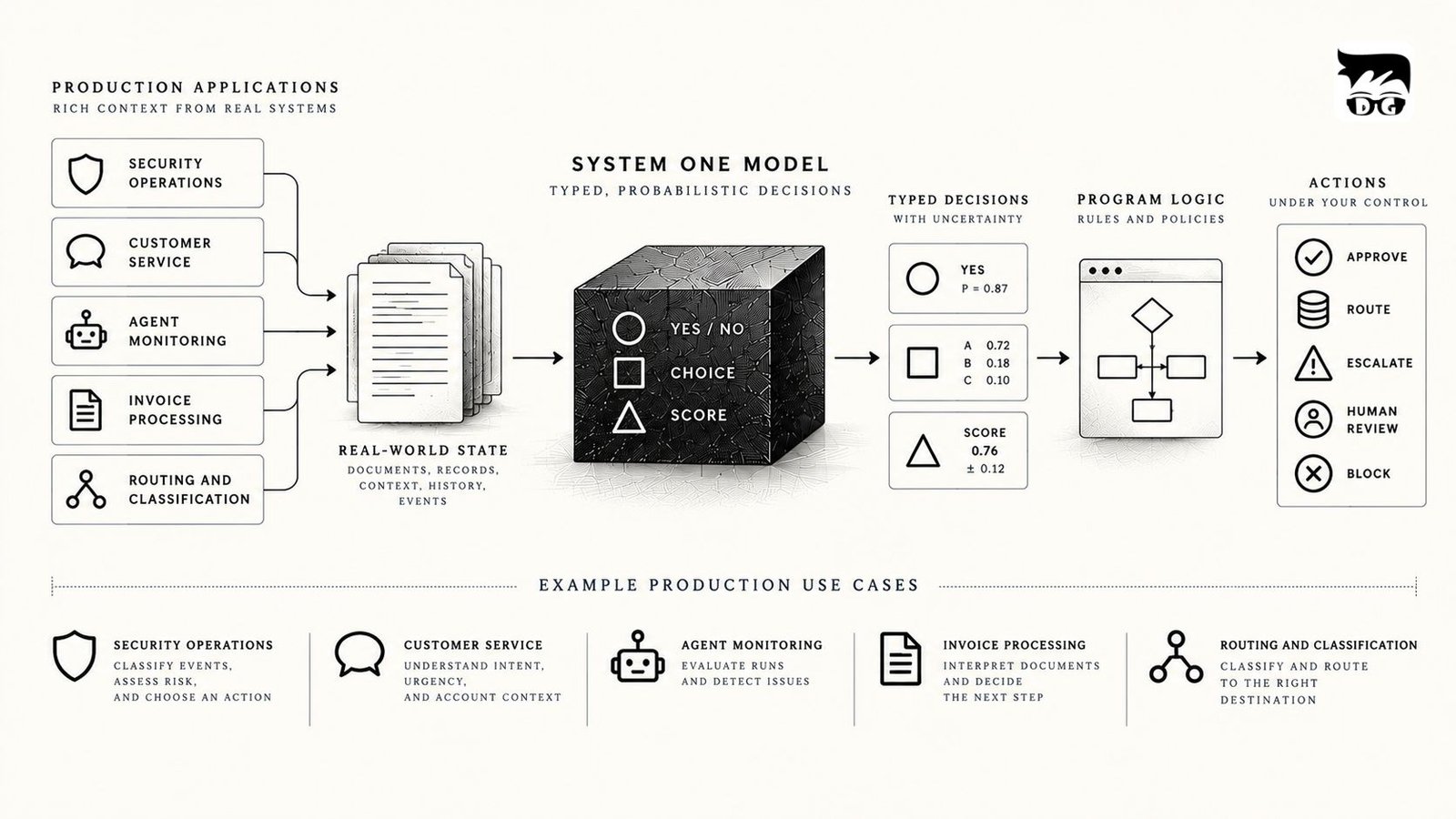
The production value of a model architecture depends less on whether it is technically different and more on whether its computational characteristics match the problem the software needs to solve. For System One Models, that distinction is particularly important because the architecture is designed around typed probabilistic decisions rather than open-ended language generation.
TypeSafe describes Jev as taking unstructured state and producing typed probabilistic decisions that software can use directly, with public primitives for yes-or-no judgments, choices from defined sets, and scores. That creates a different production boundary from the conventional language-model pattern, where an application sends a prompt and then interprets generated language before applying its own logic.
The strongest production opportunities therefore appear where the application already has a defined decision space, the input contains enough contextual information to require semantic judgment, and the resulting decision can be combined with deterministic program logic. The question is not whether System One Models are better than language models in general, but which software problems become better suited to learned intelligence when the output is a bounded, typed decision.
The Production Boundary
A conventional language-model application often places generated language between the model and the application logic. The model interprets the prompt, generates text, and the surrounding software then has to extract whatever information is required for execution.
Application → Prompt → Language Model → Text → Parsing → Application Logic
A System One workflow proposes a different interface in which application state enters a decision model and the result is returned as a typed decision together with probability before program logic determines the appropriate action.
Application State → Decision Model → Typed Decision + Probability → Program Logic → Action
The distinction becomes useful when the application already knows what kind of answer it needs. A security system may not need a paragraph explaining an alert; it may need to determine whether an event is unauthorized, how strong the evidence is, and whether the appropriate response is notification, escalation, containment, or human review. TypeSafe's published security workflow follows this general pattern by asking several narrow questions about the alert and surrounding records before combining the resulting decisions with machine importance and environmental information in code.
The model therefore supplies semantic judgment while the application retains control over policy and execution. That separation is central to understanding where the architecture may fit in production.
The First Condition: A Bounded Decision Space
The most natural production fit begins with a problem whose possible outputs are already known. A customer-service system may need to determine whether a case should be refunded, frozen, routed, escalated, reviewed, or closed. An invoice system may need to decide whether an invoice should be paid, scheduled, held, corrected, disputed, or sent for approval. A security system may need to determine whether an event should trigger notification, escalation, containment, or additional investigation.
These decisions differ in domain but share an important property: the software already knows what constitutes a valid outcome. The model does not need to invent the interface or generate an arbitrary response. It needs to interpret the available state and select an appropriate value within a defined decision space.
This is closely aligned with TypeSafe's published workflow evaluations, which use Noul, Choice, and Score to represent different forms of bounded judgment. The production advantage of such an interface comes from making the decision type explicit before inference occurs, allowing the surrounding software to consume the result without treating generated language as the primary computational interface.
Rich State, Narrow Decisions
A bounded decision does not imply a simple input. Many production decisions are difficult precisely because the information required to make them is distributed across documents, records, histories, conversations, system events, and contextual state.
A security workflow may need to consider an alert alongside asset information, open tickets, registered devices, maintenance activity, and authorization records. An invoice workflow may require invoice details, purchase orders, contracts, vendor records, previous invoices, correspondence, delivery evidence, and approvals. A customer-service system may need the conversation history together with customer history, subscription information, recent charges, refunds, card status, and pending requests.
The pattern is therefore not simple input, simple output. It is closer to complex state, bounded decision. The model performs the semantic interpretation that is difficult to encode entirely through deterministic rules, while the application defines the type of decision that can emerge from that interpretation.
Complex state in → bounded decision out
This is one of the clearest distinctions from the conversational interface of a general language model, where the output itself remains language and the application must determine how that language maps onto program state.
Decomposable Workflows
The architecture becomes more interesting when a production task can be divided into several relatively narrow judgments rather than requiring one model response to perform the entire computation. This allows deterministic operations to remain in software while semantic questions are isolated into decision nodes that can be evaluated and composed independently.
Consider an agent-monitoring workflow. The system may need to determine whether an agent performed an irreversible action without permission, whether the task was completed, whether the customer was satisfied, whether there was an expectation gap or overt failure, and whether human review is required. TypeSafe's Agent Trace Observability workflow follows this general structure and then combines the individual judgments into operational outcomes.
The advantage is not simply that the task has been divided into smaller prompts. The workflow establishes explicit computational boundaries around each judgment. That can make the system easier to inspect, evaluate, modify, and connect to downstream policy because each decision exists as a defined component within the larger graph.
Decomposition therefore becomes part of the production architecture rather than merely an evaluation technique. Its usefulness will depend on how naturally the underlying business process can be separated without losing important dependencies between decisions.
Deterministic Software Should Remain in Control
A System One workflow does not become more useful by making every part of the application intelligent. In many production systems, the strongest architecture is likely to keep deterministic operations in code and introduce model inference only where interpretation, classification, or judgment is genuinely required.
Invoice processing illustrates the distinction clearly. Calculating totals, comparing dates, matching account identifiers, checking structured statuses, and applying explicit numerical rules are operations that software can perform reliably without model inference. Determining whether documentation adequately explains a discrepancy, whether an invoice appears suspicious, or whether the available evidence supports escalation involves a different kind of reasoning.
TypeSafe's published invoice workflow separates these categories, using programmatic computation for deterministic operations while applying model judgments to semantic questions. This division keeps policy and calculation under software control while using learned intelligence where rules alone may be insufficient.
Use code where the rule is sufficient; use intelligence where judgment is required.
This distinction is important for production economics as well as reliability. Sending deterministic work through a model introduces cost and uncertainty without necessarily adding useful capability, while forcing ambiguous semantic decisions into rigid rules can make the system brittle.
Uncertainty Must Have a Role in the Workflow
Some production decisions cannot be represented adequately by a discrete answer because the appropriate action depends on how strongly the available evidence supports that answer. This is where the probabilistic output of a System One Model becomes particularly relevant.
Consider a fraud-detection workflow that produces a fraud probability of 0.97. The application might automatically stop the transaction. A probability of 0.72 might instead trigger additional verification, while a substantially lower value could allow the transaction to proceed. The model has supplied the judgment and its estimated uncertainty; the application has determined what those values mean operationally.
Estimate → Interpret Uncertainty → Apply Policy → Act
This creates a production interface that is different from a conventional classifier whose output is consumed as a hard label. It also places greater responsibility on the quality of calibration, because the usefulness of a probability depends on whether it provides a reliable signal about the likelihood of the underlying condition.
TypeSafe presents calibrated confidence as a central property of System One Models, which makes uncertainty particularly relevant to production workflows where different confidence levels can legitimately lead to different operational responses.
Where the Architecture May Fit Naturally
The conditions above point toward several production categories where System One Models may be particularly relevant. These are not exclusive application areas, and the architectural fit still depends on the specific workflow, but they share combinations of rich contextual state, bounded decisions, repeated workloads, deterministic policy, and measurable outcomes.
Security Operations
Security systems continuously process alerts together with device information, authorization state, tickets, maintenance records, and other contextual signals. Many resulting decisions are bounded: classify the event, assess its severity, determine whether it requires escalation, and select an appropriate response. TypeSafe's published security workflow reflects this structure, using narrow semantic judgments that are subsequently combined with programmatic information.
Customer Service
Customer service involves repeated semantic judgments about intent, urgency, frustration, eligibility, risk, and escalation. A language model may remain the appropriate component for generating the final conversational response, while a System One component could evaluate the state of the interaction and establish the decisions and constraints that govern what the application is allowed to do. TypeSafe's customer-service workflow illustrates this decision-oriented control layer.
Agent Monitoring
As software agents perform increasingly complex tasks, systems need to evaluate their behaviour after or during execution. Whether an agent completed its task, crossed a permission boundary, created an operational risk, or requires human review are all bounded judgments that can be represented as decisions. A System One component could therefore operate around a language-model-based agent rather than replacing the agent itself.
Invoice and Financial Operations
Financial operations combine structured records and deterministic rules with documents and business context that often require interpretation. A workflow can keep calculations, account matching, dates, and explicit policy conditions in code while using semantic decisions for ambiguous evidence. The result can then feed directly into actions such as payment, hold, dispute, correction, or escalation.
Classification and Routing
Many enterprise systems continuously determine where an item should go next: a support ticket needs a queue, a transaction needs a review path, a document needs a processing category, and a security event needs an escalation route. When the destination set is known, Choice-style decisions provide a natural representation of the problem. The production value comes not merely from classification, but from classification that directly controls software execution.
Latency-Sensitive Applications
Lower latency becomes particularly valuable when intelligence sits inside an interactive or operational control loop. TypeSafe describes Jev as targeting substantially lower response times than frontier language models for System One-shaped queries and identifies real-time applications among its intended use cases. These remain TypeSafe's claims and require independent validation across representative production environments, but the underlying production criterion is straightforward: the intelligence component must fit within the application's latency budget.
Where the Fit Becomes Weaker
The same properties that make System One Models attractive for bounded decisions also define their limitations. Open-ended writing, creative generation, exploratory conversation, unconstrained translation, broad explanation, and many forms of code generation do not naturally reduce to a small predefined decision space. These workloads depend on expressive language, where the output is itself the primary product rather than an intermediate value consumed by program logic.
A System One Model could still participate in such systems, but it would not necessarily be the primary generation layer. A creative application might use decision-native intelligence to classify or route a task while relying on a language model for generation. A research assistant might use structured decisions for risk, prioritization, or source selection while retaining language generation for synthesis and communication.
This suggests that the most useful production interpretation is not that one model class replaces another, but that different forms of intelligence can occupy different positions within the same software architecture.
Language models generate. System One Models make bounded judgments. Software orchestrates.
The Hybrid Architecture
A hybrid system makes the complementary roles more explicit. Consider a customer-service application in which the language model handles the conversation while a System One component evaluates intent, urgency, fraud risk, policy eligibility, and escalation requirements. Program code then determines which actions are permitted, and the language model generates the response within those constraints.
Customer State → System One Decisions → Program Policy → Language Model → Response
This architecture separates three responsibilities that are often collapsed into a single prompt: semantic decision-making, operational policy, and language generation. The decision layer provides explicit state to the application, the policy layer remains deterministic and auditable, and the language layer retains the flexibility required for human communication.
The same pattern could apply to agent systems, where a language model performs the underlying task while a decision-oriented model evaluates permissions, task completion, risk, or the need for human intervention. It could also apply to financial systems in which semantic document interpretation feeds deterministic accounting and payment rules.
The value of the hybrid approach depends on whether separating these responsibilities produces measurable improvements in reliability, cost, latency, observability, or control. It should therefore be evaluated as an architecture rather than assumed to be superior simply because the components are specialized.
The Strongest Production Pattern
Across these examples, a common production pattern emerges. The architecture becomes more compelling when an application has rich contextual state, a bounded decision space, repeated decision volume, decomposable judgments, deterministic rules that should remain in software, meaningful uncertainty, and outcomes that can be observed and measured.
| Condition | Why It Matters |
|---|---|
| Rich contextual state | The model can interpret information that is difficult to encode entirely through rules. |
| Bounded decisions | The output can be represented as a known type. |
| Repeated decisions | Small improvements can accumulate across large volumes. |
| Decomposable judgments | The workflow can isolate individual reasoning tasks. |
| Deterministic rules | Software can retain control over policy and calculation. |
| Meaningful uncertainty | Probability can influence downstream action. |
| Tight latency requirements | Lower-latency inference can have direct application value. |
| High decision volume | Per-decision economics become significant. |
| Observable outcomes | Workflow performance can be measured rather than inferred. |
| Clear escalation paths | Uncertain cases can be routed to additional validation or human review. |
When several of these conditions appear together, the case for a decision-native component becomes stronger. When most are absent, the additional architecture may not provide enough value to justify its complexity.
The Decision Is Not the Product
A System One Model does not create a production system by itself. The model is one component within a larger architecture in which the workflow determines how the component is used, policy determines what the application does with its output, and the surrounding system determines the context in which the decision operates.
A strong model can therefore be undermined by a poorly designed workflow, an inappropriate decision type, an unsuitable confidence threshold, incomplete application state, or a policy that does not reflect the actual business requirement. These are not necessarily model failures, but they can still produce incorrect production outcomes.
This means System One Models do not remove software engineering from intelligent systems. They make the boundary between intelligence and software more explicit, which can improve control and observability but also requires teams to design decision types, workflows, thresholds, escalation paths, and monitoring deliberately.
From Model Selection to Architecture Selection
The production question therefore becomes broader than choosing the model with the strongest general benchmark performance. The relevant choice is increasingly between computational architectures that solve different classes of problems.
An open-ended research assistant may benefit from a language model because language generation is central to the task. A document-generation system may have the same requirement. A high-volume fraud workflow, by contrast, may benefit from a bounded probabilistic decision component if the application already has a defined action space and can evaluate the resulting decisions at scale.
An agent-monitoring system may use both architectures, with a language model performing the task and a System One component evaluating the agent's behaviour. A security workflow may place more of its intelligence inside structured decisions, while a creative application may have little reason to introduce a decision-native model at all.
The practical consequence is a shift from asking which model is smartest? toward asking which computational architecture best matches the problem? That is a more useful basis for production design because it considers the role intelligence needs to play rather than treating every software problem as the same inference task.
What Production Still Needs to Prove
The production case for System One Models is plausible in several problem classes, but the evidence remains early. The most important unresolved question is generalization: whether the reported advantages persist across independently designed enterprise workflows rather than only within the examples published by the model developer.
TypeSafe's current public evaluations cover four workflows created by its capabilities team, and the company acknowledges that workflow construction can introduce some bias. The evaluation also uses model-derived reference labels rather than universally established ground truth. These conditions do not invalidate the results, but they limit how broadly the current evidence can be interpreted.
Other questions concern the architecture itself. It remains important to understand how the approach behaves as decision spaces become larger, how probabilities propagate through longer decision graphs, how multiple uncertain decisions interact, and how much engineering effort is required to decompose a real enterprise process. The economic question is equally important: at what point does designing and maintaining the workflow cost more than the intelligence it is intended to make cheaper or more reliable?
Another unresolved issue is attribution. If a structured workflow performs substantially better than a single language-model prompt, how much of the improvement comes from the underlying model and how much comes from better decomposition, deterministic computation, and explicit policy? Production evaluation needs to separate these effects if the broader architectural claim is to be established.
The Deeper Shift
The most interesting consequence of System One Models may not be access to another specialized model. It may be the possibility of representing intelligence differently inside software.
Traditional software is built around deterministic functions, while language models introduced a powerful but relatively unconstrained interface between software and learned intelligence. A System One Model proposes another interface in which the application provides contextual state and receives a defined decision together with an estimate of uncertainty, after which ordinary program logic determines how that decision affects execution.
Defined state → Typed decision → Probability → Program logic
The model remains probabilistic, so it does not become equivalent to a deterministic software function. At the same time, the output is constrained enough to behave more like a software component than an open-ended language interface. That combination of probabilistic intelligence, explicit types, and programmatic composition is the production hypothesis that now needs to be tested across a much wider range of systems.
The Next Question
Production applications reveal where System One Models may fit, but individual use cases are only the beginning. Security, customer service, invoice processing, agent monitoring, routing, and real-time decision systems appear different at the surface level, yet several share the same underlying structure: rich application state enters a series of bounded semantic decisions, uncertainty informs policy, and software determines the final action.
State → Decisions → Uncertainty → Code → Action
If that pattern continues to appear across independent applications and industries, System One Models could become more than a specialized implementation from a single company. The more consequential question would then be whether a broader ecosystem could emerge around decision-native intelligence, with shared primitives, tooling, evaluation methods, workflows, and application architectures.
What happens if System One Models become a category rather than a single product?
AI Developments Database
This article is part of DataGuy's ongoing tracking of developments in artificial intelligence, model architectures, and machine-native intelligence. Relevant developments and source material are tracked through the AI Developments Database.
Sources
- TypeSafe: Introducing System One Models and Jev
- TypeSafe AI
- TypeSafe: Workflow Evals
- TypeSafe: Security Incidents Workflow
- TypeSafe: Agent Trace Observability Workflow
- TypeSafe: Invoice Processing Workflow
- TypeSafe: Customer Service Workflow
- TypeSafe API Documentation
Editorial note: TypeSafe-specific descriptions and claims in this article are based on its current public materials. The broader discussion of production fit, architectural boundaries, hybrid systems, and potential applications is DataGuy editorial analysis. Performance and production advantages described by TypeSafe should be treated as vendor claims unless independently reproduced across representative production environments.