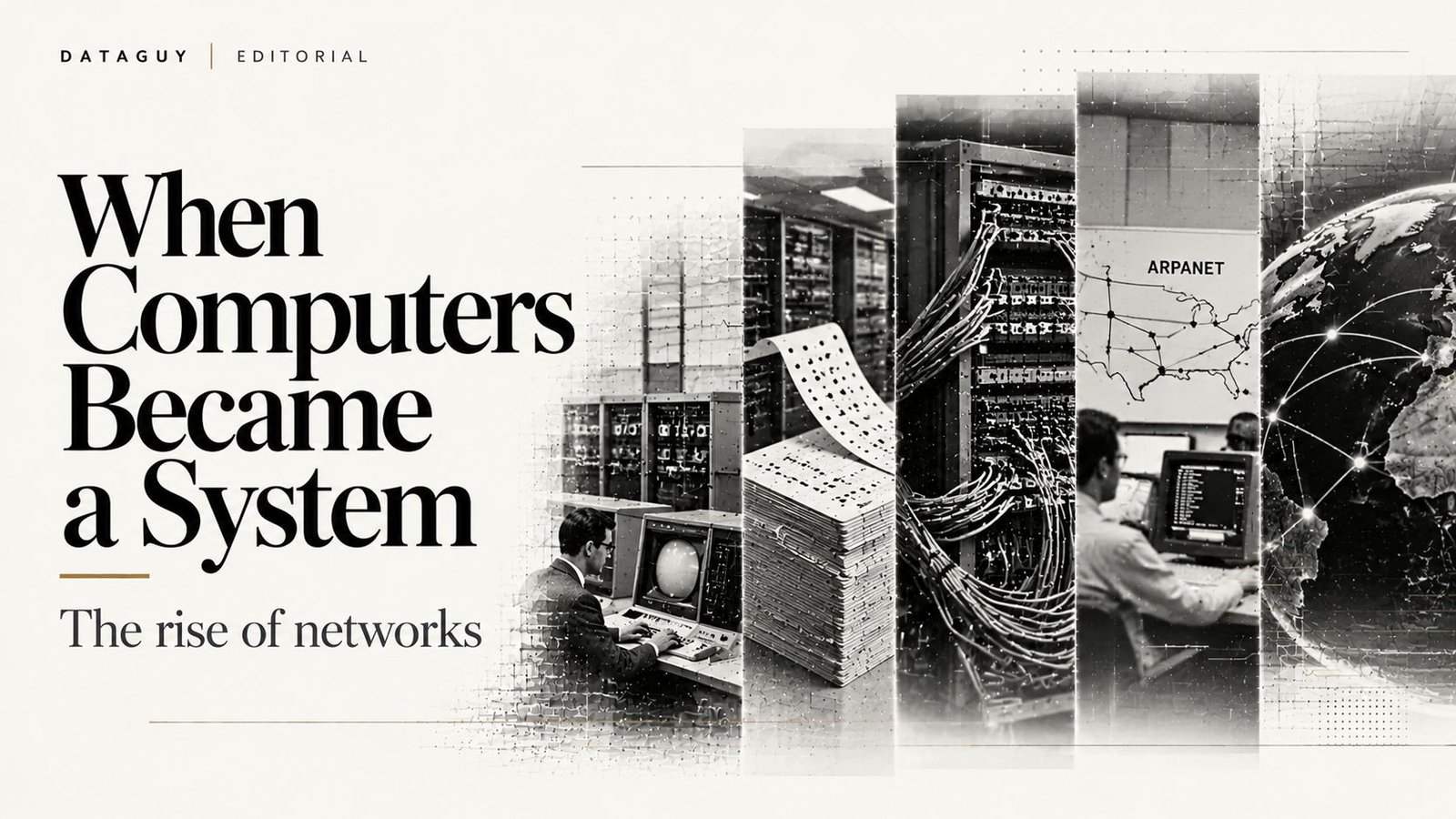
Computing became a system when useful capability began to extend beyond the boundaries of a single machine. Time-sharing allowed many people to use one computer; communication networks connected separate computers; internetworking allowed unlike networks to exchange information; and shared protocols made this arrangement capable of growing. The central change was not simply more computing power. It was the organization of computing across machines, people and institutions.
The machine becomes shared
Computing time becomes a resource that can be distributed
Early computers were expensive, scarce resources. Many operated in batch mode: users prepared jobs, submitted them and waited for results. Access to the machine was mediated by schedules and specialist operators, and a computer's capacity could sit unused while people waited for their turn.
Time-sharing changed the relationship between people and the machine. By rapidly switching the processor among active users and processes, a system could give each user the experience of an ongoing session. The computer was no longer simply executing one job after another; it was managing concurrent demands on processing time, memory and input/output.
This depended on system software that allocated resources, protected one user's work from another's and coordinated access to the machine. The operating system became an essential part of the service. It did not remove the computer's physical limits; it organized those limits so that many people could use the same underlying capability.
A defining framework
The System Shift
The progression is not a sequence in which each layer replaces the one before it. Each adds a new way to organize capability: first within a machine, then among users, then across connected machines and networks.
From shared computers to connected computers
The next problem was moving information between machines
Sharing a computer solved a problem of access, but it did not allow a user to draw easily on a machine located elsewhere. As research institutions and organizations acquired different computers, a new possibility emerged: connect those systems so that information and computing resources could move beyond the room or institution where they originated.
Computer communication presented challenges unlike ordinary voice calls. Data traffic was often irregular, and a continuous reserved circuit could use network capacity inefficiently. Packet switching offered another approach. Messages could be divided into packets that shared communication links with other traffic, then be forwarded through the network toward their destinations.
Packet switching did not make communication effortless. It shifted important responsibilities to the network: packets needed addresses, routes, and ways to cope with delays or loss. But it created a flexible basis for connecting many computers without requiring a dedicated physical circuit for every exchange.
ARPANET and the new relationship with distance
A computer no longer had to be the boundary of a task
ARPANET began operating in 1969, linking computers at research sites through packet-switched connections. The early network was limited in scale, but it demonstrated a different relationship between computation and location. A user could reach a remote computer, exchange data with another site and make use of resources that were not physically nearby.
The significance was larger than the act of sending a message. The network connected systems that had their own hardware, software and local purposes. Communication made them participants in a wider environment without turning them into one identical machine.
That shift also changed what reliability meant. A standalone computer might be assessed largely through its own operation. A networked task depended on endpoints, communication links, network equipment and the software coordinating the exchange. The capability increasingly belonged to the arrangement as a whole.
Internetworking: connecting unlike networks
A larger system needs common rules, not identical components
Early networks used different transmission technologies and conventions. Connecting them into a larger environment could not depend on making every network physically identical. It required a common way to move information across boundaries while allowing each network to retain its own internal design.
Internetworking provided this additional layer of abstraction. Work by Robert Kahn, Vint Cerf and many other researchers helped shape the protocols that became TCP/IP. Rather than constructing one enormous network, the architecture made it possible for separate networks to exchange packets according to shared rules.
This distinction is central to the Internet's design. Interoperability does not mean that every participating system has the same internal machinery. It means that systems can cooperate at agreed interfaces. Their differences remain, but those differences no longer prevent them from participating in a larger whole.
Standards become infrastructure
Protocols coordinate systems that no single organization fully controls
Networks depend on protocols for addressing, packet handling and communication between layers. These rules allow equipment and software from different developers to interoperate. A component can change internally while continuing to work with other components, provided it preserves the relevant interface and behaviour.
Standards are therefore not paperwork added after the engineering is complete. They reduce the cost of coordination. They allow independent organizations to build compatible systems, share technical knowledge and extend the network without redesigning every existing part. The Internet's Request for Comments process also provided a continuing record through which technical proposals could be discussed, revised and documented.
Shared protocols do not eliminate the need for physical infrastructure or governance. Connectivity still depends on cables, radio links, routers, power, maintenance, addressing, operational decisions and institutions. The apparent simplicity of a network service rests on many layers of agreement and upkeep.
The economics of shared capability
Computing becomes a service rather than only an owned machine
Time-sharing and networking changed how organizations could obtain computing capability. Instead of requiring every user or department to own a complete computer, an organization could provide shared access to centralized resources or connect people to remote systems. Commercial systems such as IBM's SABRE showed how connected terminals and central computing could support time-sensitive operations at organizational scale.
This model made computing easier to distribute, but it also introduced management responsibilities. Operators had to allocate capacity, maintain systems, manage identities and permissions, protect data, and respond to outages. As the number of users and connected components grew, the surrounding operational arrangements became part of the technology's value.
The broader lesson is that infrastructure is not defined only by physical size. It emerges when a capability becomes dependable and available to multiple users through systems of access, coordination and maintenance. The machine remains necessary, but the service depends on more than the machine.
When the system becomes the unit of capability
More useful outcomes depend on several components working together
Once computers can exchange information and share resources, a task may span multiple machines. Data may be stored in one location and processed in another. A service may rely on remote systems, while users collaborate across organizational and geographic boundaries. The effective capability is no longer contained within a single device.
This changes how systems must be designed and evaluated. A network link can fail while both computers remain operational. A remote service can respond slowly. A message can be delayed, lost or received more than once. Distributed systems must account for partial failure, monitoring, retries, timeouts, recovery and the management of state across components.
These mechanisms involve trade-offs. Retrying a request can recover from a temporary interruption but may repeat an operation. Replicating data can improve availability while raising questions about synchronization and consistency. Connectivity expands what systems can do, but it also creates dependencies that must be understood and managed.
The unit of design therefore shifts. The relevant object is often the complete arrangement of computers, networks, protocols, software, data and operators. A fast component cannot guarantee a fast service, and a reliable machine cannot by itself guarantee a reliable distributed system.
Cloud computing extends the systems idea
Capacity is accessed through managed infrastructure
Cloud computing extended this approach by making compute, storage and networking available through managed services and programmable interfaces. Organizations could provision capacity without buying and operating every underlying server directly. The interface appeared simple, while the provider coordinated data centres, physical machines, virtualization, networking, automation and operations.
The cloud is not a departure from the systems idea. It is one expression of it: computing capacity is delivered through a coordinated infrastructure whose physical components are abstracted behind services. The abstraction makes capacity easier to use, but it does not remove the underlying requirements for power, hardware, connectivity, security and maintenance.
It also concentrates dependencies. Availability, cost, data location, security and service design can depend on a provider's architecture and policies. Understanding cloud computing therefore requires attention both to the flexibility visible at the interface and to the industrial system that sustains it.
What lies beneath the network?
Connection depends on layers of coordination
Under a network interface are protocols, addressing, routing, transmission technologies, operating systems and physical links. Beneath these are the computers themselves, their semiconductor devices, precision manufacturing and energy supply. The earlier layers of the series remain present, but they now combine across machines and institutions rather than only inside one device.
This is the distinctive change explored here. A machine can gain capability through better components and architecture. A system gains capability when separate machines can share resources and coordinate their behaviour. A network grows when independent systems can participate without being rebuilt as one uniform structure.
Connectivity is therefore not simply another feature added to the computer. It changes the scale at which computing can be organized, the dependencies that determine reliability and the institutions required to sustain a shared technical environment.
THE ARGUMENT
Computing became a system when the computer stopped being the boundary
The programmable machine made behaviour separable from hardware. Time-sharing made computing shareable. Networks made machines communicative. Internetworking made networks interoperable. Shared protocols allowed the larger arrangement to grow across technical and institutional boundaries.
Each layer added a new form of coordination without replacing the layers beneath it. The result was not one larger computer, but a connected computational environment in which capability could be distributed across many machines and made available as infrastructure.
The next transformation concerns what moves through this environment. As records, transactions, documents, images and signals became digital, connected systems gained a growing machine-readable account of the world.
These institutional histories document the development of time-sharing, packet switching, ARPANET, internetworking and the protocols that enabled separate networks to operate as a connected system.
Computer History Museum: Internet History, 1962–1992 Computer History Museum: Internet History of the 1960s Computer History Museum: Internet History of the 1970s Internet Society: A Brief History of the Internet Internet Society: A Brief History of the Internet & Related Networks