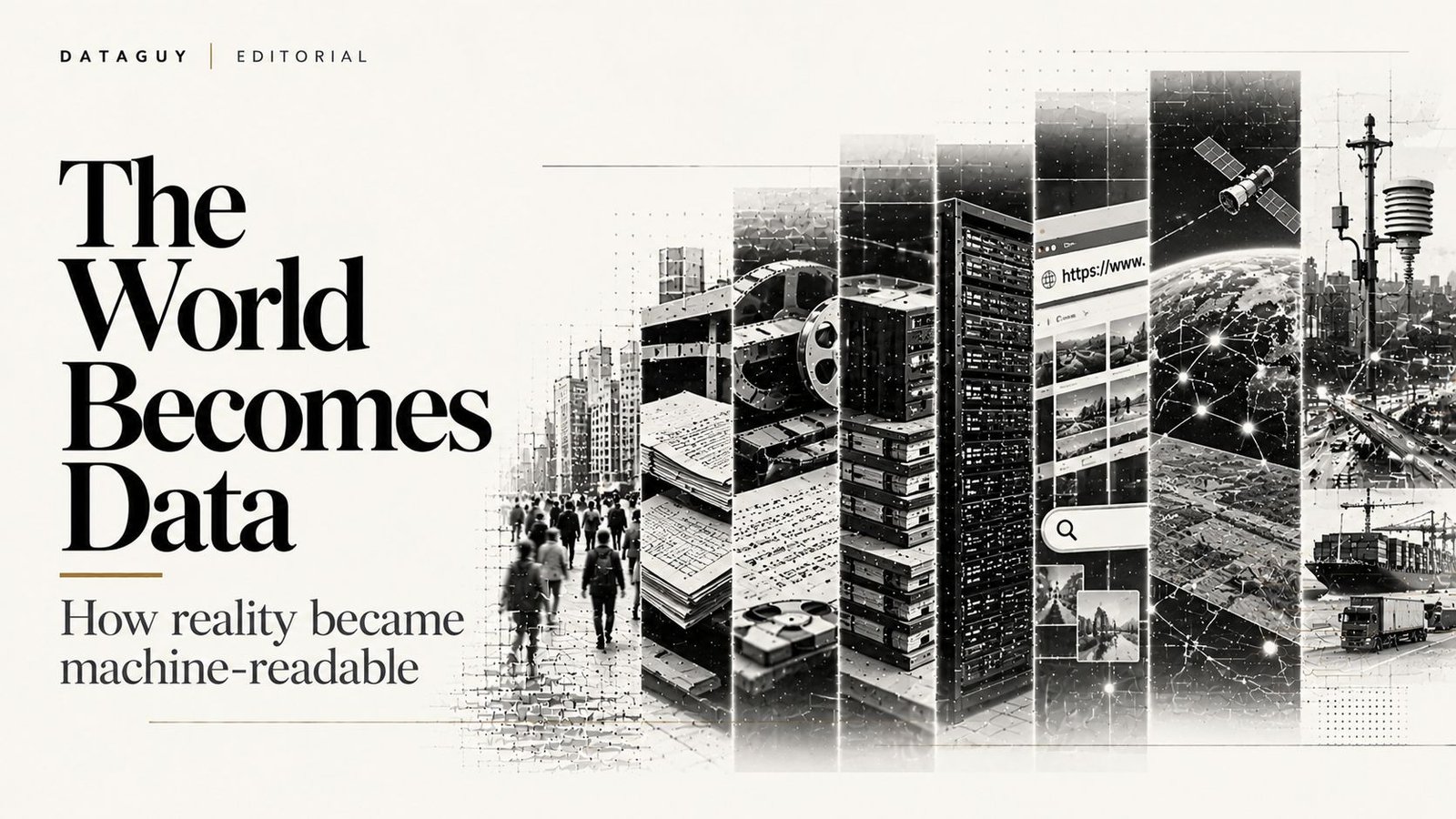
Connected computers created a wider environment for computation, but connectivity alone did not make the world machine-readable. The deeper transformation came as documents, transactions, images, measurements and everyday activity acquired digital representations that could be stored, organized, retrieved and combined. The computer was no longer merely connected to the world. Increasingly, the world was being translated into forms that computational systems could operate on.
The next constraint
A connected system still needs something to represent
The previous essay followed the shift from individual computers to connected systems. Networks allowed machines to exchange information and share resources, but much of the information people and institutions relied on still existed outside those systems. Documents remained on paper, photographs on film, transactions in ledgers, maps in physical form and many industrial observations in local instruments or handwritten records.
The next constraint was representational. For computers to become useful across more of human activity, information needed to be encoded in forms that could be stored, copied, retrieved and processed. This was not a single invention or a clean transition from an analogue world to a digital one. It was an accumulation of practices and technologies: digitization, database systems, enterprise software, digital media, the Web, search, mobile devices and sensors.
These developments did not make reality itself digital. They expanded the parts of reality that could be represented within computational systems.
Digitization changes the object
Information becomes separable from its physical carrier
When a document, photograph, sound recording or measurement is converted into digital form, its representation can be copied without reproducing the original physical object. It can travel through networks, be transformed by software and be combined with other digital representations. Text, images, audio, transactions and measurements may originate in very different contexts, yet digital systems can store and transmit them using common computational infrastructure.
This changes the practical properties of information. A physical record is tied to its medium and location. A digital representation can be duplicated, indexed, transmitted and processed at scale. Those operations do not guarantee that the representation is accurate or meaningful, but they make it possible to work with information in ways that were difficult when it remained locked in separate physical forms.
Digitization therefore did more than increase storage capacity. It made more kinds of information compatible with the existing layers of computation and networking.
Databases create structure
Stored information becomes organized information
A digital collection is not automatically a usable information system. Files can be copied and retained while still being difficult to compare, update or connect. Database management systems addressed a different problem: organizing information so that it could be retrieved and maintained systematically across applications and over time.
The relational model, introduced by Edgar F. Codd at IBM in 1970, was an important step. It represented information through relations and provided a formal way to query those relations. Data could be organized independently of the particular screen, report or program through which someone used it. Applications could work with a shared information layer rather than each maintaining its own isolated version of every record.
Structure makes relationships computationally accessible. A customer, account, shipment or product can be assigned an identifier; records can refer to one another; and queries can select or combine records according to defined conditions. The important distinction is not simply between paper and digital files. It is between information that has been digitized and information organized so that systems can operate on its relationships.
The Digital Representation Chain
The Digital Representation Chain
A machine-readable world emerges as information is represented, structured and made available for computational use.
People, organizations and physical processes generate information.
Information is encoded in digital form, directly or through digitization.
Formats, metadata, identifiers and databases give records usable meaning.
Systems store, link, transmit, index and retrieve the representations.
Information can be searched, compared, transformed and combined.
The chain is conceptual rather than strictly sequential. Digital systems can generate records directly, and information may move repeatedly between storage, structure, access and use. The decisive change is that representations become available for systematic computational operations.
Organizations begin recording themselves
Operational activity becomes persistent information
Banking, airlines, manufacturing, logistics, telecommunications and retail provided important settings for the systematic use of computerized records. Transactions and operational events could be represented in information systems that stored accounts, reservations, inventory, payments, shipments and production activity. A local event could become a persistent record that other processes could reference.
This was an organizational change as much as a technical one. Institutions increasingly conducted their work through systems that recorded and updated their own operations. The data was not simply collected after the fact; it became part of how the work was coordinated. A reservation system, for example, did not merely preserve a record of a booking. It maintained a current representation that could be checked and changed by connected processes.
Such records also shape what an organization can see about itself. Definitions, categories, incentives and omissions influence which activities become visible. A system may make transactions easy to count while leaving informal work or unrecorded circumstances outside the data. Digital records increase legibility, but they do not provide a complete account of organizational reality.
The Web connects the information layer
Documents become addressable and linkable across a network
The World Wide Web added a practical way to connect information distributed across different computers and institutions. Tim Berners-Lee proposed the Web at CERN in 1989 to support information-sharing among researchers. Its architecture combined the Internet with linked documents and common conventions for locating and retrieving resources.
A document could link to another document without requiring both to reside on the same machine or be managed by the same organization. The Web made a distributed collection of information navigable through a common interface. CERN released the Web software into the public domain in 1993, helping enable broader adoption and further development.
The Web did not create digital information, and it was not the same thing as the Internet. It built an information-sharing layer on top of network infrastructure. It made distributed information easier to publish, address and follow, allowing the growing digital record to become more accessible to people.
Search changes discoverability
Stored information becomes easier to find
As digital information expanded, storage and connectivity were not enough. People needed ways to locate relevant records among growing collections of pages, documents, files and databases. Search systems addressed this problem by building indexes and retrieving results in response to queries.
Search changed the relationship between users and information. Instead of needing to know the location of a record in advance or navigate a fixed hierarchy, a person could describe what they were looking for and receive a ranked set of results. Information systems could therefore mediate discovery across collections too large to navigate manually.
Discoverability is still shaped by the design of the system. What has been published, indexed, described and ranked influences what can be found. Private records, poorly structured documents, inaccessible formats and information excluded from an index may remain invisible. A searchable digital world is not a complete or neutral representation of the world.
Digital systems begin generating data continuously
Activity itself becomes a source of records
One major expansion occurred when digital systems stopped merely converting information created elsewhere and began generating records as a normal consequence of activity. Web servers recorded requests. Transaction systems recorded payments and purchases. Software recorded events and state changes. Mobile services produced interaction records, while digital cameras, scientific instruments and industrial equipment generated machine-readable outputs directly.
This distinction between digitized information and natively digital activity matters. Digitization converts an existing physical or analogue representation into data. Native digital activity produces records within the system in which the activity occurs. Both contribute to the expanding information substrate, but the latter can generate continuous streams of records without requiring a separate act of transcription.
These records can support coordination and analysis, but their meaning depends on the process that produced them. A timestamp, location or click is not self-explanatory. Interpretation requires context about the system, the event being recorded and the limits of what the record captures.
Sensors extend representation into the physical world
Measurements become machine-readable observations
Sensors expanded digital representation beyond documents and transactions. Cameras, microphones, industrial instruments, satellites and connected devices can turn light, sound, movement, pressure, temperature and location into signals that computational systems can store and process. The digital environment could increasingly contain measurements of physical processes as they occurred.
Measurements are not unfiltered reality. They depend on the instrument, its placement, calibration, sampling rate and the methods used to convert a signal into a value. A reading without a unit, timestamp or relevant context may be digitally recorded yet difficult to interpret. Images and audio may retain rich information, but extracting selected features from them involves additional representation choices.
Mobile computing accelerated this expansion by combining processors, storage, sensors and connectivity in devices carried through everyday environments. The boundary between information systems and the physical world became more permeable, while the volume and variety of machine-readable observations increased.
Representation is a design decision
What is recorded determines what can be asked
Turning something into data does not transfer reality into a computer without loss. It requires decisions about which features to record, which categories to use, what units to measure, how to identify an entity and how to preserve context. A date without a time zone, a measurement without a unit or a transaction without a stable identifier can be digitally stored and still be ambiguous.
Different representations support different forms of use. A narrative document may preserve nuance but be difficult to compare systematically. A structured table supports filtering and aggregation, but its categories may omit circumstances that matter. An image preserves visual information, while labels or annotations make selected aspects easier to locate or compare. No single representation is neutral or suitable for every question.
This is why a machine-readable world depends on more than storage and processing power. It also depends on schemas, metadata, identifiers, measurement practices, shared definitions and standards. These structures help information from different sources be interpreted and combined. Without them, a large collection of digital records can remain fragmented, inconsistent or misleading.
More data does not mean more knowledge
Availability is a condition, not a guarantee
The expansion of digital records made more information available to computational systems, but it did not guarantee completeness, accuracy or usefulness. Data may be missing, duplicated, outdated or collected under inconsistent definitions. Some activities are measured repeatedly while others are rarely recorded. A large dataset can therefore reflect the priorities and blind spots of the systems that produced it.
Combining records introduces further questions. Do two systems use the same definition? Do identifiers refer to the same entity? Were measurements collected under comparable conditions? Can the origin of a record be traced? Data quality is not only a property of individual values. It also depends on provenance, context and the compatibility of records across systems.
The distinction matters for the next essay. Machine learning can use examples to adjust model behaviour, but the availability of data alone does not explain how learning works or guarantee a useful result. This essay concerns the formation of the information substrate. The next concerns the mathematical and computational procedures that learn from examples.
What lies beneath data?
A digital record rests on physical and institutional infrastructure
Data can appear abstract because it moves easily between applications and locations. Beneath it are storage media, memory, file systems, databases, indexes, servers, networks, sensors and the physical infrastructure that powers and maintains them. These layers depend on the computing and communication systems developed in the earlier essays.
There is also an institutional layer. Data depends on decisions about formats, categories, identifiers, standards, access and maintenance. Someone has to decide what to record, how to define it, who can change it and how long it remains useful. A digital representation is both a technical artefact and the result of choices made by people and organizations.
The historical shift was cumulative. Digitization expanded what could be represented. Databases structured records. Enterprise systems made operational activity legible. The Web linked distributed information. Search improved discoverability. Digital services and sensors generated new records continuously. Together, these developments made a larger portion of the world available for computational use.
From representation to learning
The information substrate creates a new possibility
Once information exists in digital form, computational systems can work across collections rather than isolated records. They can compare observations, calculate relationships and process examples at scales that would be impractical to handle manually. The growing availability of digital records created more material that could potentially be used to identify regularities.
But representation and learning are different achievements. A database can store and retrieve information without deriving a model from it. A search engine can index and rank documents without learning in the same sense as a trained model. Machine learning requires methods that adjust a model using examples and an objective. Its history belongs to the next layer of the argument.
The world becoming data did not make machine learning inevitable. It changed the conditions under which learning systems could be developed and applied by making more examples available in computationally accessible forms.
The World Becomes Data
The world became data as more of reality acquired representations that machines could store, organize and operate on.
Networks connected computers, but digitization supplied them with an expanding record of information and activity. Databases gave records structure. Enterprise systems made organizational operations legible. The Web linked distributed information, search improved discoverability, and digital services and sensors produced new records continuously.
The result was not simply a greater volume of information. It was an expanding computational substrate shaped by representation, structure, context and access. More of the world could be searched, compared, combined and transformed within digital systems, although what became visible still depended on what had been recorded and how it had been defined.
The next question was how machines could do more than store, retrieve or process these records: how they could derive useful behaviour from examples.
These sources provide historical context for relational databases, the Web and the growth of digital information systems.
IBM, The Relational Database.
Computer History Museum, History of Databases.
CERN, A Short History of the Web.