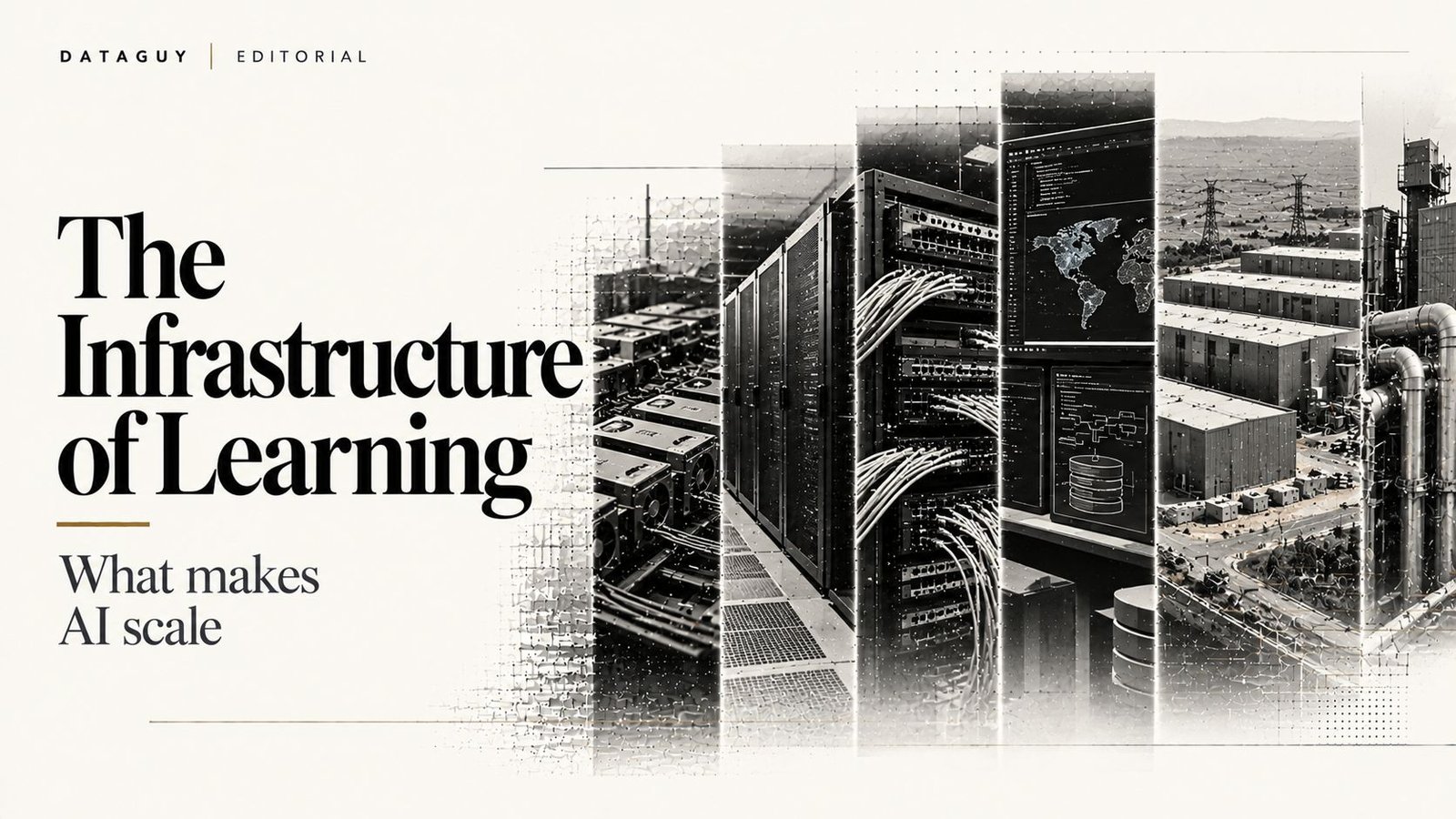
The previous essay, When Machines Learned, established a new possibility: learning could become a computational procedure. Examples could be passed through a model, errors could be measured, parameters could be adjusted and the process could be repeated. But a procedure that can be executed is not necessarily a procedure that can be executed at useful scale.
Learning becomes a different engineering problem when models grow, datasets expand and training requires computation for long periods. The work can no longer be understood as something happening inside one processor or one computer. Computation has to be divided, coordinated and supplied with enough memory, storage, networking, electricity and physical capacity to keep the process moving.
The important transformation was therefore not simply faster processors. It was the formation of an infrastructure in which specialized computation, distributed systems, software, data and capital could reinforce one another. Learning moved from a computational method toward an industrial workload.
The gap between possibility and scale
A learning algorithm can work on a small dataset with modest computation and still remain far from the conditions required for large-scale learning. The mathematical procedure may be sound while the practical cost of executing it remains prohibitive.
As models become larger, more parameters must be stored and updated. As datasets become larger, more examples must be read and processed. As training runs become longer, the system must remain operational for longer periods without losing progress to failures or inefficiencies.
These constraints interact. More computation requires more memory and movement of information. More devices require faster communication between them. Larger datasets require storage and data pipelines capable of supplying computation without becoming the bottleneck.
The infrastructure problem therefore emerges from the structure of learning itself. Once learning depends on repeated computation across large collections of examples, the physical system executing that process becomes part of the capability being produced.
Accelerated computation changes the economics
General-purpose processors were designed to perform many kinds of computation. Machine learning introduced workloads with unusually large amounts of parallel numerical calculation. Specialized accelerators became valuable because many operations involved in training could be performed simultaneously.
Graphics processors were originally developed for highly parallel graphics workloads, but their architecture also made them useful for numerical operations common in neural networks. The important transition was not that one processor became universally better. It was that a different computational architecture could be matched to the structure of the learning workload.
This changed the relationship between an algorithm and the hardware beneath it. A learning procedure could now be designed with the capabilities and constraints of specialized parallel computation in mind. Hardware was becoming part of the effective design space of machine learning.
The consequence was multiplicative. Better accelerators reduced the time required for a given amount of computation, while improved algorithms and software could use those accelerators more effectively. Learning began to benefit from a feedback loop between computational method and physical implementation.
The Learning Infrastructure Stack
The transformation from a learning algorithm into scalable learning infrastructure becomes clearer when the layers are treated as one system. Each layer removes a different constraint on the ability to execute learning at increasing scale.
The Learning Infrastructure Stack
Learning becomes industrially scalable when algorithms, data, accelerators, distributed computation, physical infrastructure and capital operate as a coordinated production system.
Learning procedures define how models are trained, adjusted and evaluated.
Large collections of machine-readable examples supply the observations through which models are trained.
Specialized processors provide the parallel computation required to execute large learning workloads efficiently.
Multiple processors and machines cooperate so that workloads larger than one system can be trained as coordinated jobs.
Power, cooling, networking, storage and physical facilities sustain computation across large clusters for extended periods.
Investment converts computational requirements into physical and organizational capacity that can be expanded over time.
The framework matters because no single layer explains scalable learning. An accelerator without suitable algorithms is underused. An algorithm without enough computation cannot reach the same scale. Computation without data has little to learn from. A large cluster without software capable of coordinating it becomes inefficient.
Scale emerges from the relationship among the layers. Each one changes the effective boundary of the others, making learning increasingly dependent on a system rather than an individual machine.
Distributed computation changes the machine
A model eventually becomes too large, or a training workload becomes too demanding, for one processor or even one computer to handle efficiently. The computational problem must then be divided across many devices.
Distributed training introduces a new requirement that was less visible in single-machine learning. Devices must exchange information about the state of the computation. Gradients, parameters and intermediate data may need to move between processors repeatedly while training proceeds.
The system therefore has two forms of work. Processors perform numerical operations, while the network coordinates the distributed state of the model. If communication becomes too slow relative to computation, additional processors may produce diminishing returns rather than proportional gains.
Scale consequently depends on the relationship between computation and communication. The machine is no longer a box containing processors and memory. It is a coordinated collection of resources whose effectiveness depends on how efficiently information can move among them.
The network becomes part of learning
Earlier in the series, networking transformed isolated computers into a connected computational system. Distributed learning makes that transformation internal to the training process itself. The network is no longer simply carrying information between applications. It is participating in the execution of the learning algorithm.
This creates a new relationship between computation and communication. More accelerators can increase available computational capacity, but they also increase the amount of coordination required. The architecture of the interconnect can therefore affect how much of the theoretical computational capacity becomes useful training work.
Large-scale training systems consequently require high-throughput communication, carefully organized synchronization and methods for reducing unnecessary movement of information. Distributed computation becomes a systems problem rather than simply a larger version of single-machine computation.
The infrastructure beneath learning is therefore becoming more tightly coupled. Processing, memory and networking can no longer be treated as independent components when the workload itself depends on their continuous interaction.
Cloud infrastructure changes the unit of access
Large-scale computation also changes the economics of who needs to own the physical machine. If computing capacity can be provisioned through shared infrastructure, an organization can access processors, storage and networking without constructing the entire physical environment itself.
Cloud computing turned infrastructure into a provisionable resource. Compute could be allocated when needed, expanded for demanding workloads and released when no longer required. The physical data centre remained essential, but its resources could be presented as an abstract computational service.
This abstraction matters for learning because training workloads are not uniform. Experiments may require modest resources, while large training runs may require clusters operating continuously for long periods. A provisionable infrastructure can accommodate these differences more flexibly than a fixed local machine.
The cloud therefore adds another layer of separation. Earlier computing separated procedures from hardware. Networking separated communication from physical location. Cloud infrastructure separates access to computational capacity from direct ownership of the physical machines providing it.
Software connects the stack
Hardware alone cannot turn a collection of processors into a scalable learning system. Software must coordinate data movement, scheduling, memory, communication, failures and the execution of the training procedure across the available resources.
This layer is easy to overlook because it sits between the learning algorithm and the physical infrastructure. Yet it determines how effectively the algorithm can use the hardware. A mathematically efficient method can still perform poorly if the software cannot keep processors supplied with work or coordinate distributed operations efficiently.
Software also makes the infrastructure reusable. Once a system can schedule workloads, manage distributed resources and recover from failures, those capabilities can support many different learning jobs rather than being reconstructed for each experiment.
The software layer therefore becomes part of the infrastructure itself. It translates abstract learning procedures into coordinated activity across physical machines.
Data becomes an infrastructure problem
Larger models require more than larger processors. They require data to arrive at the computation at sufficient speed and in a form that can be used efficiently. Storage, preprocessing, transfer and retrieval can therefore become constraints on training performance.
A training system may spend substantial resources moving data between storage and computation. If processors wait for data, additional processing capacity does not automatically increase useful training throughput.
This changes the role of data from a conceptual input into a physical infrastructure requirement. The dataset must exist somewhere. It must be stored, organized, transported and transformed. The computational system must be able to access the required examples repeatedly throughout training.
The data layer therefore joins the same infrastructure loop as compute and networking. Learning at scale depends on the ability to move information through the system as reliably as the ability to perform arithmetic on it.
Data centres become part of the model
Once learning workloads require large clusters, the physical environment housing those clusters becomes part of the computational system. Electricity must be delivered continuously. Heat must be removed. Networking equipment must remain operational. Storage and power systems must support long-running workloads.
The data centre therefore cannot be treated simply as a building containing computers. It is an engineered system that converts electrical and physical resources into sustained computational capacity.
Cooling illustrates the relationship clearly. Increasing computational density increases the concentration of heat that must be removed. Power distribution, thermal management and physical layout consequently affect how much computation can be installed and sustained in a given facility.
The physical infrastructure has become part of the effective capability of the learning system. A model cannot be trained at a scale larger than the environment capable of supplying and sustaining the required computation.
Scaling becomes measurable
Once learning is embedded in infrastructure, scale can be studied quantitatively. Model size, dataset size and training computation become variables whose relationships can be measured rather than merely described qualitatively.
Research on neural language models found empirical scaling relationships between model size, dataset size, computation and loss. The important consequence was methodological: increasing scale was not simply a matter of making models larger. The relationships among the resources could be studied and used to reason about how additional computation should be allocated.
Later compute-optimal training research refined this picture by showing that model size and training data should be increased together under a fixed compute budget. The result shifted attention from parameter count alone toward the allocation of computation across model and data.
Scale had therefore become an engineering variable. Learning infrastructure could be planned around measurable relationships among computation, data and model capacity.
Efficiency becomes part of infrastructure
Scaling does not mean adding resources without limit. Every additional processor, communication link and unit of storage introduces costs and constraints. The useful question becomes how much learning capability can be produced from a given amount of computational and physical capacity.
Efficiency can emerge from many layers. Better algorithms can reduce the computation required for a task. Better hardware can perform more useful operations for the same physical resources. Better software can reduce idle time and communication overhead. Better data pipelines can keep processors supplied with work.
These improvements compound because the infrastructure is interconnected. A faster processor may expose a communication bottleneck. Better networking may expose a storage bottleneck. More efficient computation may make it economically practical to train larger models, which in turn increases demand elsewhere in the stack.
Efficiency is therefore not a final optimization applied after scale. It is part of the mechanism through which scale becomes economically and physically possible.
Capital closes the loop
Large-scale learning requires physical systems that must be designed, purchased, constructed and operated. Accelerators require manufacturing capacity. Data centres require buildings, power and cooling. Networks require equipment and transmission infrastructure. Software requires engineering and maintenance.
These systems require investment before their computational output can generate value. Capital therefore acts as a conversion mechanism between expected future capability and present physical infrastructure.
Once infrastructure produces useful learning capability, that capability can support applications and services that create economic value. That value can justify further investment in computation, infrastructure and research. The relationship begins to form a reinforcing loop.
The loop is not automatic. Capital can be misallocated, demand can disappoint and technical constraints can change. But the structure is important because it connects machine learning to the same industrial mechanisms that allowed earlier technologies to scale.
What lies beneath learning infrastructure?
The learning system now appears to be an industrial computational environment. Yet the recursive stack reaches far below the training cluster. Each layer depends on capabilities that were accumulated earlier in the series.
The recursive question exposes the continuity of the series. Learning infrastructure depends on computation. Computation depends on semiconductors. Semiconductors depend on precision manufacturing, materials, energy and industrial organization. The newest capability remains physically grounded in layers built long before machine learning existed.
What has changed is the scale and coordination of those layers. The infrastructure is now organized specifically to produce learned computational capability, turning the earlier sequence into an integrated production system.
Learning becomes an industrial workload
The transformation becomes visible when learning is no longer treated as an experiment running on a computer and instead becomes a workload that must be provisioned, scheduled, monitored, optimized and repeated across infrastructure.
At this point, the boundary between algorithm and infrastructure becomes difficult to maintain. The algorithm determines the computational pattern. The hardware determines what can be executed efficiently. The distributed system determines how the work can be divided. The data system determines whether the computation can remain supplied. The physical facility determines whether the entire process can be sustained.
These layers increasingly co-design one another. Algorithms are developed with hardware characteristics in mind. Hardware is designed for computational patterns. Software is built to exploit both. Infrastructure is constructed around the resulting workload.
Learning has therefore acquired an industrial environment. The model is no longer the entire story of machine learning. It is the output of a larger system that produces computational capability through coordinated physical and informational processes.
Scale changes the meaning of learning
At small scale, learning can be described primarily as an algorithmic procedure. At large scale, its practical limits also depend on whether computation, communication, data movement and physical capacity can remain aligned.
The algorithm remains central, but its usefulness is shaped by the system that executes it. Infrastructure determines which workloads can be sustained, how efficiently resources are used and what constraints must be addressed before a model can be trained.
The next transformation is already visible
The infrastructure of learning resolves one constraint: learning procedures can now be executed across large datasets and coordinated computational systems. That achievement creates the conditions for a further change, but does not itself explain the economics of reusable capability.
When a trained model can support many tasks, the cost of producing it can be separated from the many uses that follow. Article 10 examines that next layer: how learned capabilities become reusable components of products, services and workflows.
Machine learning became scalable when learning acquired an industrial infrastructure
The decisive transformation was not simply faster processors. It was the coordination of algorithms, data, specialized computation, distributed systems, software, networking, physical infrastructure and capital into a system capable of sustaining large learning workloads.
Scaling relationships made resource allocation more measurable, while the constraints of communication, data movement, energy and cost made clear that no single layer could determine the result. Practical scale emerged from how the layers worked together.
Learning had moved from a procedure that could run on a computer to a workload that required an engineered system. The next question is what happens when the capability produced by that system can be reused across many applications. That is the subject of the industrialization of intelligence.
These sources support the discussion of scaling relationships, compute-optimal training, distributed training systems and the physical power infrastructure required by large-scale AI workloads.
Kaplan et al.: Scaling Laws for Neural Language Models (2020) Hoffmann et al.: Training Compute-Optimal Large Language Models (2022) Duan et al.: Efficient Training of Large Language Models on Distributed Infrastructures (2026) Power-Infrastructure Expansion Planning for Training-Oriented AI Data Centres (2026)