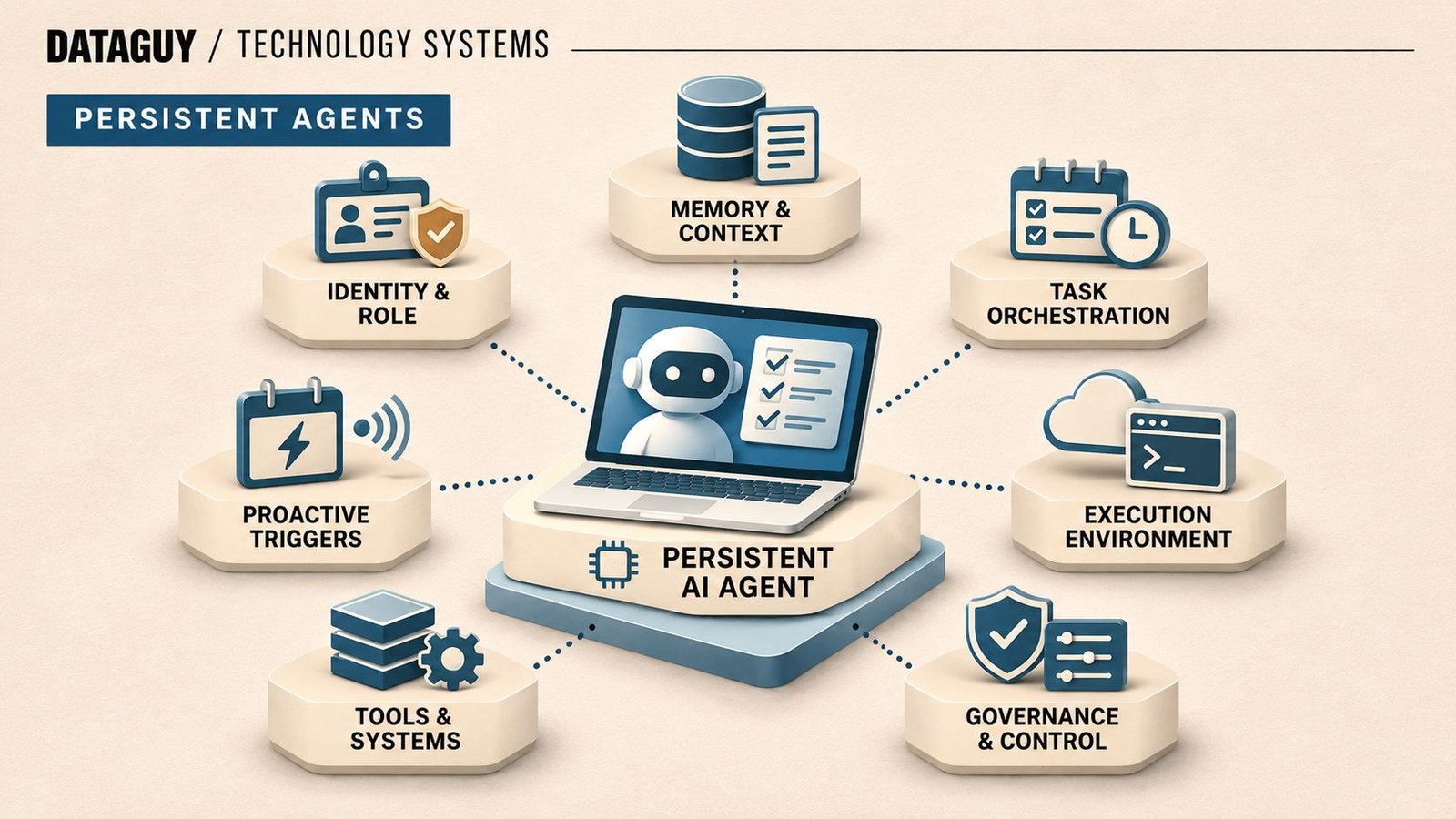
The moment an AI agent is entrusted with a responsibility that extends beyond the immediate interaction, the nature of the system changes. It must preserve the conditions under which the work began, maintain an accurate account of what has happened since, recognise when its operating context has changed and determine what remains to be done. The challenge is no longer confined to producing a sound response. It concerns the integrity of an ongoing process whose execution may span multiple sessions, applications, external events and periods of inactivity.
Consider an agent responsible for monitoring a company's regulatory exposure. Its assignment involves tracking changes across regulatory publications, identifying provisions relevant to the organisation, comparing new requirements with existing policies, maintaining an evidence trail and escalating developments to the appropriate team. The work cannot be completed through a single exchange. It depends on the continued availability of relevant information, a record of previous assessments, an understanding of unresolved issues and a controlled mechanism for initiating further work when new evidence emerges.
The distinction becomes important when the agent encounters a development that appears relevant to a previous assessment. It must determine whether the information is genuinely new, whether the earlier assessment remains valid, whether the development changes the organisation's exposure and whether the matter requires escalation. A system that merely retrieves an earlier conversation may reproduce the previous conclusion without recognising that its supporting evidence has changed. A system that remembers the regulatory requirement but loses the status of the investigation may repeat completed work or overlook an unresolved issue.
Such a system must preserve more than conversational context. It must maintain operational continuity. A previous assessment must remain distinguishable from a current finding. An unfinished task must be recoverable without duplicating completed actions. A new instruction must be reconciled with existing objectives, and an external event must not automatically become an authorised action. These requirements introduce architectural responsibilities that extend beyond the reasoning capabilities of the underlying model.
This is the central problem addressed by persistent agents. Their defining characteristic is not simply that they remain available in the background, but that they can sustain a relationship between objectives, memory, execution state, external systems and delegated authority over time. The quality of such a system depends on whether these elements remain coherent as the task evolves, the environment changes and human oversight becomes necessary.
The transition towards persistent intelligence is therefore an architectural transition. It moves the design problem from generating useful responses towards preserving the integrity of work across its entire lifecycle.
Insights Index
ToggleWhat always-on actually means
The expression always-on can suggest that an AI system continuously reasons, observes every connected source and remains actively engaged with every assigned responsibility. That interpretation conflates several distinct operating conditions. An agent can remain available without continuously executing a task. It can monitor for an event without initiating a substantial reasoning process. It can retain task state while inactive, or resume execution when a scheduled condition is met.
A useful analysis begins by separating three properties: persistence, proactivity and autonomy.
- Persistence
- Continuity across time. The system retains the information, state and execution context required to resume work after an interruption, a completed session or a period of inactivity.
- Proactivity
- The initiation of work. The system can act on a schedule, respond to a defined event, monitor a permitted information source or identify a condition that warrants attention without waiting for a new conversational instruction.
- Autonomy
- The degree of discretion available during execution. An autonomous agent can make decisions about how to pursue an objective, select tools, sequence operations and complete permitted actions without seeking approval at every step.
These properties can exist independently. A system may retain long-term memory but require a user to initiate every task. A scheduled workflow may operate proactively while following a fixed sequence of instructions. An agent may autonomously complete a complex task within one session but have no mechanism for recovering its state the following day.
Persistence concerns continuity. Proactivity concerns initiation. Autonomy concerns authority.
They can overlap, but none guarantees the presence of the others.
The distinction matters because product descriptions frequently combine all three under a single label. A platform may be described as an always-on agent because it can continue running after a user closes a laptop. That establishes something about its execution environment, but it does not, by itself, establish the quality of its memory, its ability to identify meaningful events or the scope of authority delegated to it.
Always-on intelligence is better understood as a system capable of maintaining responsibility across time. Its execution may be continuous, intermittent, scheduled or event-driven. What matters is whether the system can preserve the objective and the relevant state while remaining within its authorised operating boundaries.
The architecture of continuity
A persistent agent requires an architecture that separates responsibilities which are often compressed into a single conversational interface. The model may interpret instructions and propose actions, but the system around it must preserve state, coordinate execution, provide access to external resources and enforce control.
The following seven-component model provides a reference architecture for examining these systems. It is a DataGuy conceptual framework, not a representation of any one vendor's implementation.
Seven components of a persistent agent
Cross-cutting control: Governance applies across the other components rather than functioning only as a final execution step.
Identity and role
An agent that persists across multiple tasks needs a stable identity and a defined responsibility. Its role determines what it is expected to manage, which objectives it can pursue and whose authority it represents. This becomes particularly important when multiple agents operate within one organisation. A research agent, a finance agent and a project coordination agent may share infrastructure, but their responsibilities and access requirements should not be interchangeable.
Identity must also be distinguished from authentication and authorisation. Identity establishes which agent is acting. Authentication establishes that the agent or its execution environment is recognised. Authorisation determines what it may access or do. A persistent identity without corresponding permission boundaries can turn continuity into a mechanism for retaining excessive access.
Memory and contextual continuity
Memory provides the information required to interpret current work in relation to previous activity. It may include user preferences, organisational knowledge, earlier decisions, task history and learned procedures. However, memory is not a single undifferentiated store.
A useful distinction is between five forms of memory: working memory, which holds information currently required to perform an operation; episodic memory, which records previous interactions, events and experiences; semantic memory, which retains relatively stable facts, concepts and relationships; procedural memory, which stores instructions and learned methods for recurring work; and task-state memory, which records the current status of an objective, including completed steps, outstanding work, dependencies and pending decisions.
The fifth category is particularly important for persistent agents. A system may remember that a user prefers concise reports and that a particular project involves three departments. It may still fail to resume the project if it cannot establish which department has submitted its information, which analysis has been completed and which approval remains outstanding.
Research on memory mechanisms in language-model-based agents treats memory as a central mechanism in long-term agent-environment interaction. The architectural implication is that memory must be managed, retrieved and updated, not merely accumulated. The ACM survey on memory mechanisms provides a systematic examination of the design patterns and limitations involved.
Task and state orchestration
Task orchestration maintains the operational account of what the agent is trying to accomplish. It records objectives, dependencies, progress, deadlines, checkpoints and completion conditions. It also determines what should happen when a task is interrupted, delayed or invalidated by new information.
Consider a supplier assessment involving document collection, financial checks, compliance review and approval. If the agent completes the financial analysis but is interrupted before the compliance review, it must resume from the correct state. Re-running the entire workflow may waste resources or create duplicate records. Continuing without checking whether the supplier's documents have changed may produce an outdated assessment.
The orchestration layer must therefore distinguish between a task's intended outcome and the sequence of operations used to reach it. The objective may remain valid while individual steps need to be repeated, revised or cancelled.
Persistent execution environment
The execution environment provides the resources through which the agent performs work. This may include a cloud-hosted computer, browser, filesystem, terminal, isolated runtime, application connections and background workers.
Its significance extends beyond keeping a process alive. The environment may preserve files, sessions, intermediate outputs and the state of tools between periods of activity. Without such continuity, the agent may retain a description of its previous work but lose the environment required to continue it.
Triggers and proactive coordination
Triggers determine when the system should begin or resume an operation. They may be time-based, event-based or derived from a monitoring process. Coordination mechanisms determine how the agent prioritises multiple responsibilities, handles competing triggers and decides whether further investigation is justified.
Tools and external systems
Persistent agents derive much of their practical value from their ability to interact with systems outside the model. These may include email, calendars, enterprise applications, document repositories, databases, websites and APIs. The integration layer must preserve the relationship between the agent's intended operation and the actual action performed by the external system.
Governance and control plane
Governance determines the boundaries within which the agent operates. It includes identity enforcement, permissions, credential management, approval policies, audit trails, monitoring and the ability to interrupt or revoke execution.
The control plane must remain distinct from the agent's reasoning process. A model can propose an action, but the system responsible for enforcing permissions should not depend solely on the model's own assessment of whether that action is appropriate.
Continuity is produced by the coordination of memory, state, execution and authority.
Memory without task orchestration can preserve information without preserving progress. An execution environment without governance can sustain activity without adequate control.
These components are interdependent. Triggers without prioritisation can create unnecessary work. The architecture becomes useful only when continuity, execution and authority operate as a coherent system.
Where persistent agents live
The move towards persistent agents has also changed where agent execution takes place. A conversational interface may remain the user's primary point of interaction, but the actual work increasingly occurs in an environment that is separate from the user's device.
A cloud computer gives the agent a place to operate independently of the user's current session. It can retain files, maintain browser sessions, run commands and execute background tasks. The user can close a laptop or move to another device without necessarily interrupting the work.
This model introduces an important distinction between the interface through which an agent is controlled and the environment in which it operates. A mobile application may provide access to an agent whose execution environment is hosted elsewhere. The mobile device is not necessarily the agent's runtime.
OpenAI's Dots documentation describes an agent with its own cloud computer and browser, saved notes and context drawn from relevant ChatGPT memory. Its work can continue while the user's computer is off, and users can inspect activity, take over the computer or pause the agent. The documentation also distinguishes connected applications, local computer access and messaging channels as separate forms of access. See OpenAI's Dots overview and its Help Center documentation.
Meta's Muse uses a different emphasis. Its Secure VM is described as a dedicated environment containing the agent, workspace and connected-service data. The system separates the agent's runtime from security-sensitive services, including credential handling and permission enforcement. Meta's AI Research technical account describes the security architecture.
The distinction is not simply whether the agent has a computer. It is how the computer, persistent storage, credentials, connected services and control mechanisms are separated. A persistent runtime can improve continuity, but it also creates a durable environment in which sensitive information and active sessions may accumulate. The architecture must therefore account for the security consequences of retaining that environment.
A cloud computer is not, by itself, a complete agent architecture. It provides an execution substrate. Memory management, task orchestration, trigger handling and governance remain separate responsibilities.
From scheduled tasks to proactive intelligence
Scheduling is one of the simplest ways to extend an agent's activity beyond a conversation. A user can assign a task and specify when it should run. The system then initiates execution at the designated time without requiring a new instruction.
Event-driven execution introduces a different mechanism. Instead of waiting for a fixed time, the system responds when a defined condition occurs. An incoming email, a changed document, a delayed flight or a new entry in a connected system can initiate a workflow.
The distinction between scheduled and event-driven execution is consequential. A scheduled task operates according to a temporal rule. An event-driven task operates according to a condition observed in an external environment. Both can be useful, but neither automatically establishes that the agent understands the significance of the event.
Google's Gemini Spark documentation offers a useful illustration of the separation between a task, a schedule and a skill. The task defines the objective, the schedule defines when the work should run, and the skill provides reusable instructions and context for how the work should be performed. Its scheduling documentation describes both time-based and event-based triggers. See Google's Gemini Spark task documentation.
A more advanced form of proactivity requires the agent to identify whether a change deserves attention. This introduces a sequence of operations:
- Observe information from an authorised source.
- Determine whether the information is new or materially different.
- Relate it to an existing objective or responsibility.
- Evaluate its relevance and potential consequences.
- Decide whether to investigate, notify, recommend or initiate an authorised task.
- Preserve the result and update the task state.
This process is more demanding than running a scheduled prompt. It requires the system to distinguish meaningful change from routine activity and to decide when further work is justified.
For example, a regulatory monitoring agent should not send an alert every time a regulator publishes a document. It must identify the relevant jurisdiction, determine whether the document affects the organisation's activities, compare it with previous findings and assess whether the development changes an existing risk. The system must also preserve the evidence supporting its assessment.
Proactivity therefore depends on more than the ability to initiate a task. It requires a mechanism for evaluating the relationship between new information and existing responsibilities.
The same principle applies to notifications. An agent that continuously reports minor changes may technically be proactive but operationally unhelpful. The value of proactive intelligence depends on selectivity, relevance and the quality of escalation.
Delegation, coordination and multi-agent systems
Long-running work often involves multiple tasks that can be performed independently or in parallel. An agent may delegate research, data extraction, document analysis and validation to separate workers, then consolidate their outputs.
This arrangement can reduce execution time and allow specialised processes to operate concurrently. It also introduces coordination problems that do not arise in the same way within a single sequential workflow.
Delegation requires the parent agent to define the task, provide relevant context, specify the expected output and determine the authority available to the delegated worker. The parent must then evaluate the returned result, resolve inconsistencies and decide whether the work satisfies the original objective.
Parallel execution does not guarantee parallel correctness. Two agents may use different versions of a document, interpret the same instruction differently or produce conflicting conclusions. If they share mutable resources, one agent's changes may affect the work of another. If they operate independently, the parent agent must still reconcile their outputs.
A useful distinction is between task decomposition and agent coordination. Task decomposition divides an objective into smaller units. Coordination manages the dependencies and interactions between those units. The first is a planning problem; the second is a state-management and control problem.
OpenAI's Dots documentation describes the ability to divide work among background agents running in parallel, with separate threads that can be inspected and steered. xAI's Grok Bot documentation describes Bots that can coordinate, share context and hand off work. These examples demonstrate different forms of multi-agent orchestration, but their descriptions should not be interpreted as evidence that they use identical coordination or isolation mechanisms.
The security implications become especially important when multiple agents share infrastructure. xAI's documentation states that all Bots on an account use the same persistent cloud computer, including shared files, browser sessions, cookies and command-line credentials. Each Bot has a separate screen, but the screens are not separate security boundaries.
Parallelism is not isolation.
Separate agent identities or interfaces do not necessarily imply separate storage, credentials or execution privileges.
A robust multi-agent architecture must define ownership, data visibility, task boundaries, communication rules and the authority to modify shared resources. Without these controls, delegation can increase the number of active processes without increasing the reliability of the overall system.
The architecture of trust and control
Persistence changes the security problem because an agent may retain access to information and systems long after the interaction that originally established its purpose. A temporary instruction can become a continuing responsibility. A connected account can remain available across multiple tasks. A browser session can retain authentication. An agent can encounter untrusted instructions in documents, emails or web pages while operating with legitimate access to external services.
The resulting threat surface is not limited to the model's response. It includes the runtime, credentials, tools, connected applications, network requests, stored memory and the mechanisms through which work is delegated.
A central design principle follows: the agent should not be the sole authority deciding whether its own proposed action is permitted.
The reasoning system can determine that sending an email is the next step in a task. A separate policy mechanism should determine whether the agent has permission to send it, whether the destination is authorised and whether approval is required. This separation reduces dependence on the model's interpretation of its own authority.
Permission is not a single switch
A meaningful permission model distinguishes several questions: identity, which agent or user is making the request; authentication, whether the identity has been established; authorisation, whether it may perform the operation; scope, which resource or destination is covered; approval, whether human confirmation is required; execution enforcement, what prevents an unauthorised operation; and audit, whether the action can be reconstructed afterwards.
A broad permission such as access to email does not necessarily imply permission to send messages to every recipient, disclose every category of information or delete records. The distinction between read and write access is equally important. Monitoring a mailbox and sending a message from it are different operations with different consequences.
The separation of reasoning and enforcement
Meta's technical account of Muse provides a detailed example of this separation. The company describes an agent runtime isolated within a Linux container, with security-sensitive services operating outside that runtime. These include credential management, connector workers, independent safety mechanisms and Sentinel, which acts as the permission authority for connector actions and network egress.
In the described architecture, the agent proposes an operation, but Sentinel determines whether it may proceed. Credential surrogation prevents the main agent from directly accessing the underlying credentials. Network requests are also subject to controls that examine destinations and request details. Meta describes the use of eBPF-based controls and process-level data-flow tracking as part of this implementation.
This is a significant architectural approach because it places permission enforcement outside the agent's own reasoning environment. The model can interpret a request and formulate an action, but it cannot independently grant itself the authority to execute that action.
Human approval and its limits
Human approval is another control mechanism, but it must be designed carefully. Requiring approval for every minor operation can make a persistent agent difficult to use. Requiring approval only for a narrow set of actions can leave important decisions insufficiently supervised.
Anthropic's Claude Duet illustrates an approval-oriented design. Its launch documentation describes a research preview in which the agent works proactively, continues tasks while the user is away and checks before actions such as sending messages or making payments. Anthropic also describes credential handling that keeps passwords and sign-in tokens outside the agent's direct view, together with automated action checks and protections against prompt injection.
Approval design must also account for fatigue. If users are repeatedly asked to approve low-risk actions, they may begin approving requests without adequate inspection. A more useful policy distinguishes routine, reversible and narrowly scoped operations from consequential actions involving money, external communication, sensitive information or irreversible changes.
Approval should therefore be based on the nature and scope of an action, not merely on whether the action is initiated by an agent.
Interruption and revocation
A persistent system must provide mechanisms to pause work, stop execution, revoke access and recover from a compromised or misdirected process. These controls should operate independently of the agent's willingness to comply.
The ability to interrupt is particularly important when an agent operates across multiple systems. Stopping a conversation may not stop an underlying scheduled task, background worker or delegated process. The control architecture must make those execution paths visible and manageable.
Trust in persistent agents is not established by a model's ability to explain its actions. It depends on whether the surrounding system can constrain, inspect, interrupt and account for those actions.
Inside the emerging persistent agent architectures
The platforms emerging in this category reveal several different approaches to the same architectural problem. Some emphasise continuity across personal tasks and connected applications. Others foreground a dedicated execution environment, enterprise identity or proactive monitoring. Their common positioning should not obscure the differences in their publicly described designs.
The following comparison treats each platform as an architectural case study. It does not imply that all products have equivalent capabilities, availability or maturity.
OpenAI Dots: continuity across projects and conversations
OpenAI describes Dots as agents that can retain context across conversations, maintain saved notes, use a cloud computer and browser, and continue assigned work between interactions. Users can inspect activity, provide additional instructions, take over the computer or pause the agent. Dots can also delegate work to background agents and use connected applications within the permissions granted to them.
The architectural significance lies in the relationship between memory, task continuity and execution. The agent is not limited to retrieving a previous conversation. It can maintain a working responsibility, resume activity and bring the user back into the process when a decision is required.
The security documentation describes workspace-level controls, inherited application permissions, separate controls for browser and computer access, and automatic review of consequential actions. It also distinguishes proactive research from actions that modify connected systems. Proactive research can inspect permitted information and retain private notes, while actions such as sending messages or changing connected content follow separate permission and review rules.
This separation is important. It allows an agent to identify relevant developments without treating every discovery as permission to act on them.
Claude Duet: proactive attention and approval-oriented execution
Anthropic introduced Claude Duet as a research preview in October 2026. Its stated design centres on an agent that monitors connected work, identifies matters requiring attention, continues tasks while the user is away and seeks approval before consequential actions. The product is positioned around professional and small-business workflows rather than unrestricted personal automation.
Its architecture is notable for the way Anthropic describes credential handling and action review. The agent does not directly see passwords or sign-in tokens. An automated classifier provides an additional layer for assessing proposed actions, while dedicated safeguards address sensitive information and hidden instructions.
The design also exposes a practical tension. A proactive agent must make decisions about urgency and relevance, but it can misread a thread or misjudge what deserves attention. Anthropic acknowledges these limitations in the research-preview description. The product therefore provides a useful case study in the relationship between proactive attention, delegated execution and the need for human judgement.
Its preview status is material. The capabilities described by Anthropic should not be treated as a mature, generally available enterprise operating model.
Meta Muse: security boundaries around the agent runtime
Meta's Muse offers one of the more detailed publicly described implementations of a personal agent environment. The company describes a dedicated Secure VM, a runtime container for the agent, separate credential-handling services and an external permission authority.
The technical design places the agent's execution environment inside a restricted runtime while keeping security-sensitive services outside it. Sentinel governs connector permissions and network egress. Credential surrogation prevents the main agent from directly accessing real service credentials, while separate workers execute connector operations with scoped privileges. Durable application state is also stored separately from the runtime and credential store.
The architectural lesson is broader than the use of virtual machines. Persistent agents require boundaries between the component that interprets instructions, the component that executes operations and the component that decides whether those operations are permitted.
Meta's description is a vendor account of its own implementation, not an independent security audit. Nevertheless, it provides concrete detail about how a provider is approaching the problem of granting an agent sustained access to personal services.
Google Gemini Spark: task, schedule and reusable skill
Google's Gemini Spark illustrates the importance of separating the objective from its trigger and execution instructions. Its documentation describes tasks as the work to be accomplished, schedules as the conditions under which the work should run, and skills as reusable instructions and context that guide execution. Schedules can be based on time or events.
This decomposition is useful because it makes recurring work more explicit. A task can retain its objective while its schedule determines when it is activated. A reusable skill can provide consistent operating instructions across repeated executions.
The distinction also exposes operational constraints. Google's help documentation notes that scheduled execution can be delayed, that run times are approximate and that concurrent task limits apply. These details matter because a system's ability to schedule work does not guarantee exact execution timing or unlimited background capacity.
Microsoft Copilot Autopilot: persistence within an organisational environment
Microsoft announced Copilot Autopilot in September 2026 as a persistent, proactive agent that can monitor channels, follow threads, run recurring work and resume projects after periods of inactivity. Its announced design places the agent within an organisational tenant, with its own identity, memory, computer and workspace. Microsoft also describes integration with Work IQ and organisational governance mechanisms.
This represents a different operating context from a personal agent. The agent's work is situated within organisational identity, collaboration tools, documents and business processes. Its value depends not only on the ability to remember a user's preferences but also on its ability to interpret organisational relationships and operate within enterprise permissions.
The distinction between a personal agent and an organisational agent is consequential. An enterprise agent may need to retain responsibilities beyond the tenure of an individual employee, respect role-based access and maintain an auditable record of its operations. Microsoft has also described managed agents for shared business processes, where responsibility can persist beyond an individual user's role.
Autopilot's announced availability was described as private preview. Its architecture and positioning should therefore be treated as an emerging enterprise direction rather than evidence of a fully mature deployment model.
xAI Grok Bot: persistent computers and shared agent infrastructure
xAI's Grok Bot documentation describes named agents that operate through persistent cloud computers equipped with browsers, filesystems and terminals. Bots can retain files, browser sessions and preferences, continue work while the user's device is closed, and coordinate with other Bots. They can also learn workflows from demonstrations and reuse them on a schedule.
Its shared-computer design is particularly revealing. Bots on the same account share browser sessions, files and command-line credentials. Separate screens allow parallel work, but the documentation explicitly states that these screens are not separate security boundaries.
This makes Grok Bot a useful example for examining the difference between agent-level separation and infrastructure-level isolation. Multiple agents can have distinct roles and work surfaces while retaining access to the same underlying resources. Whether this is appropriate depends on the sensitivity of the data, the trust relationship between agents and the controls governing shared access.
| Platform | Primary architectural emphasis | Important distinction |
|---|---|---|
| OpenAI Dots | Memory, continuing tasks and delegated background work | Separates proactive research from actions requiring permissions |
| Claude Duet | Proactive attention and approval-oriented execution | Research preview with explicit action-review safeguards |
| Meta Muse | Dedicated runtime and external permission enforcement | Separates agent execution from credential and policy services |
| Gemini Spark | Tasks, schedules and reusable skills | Separates what should happen, when and how |
| Copilot Autopilot | Enterprise identity and persistent organisational work | Places the agent within a tenant and organisational context |
| Grok Bot | Persistent cloud computers and multi-agent coordination | Shared account-level computer resources are not agent-isolated |
The comparison reveals no single universal architecture. The systems differ in their execution environments, memory models, access boundaries and intended operating contexts. Their convergence lies in a broader design direction: the agent is becoming a continuing participant in a workflow rather than a temporary interface for generating a response.
That direction should not be mistaken for a settled architecture. The public descriptions provide evidence of design choices and product capabilities, but they do not establish comparative reliability, long-term performance or the effectiveness of every security control under real-world operating conditions.
The operational limits of persistence
An agent that remains available for longer periods has more opportunities to accumulate context, observe changes and complete work. It also has more opportunities to act on outdated information, repeat operations, misunderstand a changed instruction or continue a task whose original purpose is no longer valid.
Persistence increases the importance of operational discipline. Several failure conditions deserve particular attention.
Stale context and changing facts
Information that was correct when a task began may no longer be correct when it resumes. A supplier's financial position can change, a regulatory interpretation can be revised and an employee's role can change. The agent must distinguish between information that remains valid and information that requires verification.
Memory should therefore retain provenance and temporal context. A stored fact should not be treated as permanently current simply because it has been retained. The system needs to know where information came from, when it was observed and whether it has been superseded.
Contradictory instructions and changing objectives
Long-running work can receive new instructions while an earlier task remains active. A user may change a deadline, modify the intended audience or withdraw permission for a particular operation. The agent must reconcile the new instruction with the existing task state.
This is not simply a memory-retrieval problem. It is a question of authority and precedence. The system needs rules for determining which instructions remain valid, which are superseded and which require clarification.
Interrupted execution and incomplete state
A task may fail because a browser session expires, an API becomes unavailable, a network connection is interrupted or an external service rejects an operation. The agent must be able to distinguish between an action that was not performed and an action that may have succeeded even though the response was not received.
This distinction matters when operations are repeated. Sending the same email twice or creating duplicate records can have real consequences. Systems should use checkpoints, operation identifiers, idempotency controls where available and explicit confirmation of external state before retrying consequential actions.
Continuous monitoring and unnecessary activity
A system that monitors too frequently can consume resources and generate excessive notifications. A system that monitors too infrequently may miss important developments. The appropriate frequency depends on the task, the volatility of the information source and the cost of delayed detection.
Persistent agents therefore need mechanisms for prioritisation, event filtering and escalation. Remaining active is not the same as remaining useful.
Multi-agent coordination failures
Delegated agents can return inconsistent findings, work from different source versions or modify shared resources in conflicting ways. Parallel execution can increase throughput, but it also increases the number of state transitions and dependencies that must be managed.
A parent agent must validate delegated outputs against the original objective and preserve a clear record of which agent performed each operation.
Security exposure over time
Persistent access creates a longer-lived attack surface. An agent may encounter malicious instructions in a document or website long after the user granted access to an account. If the agent can act on external systems, a successful prompt-injection attempt may have consequences beyond an incorrect answer.
Isolation, scoped credentials, network controls and independent policy enforcement reduce exposure, but they do not eliminate the need for monitoring, review and revocation.
Cost and resource management
Background work consumes compute, storage, model inference, network access and external service capacity. A task that appears inexpensive as a single interaction may become expensive when it repeatedly checks sources, invokes multiple agents or processes large amounts of historical context.
The architecture must therefore manage when to reason, when to retrieve, when to wait and when to stop. A persistent agent that cannot recognise completion or diminishing value can continue consuming resources without producing corresponding benefit.
The central operational requirement is controlled continuity. The system must know not only how to continue work, but also when to pause, revalidate, seek clarification, escalate or terminate the task.
From AI assistants to persistent intelligence systems
The emergence of persistent agents changes the unit of interaction between people and software. In a conventional assistant model, the user initiates an exchange and receives a response. In a persistent model, the user delegates an objective and the system maintains responsibility for progressing it within defined boundaries.
This changes the role of the interface. The conversation remains useful for setting objectives, clarifying intent and reviewing outcomes, but it is no longer the entire operating environment. Work may continue through background tasks, connected applications, cloud computers and delegated agents. The interface becomes a place to direct and supervise a process that exists beyond the conversation.
The transition also changes how agent quality should be evaluated. A system that produces an excellent response in one session may still be unsuitable for a long-running responsibility. Its performance must be examined across the lifecycle of work.
- Continuity: Can the agent resume work without losing important context or task state?
- State accuracy: Can it distinguish completed, pending, failed and invalidated operations?
- Freshness: Does it verify information whose validity may have changed?
- Trigger quality: Does it initiate work at the appropriate time and under the right conditions?
- Execution reliability: Can it recover from interruptions without duplicating or corrupting operations?
- Permission discipline: Does it operate within the authority granted to it?
- Coordination: Can it delegate and reconcile work without losing accountability?
- Observability: Can a user or administrator understand what the agent has done and why?
- Interruptibility: Can work be paused, stopped or revoked independently of the agent's own decisions?
- Resource discipline: Does it use time, compute and connected services proportionately to the task?
These dimensions shift evaluation away from isolated model performance towards system behaviour over time. They also reveal why a more capable reasoning model cannot, on its own, solve the central problem. A model may interpret instructions accurately, but it cannot compensate for missing task state, unreliable triggers, stale external data or inadequate permission enforcement.
Persistent intelligence depends on the coordination of several layers of infrastructure. Memory preserves relevant context. Orchestration maintains the state of work. Execution environments provide continuity. Triggers determine when work should resume. External integrations connect the agent to operational systems. Governance constrains the authority under which all of these components act.
The architecture must also preserve human accountability. Delegation does not transfer responsibility for every consequence to the agent. Organisations and individuals still need to determine which decisions can be delegated, which actions require approval and who is accountable when an operation causes harm.
The more responsibility an agent retains across time, the more important these boundaries become. A system that can remember, monitor and act is not necessarily a system that should be permitted to act without supervision. The design challenge is to make continuity useful without allowing persistence to become uncontrolled authority.
The architecture of responsibility
Persistent agents introduce a different relationship between intelligence and software. Their significance does not arise simply from the ability to run in the background or interact with more applications. It arises from the possibility of maintaining responsibility for a defined objective across changing conditions, multiple systems and extended periods of time.
That responsibility requires a system to preserve more than information. It must maintain the relationship between what it was asked to accomplish, what it has already done, what has changed, what remains unresolved and what it is authorised to do next. These relationships form the operational foundation of persistent intelligence.
The emerging implementations demonstrate that this foundation is being approached through several architectural strategies. Cloud computers provide persistent execution environments. Memory systems retain context and experience. Task orchestration maintains progress. Schedules and event triggers initiate work. Multi-agent coordination distributes responsibilities. Independent permission mechanisms constrain execution.
None of these components is sufficient in isolation. Their value depends on the integrity of the relationships between them. Memory without state management can preserve facts while losing progress. Proactivity without selectivity can create unnecessary activity. Autonomy without independent enforcement can turn delegated authority into uncontrolled access. Parallel agents without isolation can multiply the consequences of a shared security weakness.
The architectural direction is therefore clear, even though the implementations remain at different stages of maturity. The next generation of AI systems will increasingly be evaluated not only by the quality of their reasoning, but by their ability to sustain reliable, observable and controlled work over time.
Persistent intelligence is ultimately a question of architectural responsibility.
The model supplies reasoning, but the system must preserve continuity, coordinate execution and enforce authority. That is what separates an agent that can continue working from one that can be trusted with an ongoing responsibility.
References: Technical Documentation and Further Reading
The following sources provide the technical and architectural basis for this article. Product capabilities and availability are described as documented by their respective providers. Vendor architecture descriptions should not be interpreted as independent security validation.
- OpenAI. Meet dots. ChatGPT Learn. OpenAI.
- OpenAI. Getting started with your dot. OpenAI Help Center. Help Center.
- OpenAI. Tasks and memory. ChatGPT Learn. OpenAI.
- OpenAI. Safety and security in dots. ChatGPT Learn. OpenAI.
- Anthropic. Introducing Claude Duet. October 21, 2026. Anthropic.
- Anthropic. Claude Duet documentation. Anthropic Support.
- Meta. Introducing Muse. September 8, 2026. Meta AI.
- Meta AI Research. How We Built Safety Into Muse. September 8, 2026. Meta AI Research.
- Google. Introducing Gemini Spark. July 29, 2026. Google Blog.
- Google. Create and manage schedules for tasks in Gemini Spark. Google Help.
- Microsoft. Introducing the New Copilot with Home, Code and Autopilot. September 25, 2026. Microsoft.
- Microsoft. Delegate Shared Business Processes to Agents That Are More Persistent and Proactive. Microsoft.
- xAI. Grok Bot. xAI Documentation.
- xAI. Use the Computer and Apps. xAI Documentation.
- Zhang, Z. et al. (2025). A Survey on the Memory Mechanism of Large Language Model-Based Agents. ACM Transactions on Information Systems, 43(6), Article 155. ACM Digital Library.