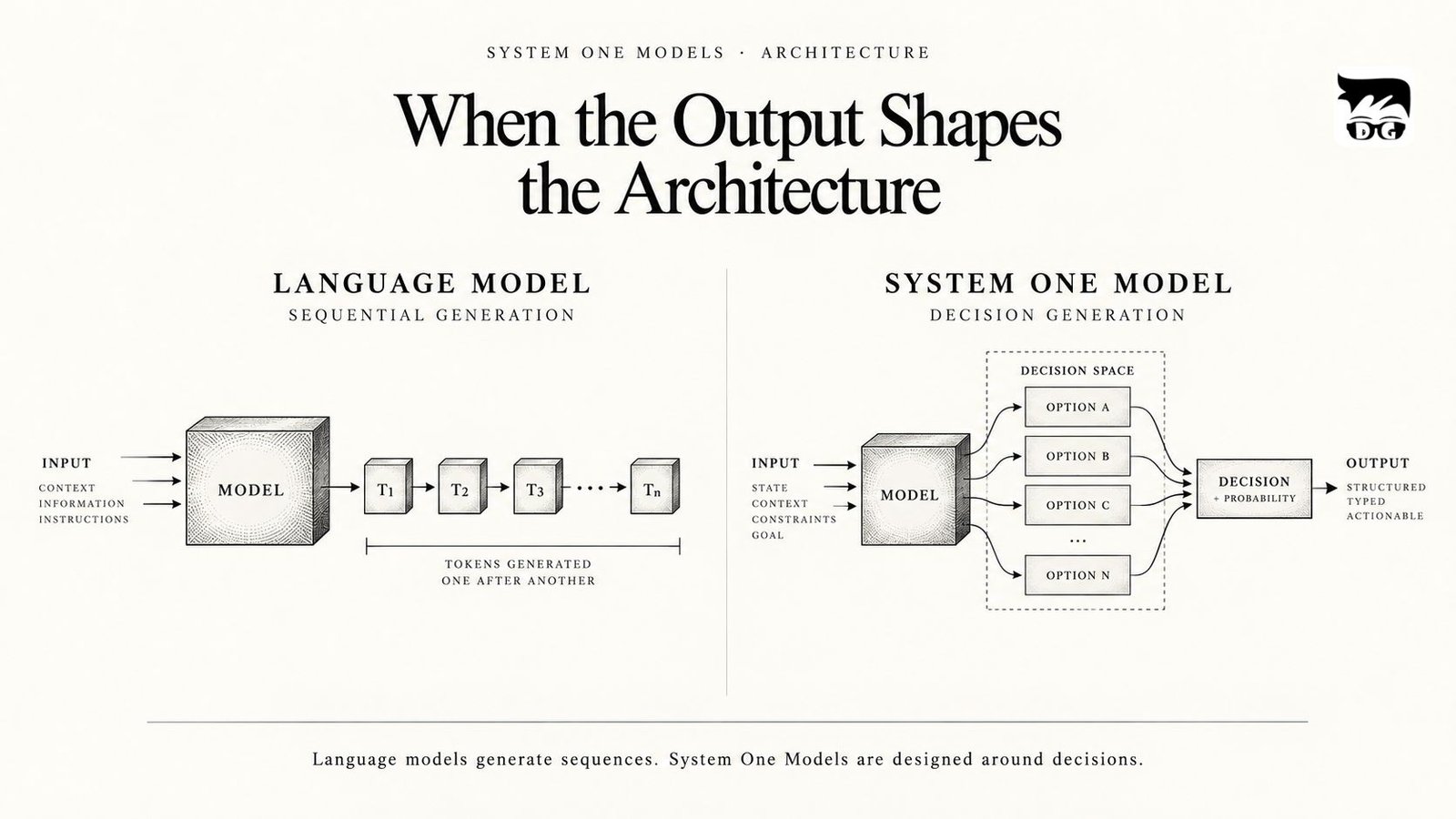
The difference between a language model and a System One Model is not simply the format of the response they produce. It begins with what the model is designed to do.
Language models are fundamentally built around generating sequences of tokens. They can produce explanations, code, summaries, classifications, and many other forms of output because language provides a remarkably flexible interface between intelligence and its users.
System One Models start from a different requirement. They are designed around making structured decisions that software can use directly. That change in the intended output affects the architecture, the inference process, and the relationship between the model and the application around it.
The Hidden Assumption Inside a Language Model
Modern language models expose intelligence primarily through language. An application provides a prompt or sequence of messages, the model processes that context, and it generates tokens that form the response.
This interface is remarkably flexible because the same underlying mechanism can support conversation, writing, coding, analysis, explanation, and many other tasks. The output does not need to belong to a predefined decision space because the model can continue generating language for as long as the task requires.
That flexibility becomes more complicated when the consumer of the output is software rather than a person. A program does not interpret language in the same way that a human does. It needs values, states, classifications, scores, or other results that can become part of its execution logic.
When a language model is used for that purpose, the application often has to place another layer between the model and the action it needs to take.
Language-centric flow:
Software → Language Model → Generated Text → Parsing → Validation → Software
The model produces language first, while the application has to recover the structured meaning it actually needs.
The Interface Shapes the Architecture
This is where the System One approach takes a different direction. TypeSafe AI describes System One Models as a new class of models designed for decisions inside software, rather than as language models with another output format.
TypeSafe describes Jev as using a new model architecture, a parallel sampler, and a different training approach called Reinforcement Learning for Calibrated Decisions, or RLCD. These mechanisms are important, but their significance becomes clearer when viewed through the problem the architecture is intended to solve.
If the application needs a decision rather than a sentence, there is less reason for the model to construct a natural-language representation and then ask another piece of software to interpret it.
The intended interface can instead become much more direct.
Decision-centric flow:
Software → System One Model → Structured Decision → Software
The model is designed to produce the result that the application needs, rather than producing an intermediate representation that the application must interpret before it can act.
From Sequence Generation to Decision Generation
TypeSafe's description of Jev makes this distinction particularly important. The company describes conventional language model inference as sequential, where tokens are generated one after another and each new token depends on the sequence that has already been produced.
TypeSafe describes Jev differently, with outputs generated in parallel within a single query. The significance of that approach becomes easier to understand when the model is considered as a decision system rather than as a text generator.
Imagine a software system that needs to determine which of several predefined routes an incoming request should follow. A language model could generate a sentence explaining which route appears appropriate, after which the application would need to interpret that sentence and map it back to one of its available routes.
A decision-oriented model can instead operate directly within the defined decision space and return the corresponding result.
The distinction is therefore deeper than text versus JSON. JSON can be generated by a language model, but the underlying process can still be sequential token generation. The more fundamental distinction is between generating an arbitrary sequence and making a decision within a defined output space.
The Output Space Comes First
One of the most useful ways to understand the architecture is to consider the space of possible outputs.
A general language model operates across an extremely large space of possible token sequences. This is what allows it to answer open-ended questions and express ideas in many different forms.
A System One Model approaches the problem from the other direction. The application can define what constitutes a valid decision before inference takes place, allowing the model to operate within a known output space.
A software system might need to choose between several possible routes, evaluate a continuous quantity, classify an event, or determine the probability that a condition is true. Each of these requirements can be represented as a structured decision rather than as free-form language.
TypeSafe describes Jev as producing typed values together with probabilities and confidence information. The specific decision primitives behind this interface deserve a separate examination later in the series.
For the architecture, the important point is that the output space becomes part of the model interface itself.
The Model Becomes a Software Component
This change also affects the role that the model plays inside an application.
A language model is often treated as a conversational or generative endpoint. The application sends information to the model and receives a flexible response that may require additional interpretation before it can influence program execution.
A System One Models is intended to behave more like a computational component within the application. The surrounding system can continue to contain deterministic rules, databases, APIs, functions, and other services, while the model provides judgment where fixed rules are insufficient.
The software remains responsible for the workflow, while the model supplies the semantic judgment required at a particular point in that workflow.
This distinction becomes particularly useful for decisions that are difficult to express through traditional conditional logic. A customer support system, for example, may have straightforward rules for transaction limits, while determining whether a message represents a refund request or whether an incoming request requires escalation may depend on language and context.
A System One Model is designed to provide that judgment while allowing the surrounding software to determine what happens next.
Traditional software:
if condition: execute()
Decision-oriented software:
if semantic_decision: execute()
A Smaller LLM Would Not Solve the Same Problem
It is tempting to interpret System One Models as smaller language models that have been optimized for speed. That explanation, however, misses the architectural distinction TypeSafe is proposing.
A smaller language model can reduce computational requirements while preserving the same fundamental interface. It still generates tokens, it can still produce arbitrary strings, and software may still need to parse and validate those strings before using them.
Reducing model size therefore does not automatically change the relationship between the model and the application.
TypeSafe describes System One as a different model class with a different architecture, sampler, and training approach. The distinction is consequently deeper than the number of parameters or the speed of inference.
The model is designed around a different computational contract.
The Computational Contract
A useful way to frame the difference is through the contract established between the model and the software using it.
| Language Model | System One Model |
|---|---|
| The model receives context and generates a flexible sequence of tokens. | The model receives application state and produces a structured decision within a defined output space. |
| The output is usually language that software may need to interpret. | The output is intended to be directly usable by surrounding software. |
| Inference is fundamentally organized around sequential token generation. | TypeSafe describes Jev as using parallel decision sampling. |
| The receiving application is responsible for interpreting the generated response. | The application can consume the model's decision as part of its execution logic. |
This does not mean that one interface replaces the other. Language remains useful when the output itself needs to be flexible, expressive, or intended for human interpretation.
The architectural question changes when the output is going directly back into software. In that environment, unrestricted language can introduce an intermediate layer that the application does not necessarily need.
The Deeper Architectural Shift
The most important proposition behind System One Models is therefore not simply that they can produce structured outputs. Conventional language models can already be constrained to produce structured formats.
The deeper proposition is that the model itself is designed around the structure of the decision that software needs to make.
This is why TypeSafe connects several capabilities together, including a new architecture, parallel sampling, typed outputs, calibrated confidence, and decision-oriented training. These are presented as parts of a common design direction rather than as independent features.
The architecture begins with a different question: what does the software actually need the model to produce?
For a language model, the answer is generally a sequence of tokens that can express almost anything within the limits of the model.
For a System One Model, the intended answer is a decision that can become part of computation.
That difference provides the foundation for the mechanisms we need to examine next.
What We Know and What Remains Open
TypeSafe has publicly described Jev as using a new architecture and a parallel sampler, and the company's public material provides a clear distinction between sequential language generation and decision-oriented inference.
The broader architectural direction is therefore becoming clearer, but the public material does not fully document every internal implementation detail of the model.
That distinction matters when evaluating an emerging model category. We can examine the architectural principles that TypeSafe has described without assuming that every internal mechanism has already been publicly established.
The next question is therefore more specific. If a System One Model does not need to generate a sequence of tokens in the same way as a language model, how does its inference process actually work?
That leads directly to the next part of the investigation: sequential generation versus parallel decision sampling.
AI Developments Database
Explore the evolving landscape of model architectures, machine-native systems, and AI developments in the DataGuy Intelligence Repository..
Sources List
- TypeSafe AI: Introducing System One Models & Jev
- TypeSafe AI: System One Models and Jev