The previous article examined what happens when intelligence becomes a typed component inside software. The model no longer needs to produce language that another layer of software interprets. It can produce a defined decision that the application can use directly.
That architectural change raises a natural question.
If the model is doing less than a general language model in one sense, can it also do the work differently enough to become substantially faster and cheaper?
TypeSafe believes the answer is yes.
The company describes Jev as a System One Model designed around structured decisions rather than string generation. It attributes the performance difference to a combination of a new model architecture, a parallel sampler, and a training approach designed around calibrated decisions.
Those are significant claims.
They also need to be separated into two different questions.
What does the architecture make possible?
What has actually been demonstrated?
The first can be reasoned about from the interface and computational design. The second requires measurement.
That distinction matters because faster inference is not automatically a consequence of structured output, and lower token cost does not automatically mean lower total system cost.
Language Generation Has a Different Computational Shape
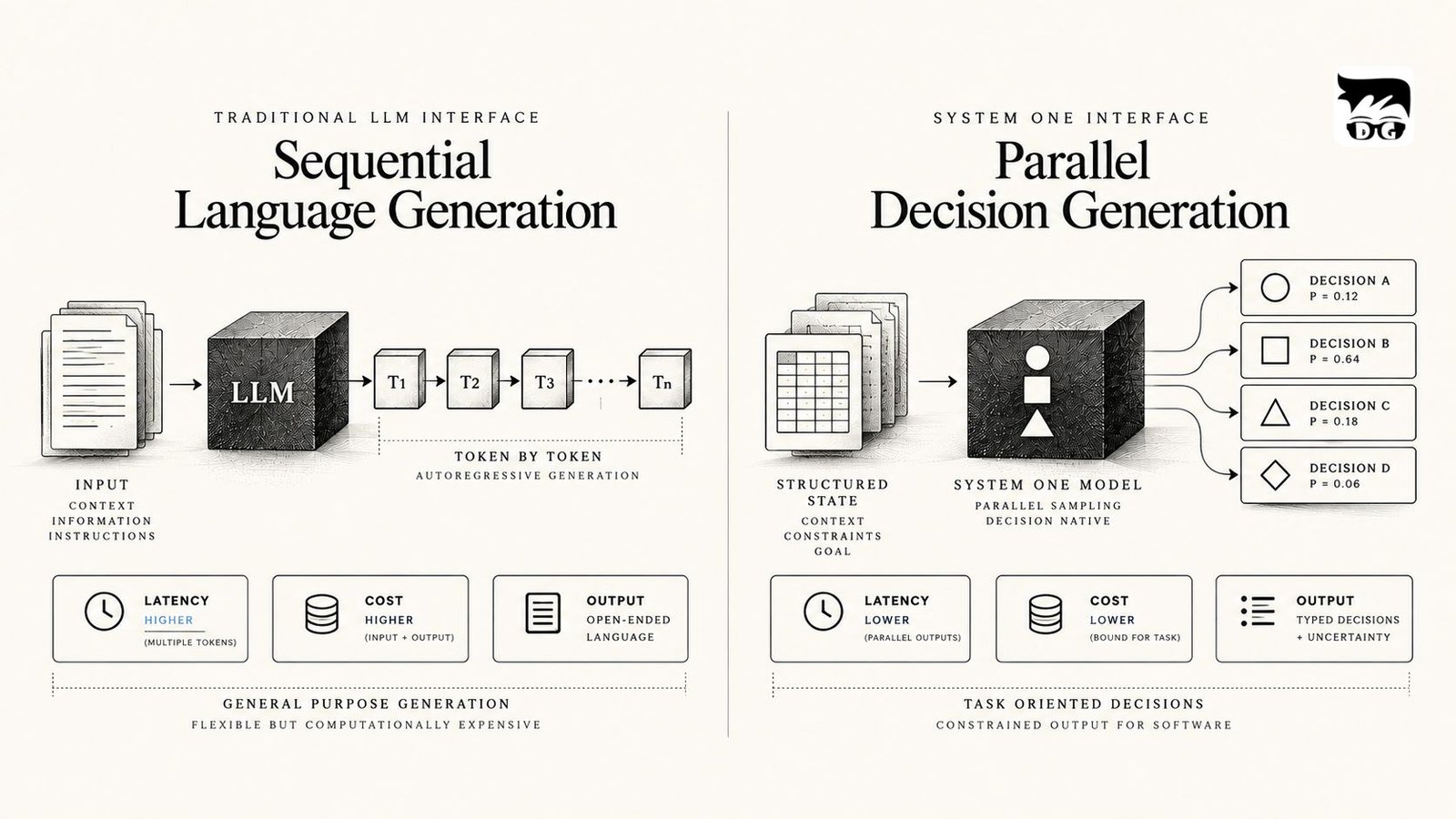
A conventional language model generates a sequence.
Given an input, it produces one token, then another, then another. Each subsequent token depends on the preceding sequence.
The result might be a sentence, a paragraph, a program, or an entire conversation.
That flexibility is one of the reasons language models are so useful.
It is also computationally expensive.
If an application asks a language model to determine whether a transaction is suspicious, the model does not have to produce a long explanation. But a general language model is still operating within an architecture designed to generate arbitrary sequences of tokens.
Language generation:
Input → Model → Token 1 → Token 2 → Token 3 → ... → Token N
The output space is open-ended.
The model can continue generating because there is no small predefined set of valid answers.
System One Models approach the problem differently.
TypeSafe describes Jev as generating structured decisions in parallel rather than autoregressively generating a string.
Decision generation:
Input State → Defined Decision Space → Decision + Probability
The difference is not simply that the output is shorter.
The computation is organized around a different kind of output.
The Output Space Matters
Consider a customer support system that needs to determine what should happen next.
The possible actions might be:
- REFUND
- FREEZE_CARD
- SET_INTENT
- HAND_OFF
- FLAG_FOR_REVIEW
- CLOSE
A language model can generate a response explaining which action it recommends.
A decision-oriented model can be asked to select from a defined set.
That distinction constrains the problem.
The model does not need to discover the shape of the answer while generating it. The application has already defined the decision space.
TypeSafe's API exposes this through Noul, Choice, and Score questions. A Choice question selects from a defined set, Noul handles yes-or-no judgments, and Score represents a value on a scale.
The important economic implication is that the output space becomes part of the computational design.
A model that only needs to choose among known alternatives does not have the same output problem as a model that must generate arbitrary language.
That does not prove a particular speedup.
It creates the conditions under which a different speedup may be possible.
Fewer Outputs Can Mean Less Work
There is a temptation to summarize the argument as:
Fewer tokens means lower cost.
That is incomplete because inference cost depends on much more than the number of output tokens. Model architecture, model size, input processing, memory movement, hardware utilization, batching, parallelism, serving infrastructure, and the number of calls within a workflow can all affect the economics.
Output constraints can nevertheless change the computational problem. A model generating a paragraph has to construct a sequence of tokens, while a model selecting one of several known alternatives operates within a much narrower output space. The distinction becomes more significant when an application needs many independent decisions rather than a single long response.
Consider a workflow that needs to answer ten questions:
- Is the transaction suspicious?
- Is the customer authenticated?
- Is the request eligible for a refund?
- Is the customer frustrated?
- Is there a legal risk?
- Does the request require a human?
- Which intent applies?
- How urgent is the request?
- How severe is the risk?
- What action should follow?
A general language model might be asked to reason through the entire problem in a single response, whereas a structured workflow can decompose the same task into explicit decision nodes and let deterministic code handle the parts that do not require model judgment.
The resulting economics therefore depend on the shape of the entire computation, including how many decisions are required, how those decisions are structured, and how the surrounding software combines them, rather than simply on the price of one model call.
Parallelism Changes the Shape of the Problem
This is where TypeSafe's architectural claim becomes particularly interesting.
TypeSafe says Jev uses a parallel sampler that produces the outputs of a query together rather than generating a sequence of tokens one after another.
That is fundamentally different from the usual autoregressive generation pattern.
Sequential generation:
Decision → Token 1 → Token 2 → Token 3 → Token 4
Decision-oriented generation:
State → Decision Space → Multiple Outputs
The advantage of parallelism is not that parallel computation is automatically cheap.
The advantage is that some workloads can expose enough independent structure for hardware to process them efficiently.
This becomes especially relevant when a software workflow contains multiple narrow judgments.
A customer service system, for example, may need to assess intent, frustration, urgency, risk, and escalation requirements from the same state.
TypeSafe's published customer service workflow follows this kind of decomposition, evaluating multiple readings of the conversation and customer state rather than asking a model to solve the entire problem as one unrestricted response.
That is a different computational shape from generating a long natural-language answer.
Latency Is Not the Same as Cost
Speed and cost are related, but they are not the same metric.
A system can be extremely fast and still be expensive.
Another system can be inexpensive per call but slow enough to be unusable in an interactive application.
For production software, several economic dimensions matter:
| Dimension | Question |
|---|---|
| Latency | How long does one decision take? |
| Throughput | How many decisions can the system process? |
| Input cost | What does the supplied state cost to process? |
| Output cost | What does the resulting computation cost? |
| Workflow cost | What does the complete task cost? |
| Infrastructure cost | What does serving the model require? |
| Human cost | How much review remains necessary? |
| Error cost | What happens when the decision is wrong? |
This distinction is important because a cheap model call does not necessarily produce a cheap workflow.
If a system requires twenty model calls to accomplish something that another model handles in one call, the per-call price tells us very little about the total economics.
The relevant unit is the completed task.
Workflow Economics Matter More Than Single-Call Economics
This is one of the more important ideas in TypeSafe's current evaluation methodology.
Its workflow evaluation framework compares models inside structured workflows rather than only comparing individual model responses. The workflow decomposes tasks into programmatic rules and narrow intelligent judgments, then measures accuracy, cost, and time across the complete process.
That changes the economic question.
Instead of asking:
Which model has the cheapest API call?
The better question is:
Which architecture completes the required software task with the lowest combination of compute, latency, and error?
This matters because software does not buy tokens.
Software buys outcomes.
An invoice system does not need an inexpensive classification call. It needs a correctly processed invoice.
A customer service platform does not need cheap inference. It needs the right next action within an acceptable response time.
An automated security system does not need a low-cost prediction. It needs a decision that is sufficiently reliable to justify the action it triggers.
The economic unit is therefore the workflow.
The Hidden Cost of Language as an Interface
There is another cost that does not always appear on an inference bill: interpretation.
When software consumes generated language, it often needs additional mechanisms to turn that language into reliable program state.
Generation → Parsing → Validation → Error Handling → Interpretation → Business Logic
Each layer adds engineering work.
There may also be retries, schema failures, malformed outputs, defensive prompts, post-processing, and human review.
A decision-native interface can potentially reduce some of this overhead by making the decision space explicit at the model boundary.
This does not mean the surrounding software becomes simpler by default.
The complexity moves from interpreting an arbitrary response toward defining the decision correctly, establishing the allowed values, determining thresholds, designing the workflow, and monitoring semantic errors.
The economic question is therefore broader than the price of model inference.
What matters is the total engineering cost required to turn intelligence into a reliable software action.
Small Decisions Can Become Economically Significant
A single decision may not seem important enough to justify a specialized model.
Scale changes that calculation.
Imagine a software system processing millions of events.
For each event, it needs only a handful of semantic judgments.
At that point, the difference between a general language generation architecture and a specialized decision architecture can become significant.
A few milliseconds saved per decision can matter when multiplied across millions of decisions.
A small reduction in cost per decision can become substantial at high volume.
More importantly, lower latency can make intelligence viable in places where slower inference is impractical.
TypeSafe positions Jev for real-time applications and high-volume workloads, including workflows where low response times matter.
The underlying economic idea is broader than Jev.
When the marginal cost of intelligence falls, applications can afford to ask more questions.
That can change system design.
Cheap Intelligence Can Change What Software Does
This is where the name Jev becomes relevant.
TypeSafe says it named Jev after economist William Stanley Jevons and expects machine intelligence to behave similarly to the historical relationship between efficiency and demand: when intelligence becomes cheaper, more use cases may become economically viable.
The important idea is not simply that a cheaper model saves money.
A cheaper decision can change the number of decisions a system is willing to make.
Consider a system that currently uses deterministic rules because calling a frontier model for every event is too expensive.
If semantic judgment becomes inexpensive enough, the architecture can change.
Rules → Exception → Human
could become:
Rules → Semantic Decision → Rules → Semantic Decision → Action
The system can afford to inspect more of the world.
That is potentially more important than the price reduction itself.
But Lower Cost Does Not Mean Lower Total Complexity
There is a risk in treating specialized inference economics as a simple replacement story.
A System One architecture may reduce inference costs while requiring more explicit engineering around the model.
The decision primitives need to be defined, and the boundary between deterministic code and model-driven judgment needs to be made explicit.
The workflow then has to be constructed around those decisions, with confidence thresholds that determine how different levels of uncertainty should affect execution.
The resulting system also needs to be evaluated and monitored, particularly for cases where the model is uncertain, incorrect, or operating outside the assumptions built into the workflow.
TypeSafe's own workflow material makes this point indirectly. Its published workflows depend on domain-specific decomposition and engineering, and the company notes that strong workflows tend to involve many independent questions whose behavior depends on probabilities rather than only discrete decisions.
The model may become cheaper.
The system does not necessarily become simpler.
What TypeSafe Actually Claims About Jev
TypeSafe's current public material makes several performance and economic claims.
- 70 ms to 500 ms end-to-end response times for Jev.
- $0.042 per million input tokens.
- Output tokens priced at effectively zero.
- Large workflow-level speed and cost advantages compared with selected frontier models.
- Parallel sampling rather than sequential token generation.
- Structured outputs designed for software rather than general string generation.
The company's homepage currently summarizes one workflow comparison as 193.6× faster and 444.6× cheaper.
These numbers should not be treated as universal properties of System One Models.
TypeSafe itself provides important qualifications.
It says the published workflow results come from four example workflows, that the workflows were created by people on its own capabilities team, and that this could introduce bias. It also notes that its LLM comparisons use a wrapper to produce structured decisions, and that the pricing may potentially be subsidized until long-term economics are established.
Editorial caution: These are current vendor claims, not independent conclusions about the economics of System One Models as a category.
What the Architecture Lets Us Infer
There are several conclusions that are reasonable to explore without accepting every vendor claim. A bounded decision space can reduce the need for arbitrary sequence generation, while parallel sampling can change how multiple decisions are computed and typed outputs can reduce some integration overhead. Workflow decomposition can also allow software to handle deterministic rules without involving the model, while a specialized model does not need to optimize for every form of language generation. Together, these choices could produce a different performance profile, but none of them establishes a universal multiplier.
The actual advantage depends on the workload. A task that requires long-form generation is fundamentally different from one that requires ten narrow decisions, just as a decision space containing four options differs from one containing hundreds. The characteristics of the input state, the size of the context, the number of decisions, and the latency requirements all influence the resulting economics, with a latency-sensitive application presenting a different problem from an offline batch process.
The architecture therefore creates the possibility of different economics, but the workload determines whether those economics actually appear.
The Real Economic Unit Is the Decision
This may be the most useful way to think about the System One proposition.
Language models made intelligence available through a unit called the generated sequence.
System One Models attempt to make intelligence available through a unit called the decision.
That changes what engineers can optimize.
Instead of:
How much does it cost to generate this answer?
Ask:
How much does it cost to make this decision?
That is a more useful question for software.
A production system rarely needs intelligence for its own sake.
It needs intelligence at specific points in a computational process.
If those points can be isolated, typed, evaluated, and executed efficiently, then the economics of intelligence can become part of software architecture rather than merely a model-provider pricing decision.
What We Still Need to Measure
The current public evidence is promising, but a serious evaluation of System One economics needs broader measurement.
At minimum, we would want to compare:
- Latency at different decision cardinalities
- Cost across different input sizes
- Performance under concurrent workloads
- Throughput under production-like traffic
- Workflow cost rather than isolated call cost
- Accuracy at equivalent cost
- Accuracy at equivalent latency
- Human-review reduction
- Error and retry costs
- Infrastructure requirements
- Performance across independent workflows
- Long-term serving economics
We would also need independent evaluations.
TypeSafe's own workflow evaluation framework is an important starting point because it measures complete workflows rather than only isolated benchmark scores. Independent replication would make the claims considerably stronger.
That is especially important because TypeSafe argues that conventional benchmarks are not sufficient for this new model class and has chosen to emphasize workflow-oriented evaluations.
The Economic Shift Is Not Simply About Smaller Models
It would be easy to interpret System One Models as another attempt to make smaller, cheaper language models.
That misses the architectural argument.
Not simply:
Take an LLM and make it smaller.
Instead:
Design the model around a different computational task.
That distinction matters.
If the task is different, the model does not need to optimize for every capability associated with unrestricted language generation.
It can instead optimize for the properties that software needs from a decision component:
- Bounded outputs
- Predictable structure
- Calibrated uncertainty
- Low latency
- Efficient inference
- Composability
That is why the economics question belongs in this series.
The potential cost advantage is not an isolated optimization.
It may be a consequence of changing what the model is being asked to do.
The Deeper Shift
The economic implications begin with a change in the way intelligence is exposed to software.
When the interface changes, the computational problem changes with it.
When the computational problem changes, the economics may change as well.
The important question is therefore not whether Jev is simply faster than a particular language model.
The more interesting question is whether decision-native intelligence creates a different cost-performance frontier for software.
If it does, the consequence could extend beyond cheaper inference.
It could make semantic decisions economically viable in places where software previously relied on brittle rules because general-purpose AI was too slow, too expensive, or too difficult to integrate.
That would make the real unit of AI economics smaller than the model.
It would be the decision.
The Next Question
If System One Models can change the economics of individual decisions, the next question becomes unavoidable.
How should we know whether they are actually better for software?
A model that is faster and cheaper is not necessarily more useful.
A decision that is inexpensive but poorly calibrated can create more cost than it saves.
A workflow that performs well on one task may fail on another.
And a benchmark designed for language models may tell us very little about a model designed to operate inside code.
The next article therefore moves from performance and economics to evaluation.
It asks how TypeSafe evaluates System One workflows and what a meaningful evaluation methodology for decision-native intelligence should look like.
AI Developments Database
This article is part of DataGuy's ongoing tracking of developments in artificial intelligence, model architectures, and machine-native intelligence. Relevant developments and source material are tracked through the AI Developments Database.
Sources
- TypeSafe: Introducing System One Models and Jev
- TypeSafe AI
- TypeSafe API Documentation
- TypeSafe Workflow Evaluations
- TypeSafe Customer Service Workflow Evaluation
- TypeSafe: Lies, Damned Lies, and Benchmarks
Editorial note: Performance, pricing, and workflow claims attributed to TypeSafe are presented as the company's current public claims rather than independently established facts. The architectural interpretation and economic analysis in this article are DataGuy editorial analysis. The central distinction is between what the architecture could enable and what independent measurement has demonstrated.