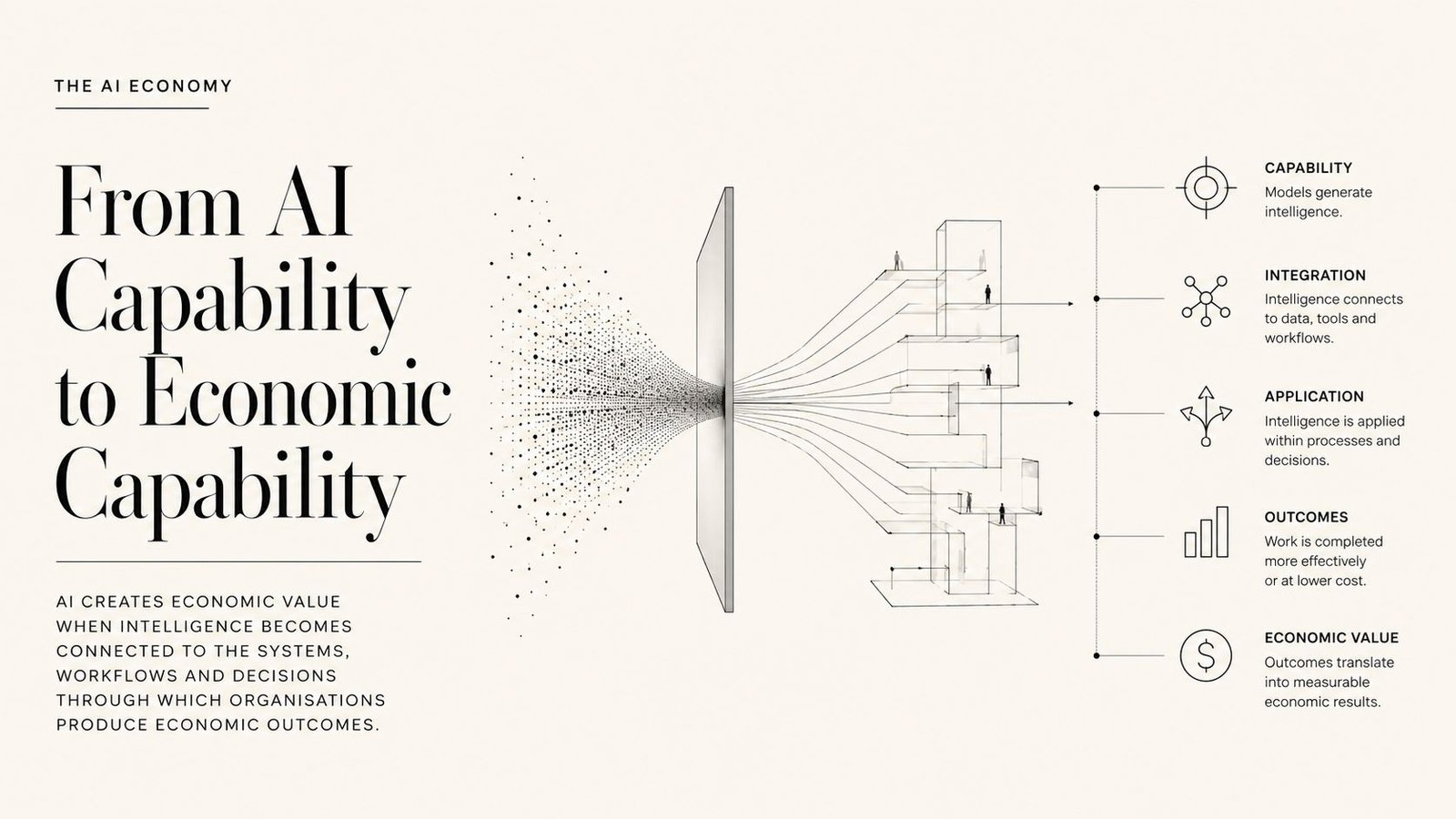
Artificial intelligence has moved beyond the question of whether machines can perform useful tasks. The more consequential question is how those capabilities become part of economic activity. A model can write, analyse, code, search, reason and generate decisions, but those capabilities create economic value only when they are connected to the way an organisation actually works.
Technical capability and economic capability do not develop at the same speed. A system can become more capable without materially changing the economics of an organisation. A smaller improvement can matter far more when it removes a bottleneck, shortens a process or makes work economically viable that previously required substantial human effort.
The important change, therefore, is not simply the improvement of software. Artificial intelligence is creating a layer between technical capability and economic activity. The decisive question is whether an organisation can connect machine output to a process in which the resulting value exceeds the cost of using the intelligence.
Capability becomes valuable inside a system
Software has traditionally created value by executing defined instructions at low marginal cost and reproducing that logic across large numbers of users. AI changes the relationship between software and work because systems can generate outputs that previously required human reasoning.
But value does not reside entirely inside the model. A generated report matters when someone uses it. A coding system matters when it changes development throughput. A system that identifies an operational problem becomes consequential when the organisation can act before the cost of the problem increases.
Economic value therefore emerges from the relationship between capability and the operating system around it. Data, workflows, people, software, decisions and incentives determine whether technical capability becomes productive capacity.
Integration changes the economics of work
Early enterprise AI adoption often treated intelligence as an additional tool. Employees could generate documents, summarise information or produce code without changing the underlying structure of the organisation. Useful productivity gains were possible, but much of the economic system remained unchanged.
Greater value emerges when intelligence becomes part of a recurring process. A customer support system can classify requests before they reach an employee. A software organisation can integrate coding assistance into development workflows. A research team can use machine reasoning to examine a larger body of material before experts make a decision.
The unit of analysis consequently changes. The relevant question is not whether an employee has access to an AI system, but whether the organisation has redesigned a process so that intelligence changes the amount, speed or quality of economic work that can be completed.
The same technology can therefore produce very different results across organisations. The difference lies in the quality of the connection between intelligence and the process through which work is performed.
The Intelligence Value Chain
The transition from technical capability to economic capability can be understood as six connected stages. Each stage determines whether intelligence is converted into productive work and, ultimately, an economic outcome.
The Intelligence Value Chain
AI capability creates economic value only when it moves through the operating system of an organisation.
What the system can understand, generate, predict or execute.
How intelligence becomes available to people, software and workflows.
How intelligence becomes part of an existing organisational process.
How intelligence changes decisions, actions or completed work.
The measurable economic benefit created by the changed process.
Greater economic performance when the stages reinforce one another.
The framework separates technical capability from economic outcome. A system can perform a task exceptionally well while producing little value if access is difficult, integration is poor or the resulting output does not change the underlying process.
The relationship also works in reverse. An organisation can generate significant value from an existing model when it has redesigned its processes around that capability. The competitive difference can therefore emerge from the organisation surrounding the intelligence rather than from the intelligence alone.
Access is not adoption
The spread of AI tools has made access increasingly common. Employees can use models through consumer applications, enterprise platforms and software products without building the underlying technology themselves. Broad availability reduces the importance of simple access as a durable source of advantage.
Adoption requires a different set of decisions. An organisation has to determine where intelligence belongs, what information it can use, which systems it can interact with and how its outputs enter existing processes. Those choices determine whether AI remains an isolated productivity aid or becomes part of the operating model.
Organisations with access to similar models can therefore produce very different results. The underlying technology may be broadly comparable while the surrounding processes, data structures, incentives and management practices are not. Economic value depends on the quality of the connection.
The cost of intelligence becomes part of the calculation
AI introduces a recurring economic consideration that traditional software often obscured. Intelligence is consumed each time a system performs reasoning, generation or inference. The cost of that consumption depends on the model, the complexity of the task, the amount of information processed and the frequency with which the capability is used.
That changes the management problem. Organisations have to decide how much intelligence a task requires and whether the resulting economic value justifies the cost. A simple classification problem does not necessarily require the same level of reasoning as a complex research or engineering task.
AI deployment therefore creates an allocation problem. Intelligence has to be directed toward tasks where additional reasoning produces sufficient economic benefit. Treating every problem as requiring the highest available capability can increase consumption without increasing value proportionally.
Economic capability is a management problem
Once intelligence becomes a recurring input into work, management systems become part of its economic performance. Organisations need visibility into where AI is being used, how workflows are changing and whether the resulting outputs are producing meaningful benefits.
Not every benefit needs to be reduced to a precise financial calculation. Faster decisions, improved quality, reduced waiting time and greater organisational capacity can matter even when they are difficult to isolate in a single metric. The essential requirement is that AI activity can be connected to an outcome that matters.
As AI capabilities become more widely available, competitive advantage moves away from access alone. A more durable advantage can emerge from the ability to recognise where intelligence changes the economics of a process and then redesign that process accordingly.
The difference is organisational rather than purely technological. Two organisations can use similar models and still achieve different outcomes because one has redesigned its workflows, allocated intelligence carefully and connected machine output to decisions that matter.
The economic unit is no longer the model
The important shift in the AI economy is not simply the improvement of models. It is the movement of intelligence into the operating systems of organisations. Once intelligence becomes connected to recurring processes, its value depends on whether the organisation can turn that capability into productive capacity.
Competitive advantage therefore moves away from access alone. Similar models can produce different economic results because organisations differ in how they redesign workflows, allocate intelligence and connect machine output to decisions that matter.
The boundary between technical capability and economic capability is where the value of AI is ultimately determined. It is where software becomes productive capacity, and where organisational design becomes part of the economics of intelligence.
The underlying AI developments and source material are available through the DataGuy AI Developments database.
Explore AI Developments