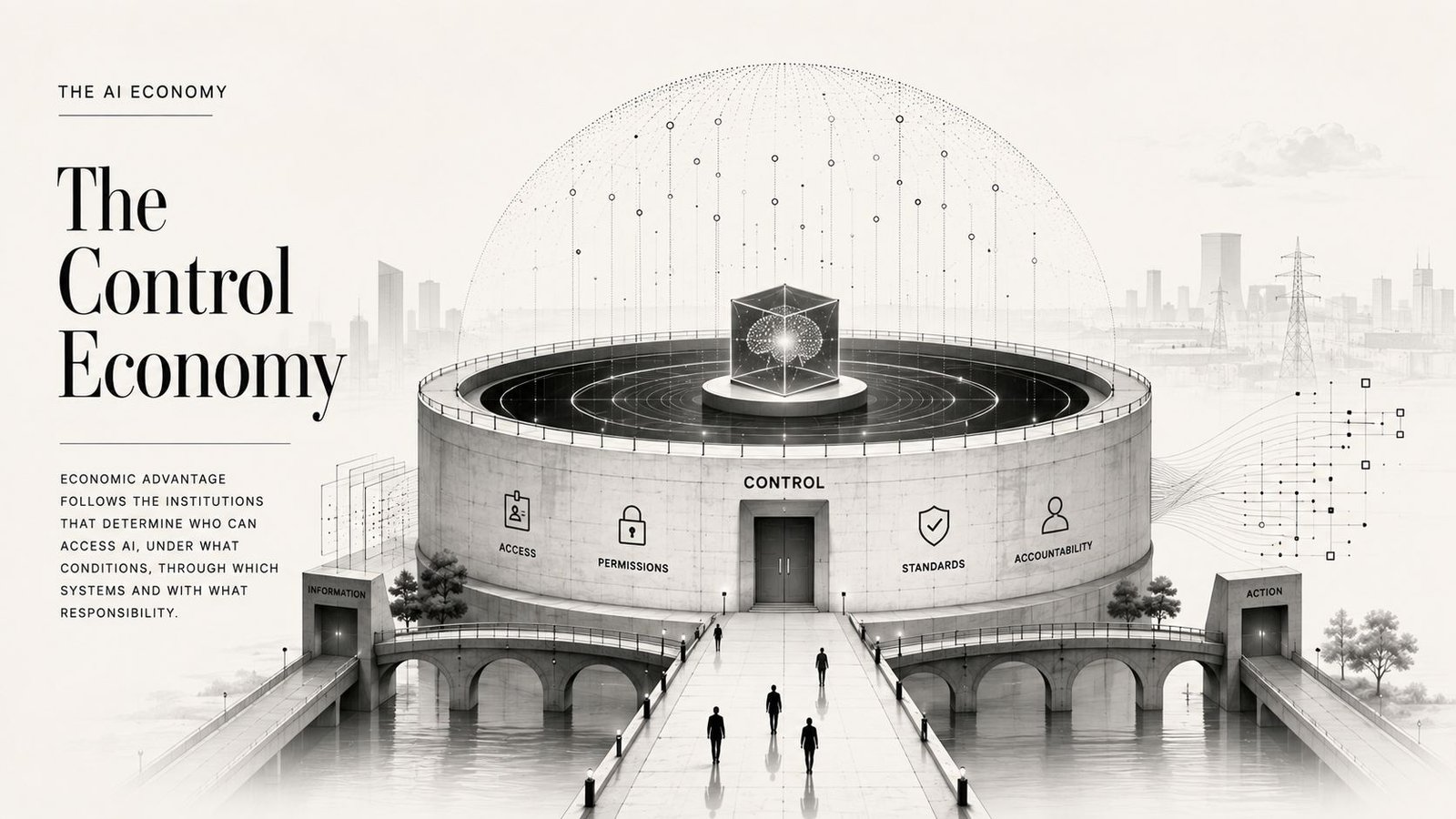
The economics of artificial intelligence are often discussed in terms of capability and cost. A more consequential question emerges once those capabilities become embedded in organisations and infrastructure: who decides where intelligence can be used, what it can access and which actions it is permitted to perform.
Control becomes economically important when AI moves from an optional tool into a system that influences work, information, infrastructure and decisions. At that point, access is no longer a simple technical question. Permissions, standards, data boundaries, institutional rules and accountability determine how much of the available capability can actually be deployed.
Economic advantage can emerge when those conditions become controllable. Organisations and institutions that determine how AI operates influence which systems connect to which data, which users receive access, which actions require approval and which standards govern the resulting activity.
The central change is therefore a movement from control over software toward control over the conditions under which intelligence becomes usable economic capacity.
Capability alone does not determine use
A capable AI system can exist without being available for every purpose. An organisation may restrict access to sensitive information, prevent automated actions in consequential systems or require human approval before a machine-generated decision can affect an external party.
Such restrictions do not necessarily reduce the technical capability of the system. They determine how much of that capability can be exercised within a particular institution. The distinction becomes important as AI systems gain access to business records, operational software, financial systems and other environments where an incorrect action can have material consequences.
The economic value of intelligence therefore depends partly on the rules surrounding it. A system with broad capability but narrow permissions may create less economic value than a comparable system operating within a carefully designed environment that gives it access to the information and tools required for productive work.
Access becomes an economic variable
Access has several dimensions. An employee may have access to a model but not to the data required to use it effectively. A model may have access to information but not to the software required to act on that information. A system may have both but lack permission to execute a consequential action.
Practical reach depends on these boundaries. A single permission can separate observing a process from changing it. Another can separate generating a recommendation from completing an action.
As organisations delegate more work to software, access therefore becomes part of the production system. Decisions about identity, permissions and system integration determine how much work can move through the machine layer without returning to a human operator.
Control is distributed across the system
No single permission determines the full operating boundary of AI. Control is distributed across several layers of the system, from access to information through the authority to act and the responsibility for the outcome.
The stack is cumulative. Access determines what the system can reach. Permission determines what it can do with that access. Standards establish the conditions under which actions are acceptable. Oversight determines where human intervention remains necessary. Accountability establishes who carries responsibility for the outcome.
Control at one layer can constrain the layers below it. An organisation may provide extensive access to information while restricting the actions that can be taken. It may permit automated execution while requiring human approval for specific categories of decisions. The practical operating boundary is created by the complete stack rather than by any single rule.
Data access determines the depth of intelligence
AI systems are limited by the information available to them. A model can possess broad reasoning capability while producing limited organisational value if it cannot access the information needed to understand a particular process.
Data access consequently becomes an economic design problem. Organisations need to determine which information can be exposed to AI systems, which systems can share information with one another and how sensitive material should be isolated.
Data governance therefore becomes part of AI economics. The organisation that can connect useful information to machine reasoning while maintaining appropriate boundaries can create more productive uses than one that keeps every data source isolated.
The challenge is to expand useful access without turning broad access into uncontrolled exposure. That balance becomes more difficult as AI systems become capable of combining information from multiple sources and using it within larger workflows.
Permission determines the distance from advice to action
An AI system that can only produce recommendations occupies a different position from one that can modify records, send communications or initiate transactions. The difference is created by permission rather than by intelligence alone.
Permission architecture therefore becomes an important part of organisational design. Systems can be given narrow authority for routine actions while more consequential decisions remain subject to approval. The objective is to allow machine execution where the economic benefit is clear without giving the system unrestricted control over the surrounding environment.
As the scope of delegated work expands, the design of permissions becomes a direct determinant of how much execution can be transferred to software. A restrictive system may preserve control at the cost of additional human coordination. A broader system can reduce coordination costs while increasing the consequences of an incorrect action.
The economic value of autonomy therefore depends on the boundary around it: broad enough to enable useful execution, precise enough to contain consequential risk.
Standards determine where capability can travel
AI systems increasingly operate across organisational and national boundaries. Models can be integrated into cloud platforms, enterprise applications and external services, which means their use can be affected by technical standards, contractual requirements, industry rules and public policy.
Standards create common conditions for participation. They determine how systems exchange information, how identities are established, how activity is recorded and how organisations demonstrate compliance with requirements that apply to their operations.
Standards can be easy to underestimate because they rarely appear in the user interface. Yet they influence which systems can connect, which vendors can participate and how easily a capability can move between organisations.
Control therefore extends beyond the organisation operating the model. Institutions that establish or enforce standards can influence the shape of the market in which that model is deployed.
Oversight changes when machine activity expands
Human oversight becomes more difficult when AI systems produce larger volumes of work. A person who reviews ten outputs can examine each one directly. A person responsible for supervising thousands of machine-generated actions has to rely on thresholds, exception handling, sampling and monitoring systems.
The economics of control change as oversight becomes a process that has to be designed. Organisations need to decide which activities require direct review, which can be monitored statistically and which can proceed automatically unless an exception occurs.
The result is a shift from reviewing every action toward designing systems that make important deviations visible. Control becomes partly architectural rather than purely manual.
This matters because increasing machine execution without redesigning oversight can simply move the bottleneck from production to review.
Accountability remains attached to institutions
Delegating work to software does not remove the institution from the consequences of that work. Someone still has to establish the conditions under which the system operates and determine who is responsible when those conditions are exceeded.
Accountability becomes particularly important when AI is used in processes that affect customers, employees, financial decisions, access to services or other consequential outcomes. The organisation needs a clear relationship between the authority to act and responsibility for the result.
Technical capability cannot remove this institutional boundary. A system can perform an action autonomously, but the institution that gave it permission remains part of the governance structure surrounding that action.
The more responsibility delegated to software, the more carefully organisations have to define where authority ends and institutional responsibility begins.
Control can become a competitive advantage
Organisations with strong control systems can sometimes deploy AI more extensively because they can establish clear boundaries around its use. They can determine what information the system can access, what actions it can take and which outcomes require review.
That capability can provide an advantage over organisations that respond to uncertainty by restricting AI use across an entire process. The difference is not necessarily a more capable model. It is the ability to create precise controls that allow useful machine activity without creating unacceptable exposure.
Control can therefore increase the usable portion of technical capability. A well-designed governance system can allow more automation because it makes the conditions of that automation explicit.
Governance and productivity are therefore closely connected. Better control does not always mean less freedom for the system. In some settings, better control creates the confidence required to delegate more work.
Institutions shape the distribution of AI capacity
Control also operates at the level of markets and public institutions. Governments determine regulatory conditions. Infrastructure providers determine access to computing capacity. Platform operators determine which capabilities can be integrated into their systems. Enterprises determine how their own data and workflows can be used.
These decisions shape where AI capability can travel and under what conditions it can become economically useful. A capability may be technically available across a market while remaining practically inaccessible to organisations that lack the necessary infrastructure, permissions or institutional capacity.
The distribution of advantage is therefore more complex than model capability alone would suggest. Economic power can accumulate around institutions that control the gateways through which intelligence enters productive activity.
Control creates dependencies
Dependence becomes visible when an organisation relies on another institution for a critical layer of AI access. A company may depend on a cloud provider for compute, a platform for model access, an identity system for permissions or an external service for a critical part of its workflow.
Such dependencies can reduce the organisation's ability to change providers, alter operating conditions or control the economics of the system independently. Technical architecture consequently has a direct relationship with institutional power.
Organisations that control fewer layers of the stack may still benefit from AI, but they operate within the conditions established by the institutions that control the underlying access points.
The strategic question becomes how much of the control stack an organisation needs to own, how much it can safely delegate and where dependence on external systems creates material exposure.
Control is becoming part of infrastructure
As AI systems become embedded in production processes, control mechanisms begin to resemble infrastructure. Identity systems, permissions, audit records, policy engines, monitoring systems and approval workflows determine whether machine activity can operate reliably inside an institution.
These systems are often invisible when they work well. Their importance becomes apparent when an organisation tries to expand AI use and discovers that its surrounding controls cannot support the required scale.
An organisation may have access to capable models and sufficient computing resources while still being unable to deploy them widely because its control systems are too weak or fragmented.
The control problem also grows with capability. As the range of machine activity expands, organisations need more precise ways to distinguish between actions that can be automated, actions that require review and actions that should remain outside machine authority.
The ability to make those distinctions efficiently becomes part of the productive capacity of the organisation itself.
Economic power follows the boundaries of intelligence
AI capability does not determine economic value on its own. The institutional system around it determines what intelligence can reach, what it can do, how its actions are governed and who carries responsibility for the outcome.
That is why similar technical capabilities can produce different results across organisations. The difference can lie in the quality of the control systems that turn access into usable, bounded machine activity.
Control therefore becomes a productive capability. Institutions that can establish precise boundaries around machine activity can often use more of the available intelligence because they can distinguish useful delegation from unacceptable exposure.
As AI moves further into infrastructure, workflows and consequential decisions, competitive advantage will depend increasingly on who controls the pathways through which machine capability becomes action.
The underlying AI developments and source material are available through the DataGuy AI Developments database.
Explore AI Developments