DataGuy Editorial
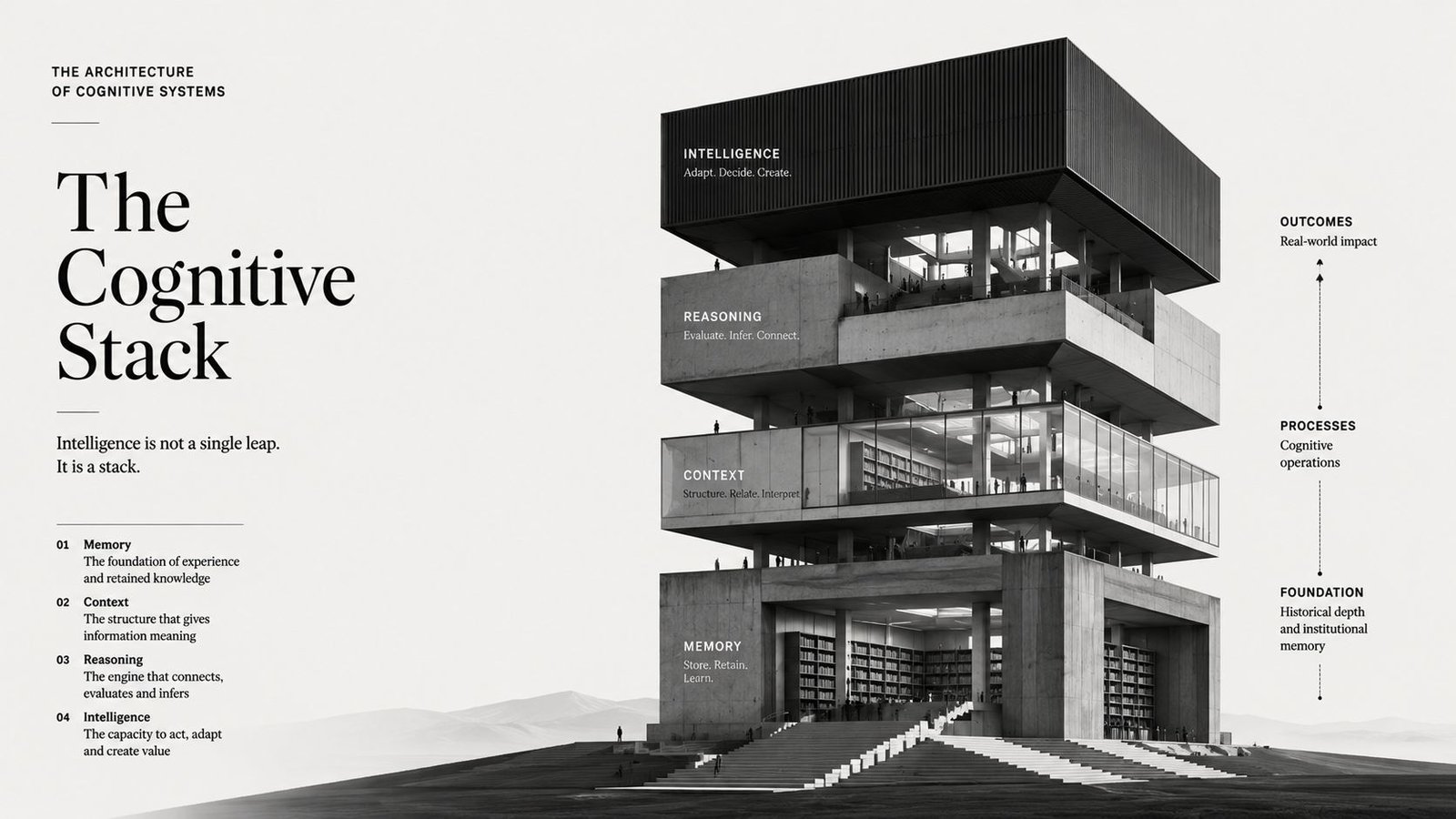
The Cognitive Stack
Every technological revolution eventually creates a stack. The industrial economy created production stacks. The digital economy created software stacks. The intelligence economy is beginning to create something new altogether. A cognitive stack that connects information, memory, context, reasoning, and action into a system capable of continuously generating organizational intelligence.
By
Pradeep Kumar K
· Editorial Analysis · Cognitive Architecture · Intelligence Systems
June 2026 · 18 min read
Executive Summary
- Every major technological era develops layered architectures that transform individual capabilities into scalable systems.
- Artificial intelligence is evolving beyond models and tools into a broader cognitive architecture composed of information, memory, context, reasoning, and action.
- Most organizations continue to focus on individual AI components while overlooking the larger system through which intelligence is created and deployed.
- Memory preserves understanding, context provides relevance, reasoning generates judgment, and action converts intelligence into economic value.
- The organizations that build effective cognitive stacks will create intelligence systems that improve continuously through accumulated experience.
- The next generation of competitive advantage may emerge not from possessing better models, but from designing superior cognitive architectures.
Every technological revolution eventually creates a stack.
The history of technology can be understood as a progression from individual capabilities to interconnected systems. Early innovations often appear as isolated breakthroughs. Over time, however, those breakthroughs become components within larger architectures that define how value is created. The industrial economy did not emerge simply because factories existed. It emerged because production systems connected raw materials, manufacturing processes, transportation networks, labor, and distribution into coherent economic structures. The digital economy followed a similar path. Databases, networking technologies, operating systems, cloud infrastructure, software applications, and user interfaces evolved into layered stacks that transformed computing from a specialized capability into a global platform for economic activity.
Artificial intelligence appears to be entering a similar phase of development. Much of today's conversation remains focused on individual components. Organizations debate models, evaluate benchmarks, compare reasoning capabilities, and experiment with agents. These discussions are important because components matter. Yet history suggests that transformative technologies rarely create lasting value through individual components alone. Their greatest impact emerges when those components become integrated into systems. The critical question therefore is not which model performs best. The more important question is what architecture emerges around intelligence itself.
The answer may be the cognitive stack.
The previous articles in this series explored several foundational ideas. Intelligence is becoming increasingly accessible and increasingly utility-like. Context is becoming a scarce resource. Context behaves increasingly like capital. Memory is emerging as the infrastructure layer responsible for preserving and compounding organizational understanding. Each of these arguments addressed a different aspect of the intelligence economy. The cognitive stack provides a framework for understanding how they connect. Rather than viewing intelligence as a standalone capability, the cognitive stack treats intelligence as an emergent property arising from the interaction of multiple layers.
This distinction is significant because organizations often misunderstand the nature of intelligent systems. Many enterprises approach artificial intelligence in the same way they previously approached software procurement. They acquire models, implement tools, and deploy applications with the expectation that intelligence will emerge automatically. Yet intelligence does not operate in isolation. Human cognition depends upon memory, context, reasoning, and action. Organizational intelligence depends upon similar structures. A model may provide reasoning capabilities, but reasoning alone does not create understanding. Information provides inputs. Memory provides continuity. Context provides relevance. Reasoning generates judgment. Action converts judgment into outcomes. Remove any layer and the effectiveness of the entire system begins to deteriorate.
This perspective suggests that the future of artificial intelligence may be less about individual models and more about architectural design. Competitive advantage may increasingly depend on how effectively organizations connect information, memory, context, reasoning, and action into systems capable of continuous improvement. The organizations that understand this shift will likely focus less on isolated capabilities and more on cognitive architecture. Their objective will not simply be deploying intelligence. Their objective will be building systems through which intelligence can accumulate, learn, and create value over time.
The implications extend beyond technology. Every economic era develops dominant architectures that shape organizational behavior. Factories shaped industrial organizations. Enterprise software shaped digital organizations. Cognitive architectures may shape intelligent organizations. Understanding this transition is therefore not merely a technical challenge. It is a strategic one. The architecture through which intelligence operates may ultimately become more important than intelligence itself.
Central Thesis
The intelligence economy is creating a new architectural layer between information and action. As organizations move beyond standalone AI tools, competitive advantage increasingly depends upon the design of cognitive stacks that connect information, memory, context, reasoning, and execution into systems capable of continuously generating organizational intelligence.
Part I · The Evolution Of Technology Stacks
Why Every Technological Era Creates New Architectures
Technological progress rarely occurs through isolated inventions. Individual breakthroughs attract attention, but enduring economic impact emerges when those breakthroughs become integrated into larger systems. The history of computing provides a useful example. Early computers were remarkable technological achievements, yet their economic significance remained limited until complementary layers emerged. Operating systems standardized interactions between hardware and software. Databases enabled persistent information storage. Networks enabled communication. Applications transformed computing power into practical utility. Together, these layers formed a technology stack capable of supporting entirely new industries.
The same pattern appears across other domains. The internet was not simply a network. It became an ecosystem composed of protocols, infrastructure, platforms, applications, and interfaces. Cloud computing was not merely remote infrastructure. It evolved into a layered architecture supporting software development, data management, security, analytics, and global deployment. In each case, value migrated from individual technologies toward the systems connecting them. Organizations that understood the architecture often created more durable advantages than those focused exclusively on individual components.
Artificial intelligence appears to be following a similar trajectory. Early adoption focused primarily on model capabilities because models represented the most visible form of innovation. As adoption expands, organizations increasingly encounter challenges that models alone cannot solve. Intelligence requires access to information. Information requires memory. Memory requires context. Context requires interpretation. Interpretation requires action. These dependencies reveal a broader reality. Intelligence is not a single layer. It is a stack.
The emergence of this stack reflects a deeper shift in how organizations create value. During the software era, the primary objective was processing information. During the intelligence era, the objective becomes generating understanding. Information processing and understanding are related, but they are not identical. Information can be stored, transmitted, and analyzed without necessarily influencing decisions. Understanding requires context, continuity, and judgment. As organizations pursue increasingly intelligent operations, they require architectures capable of supporting all three.
Viewed through this lens, the intelligence economy resembles previous technological revolutions in one important respect. The greatest opportunities rarely emerge from isolated capabilities. They emerge from architectural shifts that reorganize how capabilities interact. The organizations that recognize the emergence of the cognitive stack early may gain advantages not because they possess better models, but because they build better systems.
Part II · The Cognitive Stack Framework
How Organizational Intelligence Actually Emerges
One of the most persistent misconceptions surrounding artificial intelligence is the belief that intelligence originates primarily from reasoning. This assumption is understandable because reasoning is the most visible component of intelligent behavior. When people interact with advanced models, they observe answers, analysis, recommendations, and decisions. The visible output creates the impression that reasoning itself is the source of intelligence. Yet both human cognition and organizational intelligence suggest a different reality. Reasoning is important, but reasoning alone is rarely sufficient. Effective judgment depends upon information, memory, context, and the ability to convert conclusions into action. Intelligence emerges not from a single capability but from the interaction of multiple layers operating together.
The distinction matters because organizations frequently focus their investments on the most visible layer while neglecting the supporting architecture beneath it. Enterprises invest in models because models produce observable outputs. They invest in agents because agents perform tasks. They invest in automation because automation generates measurable efficiencies. Yet many deployments struggle to create sustained value because the underlying cognitive architecture remains incomplete. Intelligence cannot operate effectively without access to historical understanding. Historical understanding cannot exist without memory. Memory cannot create value without context. Context cannot generate outcomes without action. Each layer depends upon the others.
This observation suggests that intelligence should be understood less as a capability and more as a system. Just as modern software depends upon multiple layers of infrastructure operating together, organizational intelligence emerges through interactions between different cognitive functions. Information provides awareness. Memory preserves continuity. Context supplies relevance. Reasoning generates judgment. Action transforms judgment into economic value. Remove any layer and the effectiveness of the system deteriorates. Strengthen the connections between layers and intelligence becomes more capable, more adaptive, and more valuable.
The importance of this perspective becomes increasingly evident as organizations move beyond experimentation toward large-scale deployment. During the early stages of AI adoption, individual capabilities often appear sufficient because use cases remain narrow. As complexity increases, however, limitations emerge. Models require organizational knowledge. Agents require memory. Decision systems require context. Workflows require continuity. The architecture surrounding intelligence becomes as important as the intelligence itself. At this point, competitive advantage begins shifting away from individual components and toward the quality of the overall system.
Foundational Framework
The Cognitive Stack
Layer 1
Information
Data, records, transactions, documents, communications, and events that provide raw organizational awareness.
Layer 2
Memory
The preservation of organizational knowledge, historical decisions, institutional experience, and accumulated understanding across time.
Layer 3
Context
The relationships, circumstances, histories, constraints, and meanings that make information relevant and actionable.
Layer 4
Reasoning
Analysis, planning, interpretation, decision-making, prioritization, and judgment generated from context-rich understanding.
Layer 5
Action
Execution, automation, workflows, interventions, and decisions that convert intelligence into measurable outcomes.
Result
↑
Organizational intelligence emerges through the interaction of all five layers rather than from any individual layer alone.
The framework reveals an important progression. Information answers the question of what happened. Memory answers the question of what has happened before. Context explains why events matter. Reasoning evaluates what should happen next. Action determines what actually happens. Each layer increases the value of the layers beneath it because intelligence depends not merely on acquiring knowledge but on transforming knowledge into decisions and decisions into outcomes. The stack therefore functions less like a hierarchy and more like a chain of value creation.
This perspective also helps explain why many organizations remain rich in data while struggling to become truly intelligent. Investments often concentrate on information and analytics because those layers are relatively easy to measure. Far fewer organizations invest systematically in memory, context, and cognitive continuity. The result is a structural imbalance. Intelligence systems possess access to information but lack sufficient historical understanding. They generate outputs but struggle to develop judgment. They automate processes without necessarily improving decision quality. The issue is not the absence of intelligence. The issue is the absence of a complete cognitive stack.
The strongest organizations of the intelligence era will likely recognize that intelligence behaves differently from previous technological capabilities. Intelligence does not function effectively as a standalone resource. It depends upon surrounding layers that provide continuity, relevance, and direction. As a result, future competitive advantage may depend less on acquiring more intelligence and more on designing architectures that allow intelligence to operate within richer cognitive environments.
The Architectural Shift
The software era focused on processing information. The intelligence era focuses on generating understanding. Information systems optimized the movement of data. Cognitive systems optimize the movement of meaning. The difference may define the next generation of enterprise architecture.
This realization challenges one of the dominant assumptions of the current AI landscape. Most discussions continue to revolve around models because models remain the most visible component of intelligent systems. Yet visibility should not be confused with importance. Throughout technology history, the most visible layer rarely determines long-term advantage. Operating systems became more important than processors. Platforms became more important than applications. Networks became more important than individual devices. The intelligence economy may reveal a similar pattern. Models matter, but models alone are not the system.
Understanding this distinction is essential because it shifts attention toward the next stage of organizational development. If intelligence emerges from the interaction of multiple cognitive layers, then organizations must think differently about how they design intelligent systems. The challenge is no longer simply selecting a model. The challenge is constructing an architecture capable of continuously transforming information into understanding and understanding into action.
Part III · Why Models Are Not The System
The Limits Of Model-Centric Thinking
The current phase of artificial intelligence is heavily influenced by model-centric thinking. Organizations evaluate benchmark scores, reasoning capabilities, context windows, multimodal performance, and agentic features because these characteristics provide visible indicators of technological progress. Models have become the focal point of strategic discussions in much the same way that processors dominated conversations during earlier phases of computing. Yet history suggests that focusing exclusively on the most visible layer often leads organizations to underestimate the importance of the surrounding architecture.
A useful comparison can be found in the evolution of enterprise software. During the early stages of the software industry, attention frequently centered on programming languages, hardware specifications, and application functionality. Over time, however, competitive advantage shifted toward broader ecosystems that connected infrastructure, platforms, databases, workflows, and user experiences. Individual components remained important, but value increasingly emerged from how those components interacted. The intelligence economy appears to be entering a similar transition.
A powerful model operating without memory resembles an expert suffering from amnesia. It may demonstrate impressive reasoning capabilities in the moment, but it struggles to build upon previous experience. A model operating without context resembles a decision-maker lacking situational awareness. It can analyze information but cannot fully understand its significance. A model operating without action resembles an advisor whose recommendations never influence outcomes. In each case, intelligence exists, yet the broader system remains incomplete.
This observation highlights a crucial point. Organizations often believe they are building intelligence when they are actually deploying isolated reasoning engines. True organizational intelligence requires continuity, historical understanding, contextual awareness, and the ability to convert conclusions into actions that influence future outcomes. Models contribute to this process, but they do not define it. They represent one layer within a much larger architecture.
Part IV · The Intelligence Amplification Loop
How Cognitive Systems Compound Understanding
One of the defining characteristics of valuable systems is their ability to improve through use. Financial systems compound through reinvestment. Knowledge systems compound through learning. Networked systems compound through participation because each additional participant increases the value of the network. The same principle applies to intelligence. The most valuable intelligent systems are not necessarily those that begin with the highest capabilities. They are often the systems that improve continuously because every interaction strengthens future performance. Understanding this dynamic requires moving beyond static views of intelligence and toward a more cyclical perspective.
Much of today's discussion treats intelligence as an output. Organizations provide information to a system, receive an answer, and evaluate the quality of the result. While useful, this perspective captures only a small portion of the larger process. Intelligence becomes significantly more valuable when outputs influence future inputs. A decision generates an outcome. The outcome creates new information. That information becomes part of organizational memory. Memory enriches context. Context improves future reasoning. Better reasoning produces better actions. The cycle then repeats. Intelligence ceases to be a single event and becomes a continuous process of accumulation.
This distinction is important because it reveals why some organizations improve over time while others remain trapped in cycles of repetition. Both may possess access to similar technologies. Both may deploy comparable models. Yet one organization consistently learns from experience while the other repeatedly confronts the same challenges. The difference often lies in the presence of a feedback architecture capable of converting experience into understanding. Intelligence creates value not only when it generates answers, but when those answers become part of a system that improves future judgment.
The previous article introduced memory as infrastructure. This article expands that argument by positioning memory within a larger cognitive architecture. Memory preserves understanding, but preservation alone is insufficient. Preserved knowledge must influence context. Context must influence reasoning. Reasoning must influence action. Action must generate new experiences that strengthen memory. The resulting system behaves less like a repository and more like a living cycle of organizational intelligence.
Strategic Framework
The Intelligence Amplification Loop
Stage 1
Information
Organizations generate data, observations, interactions, transactions, events, and signals through daily activity.
Stage 2
Memory
Important experiences are preserved as institutional knowledge rather than disappearing through fragmentation and forgetting.
Stage 3
Context
Preserved knowledge is connected to relationships, histories, constraints, and organizational understanding.
Stage 4
Reasoning
Context-rich understanding improves analysis, prioritization, planning, and decision-making.
Stage 5
Action
Decisions become operational outcomes that influence customers, employees, systems, and markets.
Result
↺
Actions generate new information, strengthening the memory base and restarting the cycle with greater understanding.
The framework illustrates why intelligence should be viewed as a compounding system rather than a discrete capability. Each cycle increases the quality of future cycles because every outcome contributes additional experience. Over time, the organization develops richer memory, deeper context, stronger reasoning, and more effective actions. The resulting advantage emerges gradually but can become substantial because the system continuously builds upon itself. Small improvements in each layer accumulate into significant differences in organizational performance.
This compounding effect helps explain why the most valuable organizations of previous economic eras often possessed advantages that appeared difficult to replicate. Their strength did not originate from isolated assets alone. It emerged from systems capable of learning, adapting, and improving through repeated cycles of activity. The intelligence economy extends this principle. Organizations increasingly require architectures that allow understanding to accumulate rather than dissipate. The Intelligence Amplification Loop provides one mechanism through which this accumulation occurs.
The implications become particularly significant when intelligent systems are integrated throughout the enterprise. Customer interactions can contribute to organizational memory automatically. Operational outcomes can enrich future decision-making. Strategic initiatives can generate institutional understanding that remains accessible long after the original participants have moved on. In each case, intelligence becomes less dependent upon individual expertise and more dependent upon the quality of the underlying cognitive architecture.
From Automation To Amplification
Many organizations approach artificial intelligence as an automation technology. Automation focuses on reducing effort. Amplification focuses on increasing capability. The most important systems of the intelligence economy may not simply perform tasks faster. They may continuously improve the quality of organizational understanding through every interaction, every decision, and every outcome.
This perspective also reframes the role of intelligent systems within organizations. Rather than functioning merely as tools, they begin functioning as participants in an ongoing cycle of learning and adaptation. Their value depends not only on what they know today but also on their ability to contribute to what the organization knows tomorrow. Intelligence becomes cumulative. Understanding becomes scalable. Experience becomes reusable.
The emergence of amplification loops points toward a larger organizational transformation. If cognitive architectures can continuously strengthen themselves through experience, then enterprises may need to rethink how they structure teams, workflows, decision-making processes, and knowledge systems. The future organization may not be defined solely by its people or its technology. It may be defined by the quality of the cognitive systems connecting them.
Part V · Building Cognitive Organizations
From Knowledge Work To Cognitive Work
The emergence of cognitive stacks introduces a broader organizational question. What happens when intelligence becomes an architectural capability rather than an individual capability? For most of modern economic history, organizations were designed around the assumption that cognition resided primarily within people. Information systems supported employees. Processes coordinated activities. Management structures distributed decisions. Knowledge flowed through teams because teams represented the primary containers of expertise. Artificial intelligence does not eliminate these realities, but it changes their relationship.
As cognitive architectures mature, organizations gain the ability to distribute memory, context, reasoning, and decision support throughout the enterprise. Expertise becomes less dependent upon proximity to specific individuals. Historical understanding becomes more accessible. Institutional knowledge becomes easier to preserve. The result is not the replacement of human judgment but the expansion of organizational cognition. Intelligence becomes embedded within workflows rather than concentrated solely within individuals or departments.
This shift may prove as important as the transition from manual processes to software systems. Software transformed how organizations processed information. Cognitive architectures may transform how organizations generate understanding. The implications extend across every function. Customer-facing teams gain access to richer context. Operations teams gain access to accumulated institutional knowledge. Leadership teams gain access to broader historical understanding. Decision quality improves because intelligence becomes connected to memory and context at scale.
The organizations that thrive in this environment will likely be those that view intelligence as a system rather than a tool. Their objective will not be deploying isolated AI applications. Their objective will be constructing cognitive environments in which information, memory, context, reasoning, and action continuously reinforce one another. In such organizations, intelligence becomes a property of the enterprise itself rather than a capability limited to individuals, teams, or technologies.
Part VI · The Cognitive Enterprise
Why Organizations Themselves Are Becoming Intelligent Systems
Throughout history, organizations have been shaped by the dominant technologies of their era. Industrial enterprises were designed around production systems because production determined economic value. Digital enterprises were designed around information systems because information became the central resource of the economy. Organizational structures, workflows, management practices, and operating models evolved to reflect these realities. The intelligence economy introduces a different requirement. Organizations must increasingly manage not only information but understanding. As a result, enterprises themselves begin to evolve into cognitive systems.
This shift represents more than another phase of digital transformation. Digital transformation primarily focused on converting physical processes into information flows. The cognitive transformation focuses on converting information into understanding. The distinction may appear subtle, but it has profound implications. Information systems optimize the movement of data. Cognitive systems optimize the movement of meaning. They preserve historical understanding, provide contextual awareness, support reasoning, and improve decision-making across the enterprise. The objective is not merely operational efficiency. The objective is organizational intelligence.
The concept of the cognitive enterprise emerges naturally from the frameworks introduced throughout this series. Intelligence becomes accessible through infrastructure. Context becomes a scarce asset. Context evolves into capital. Memory becomes the infrastructure that preserves that capital. The cognitive stack then provides the architecture through which information, memory, context, reasoning, and action interact. When these elements operate together at scale, intelligence ceases to be a collection of isolated capabilities and becomes a property of the organization itself.
This transformation challenges traditional assumptions about where expertise resides. Historically, knowledge was concentrated within individuals, departments, and specialized teams. Accessing expertise often required locating the right person with the right experience at the right moment. Cognitive enterprises operate differently. Institutional knowledge becomes more broadly accessible because memory systems preserve understanding beyond individuals. Context becomes easier to retrieve because cognitive architectures connect information across organizational boundaries. Decision-making becomes more informed because historical experience participates directly in current activities. Expertise remains valuable, but expertise becomes increasingly augmented by organizational intelligence.
Enterprise Framework
The Cognitive Enterprise Model
Capability 1
Remembers
Institutional knowledge persists across employees, projects, business cycles, and organizational change.
Capability 2
Understands
Information is enriched by context, history, relationships, and accumulated organizational experience.
Capability 3
Reasons
Decisions benefit from memory, context, strategic understanding, and broader organizational awareness.
Capability 4
Acts
Understanding is translated into coordinated actions, workflows, decisions, and operational outcomes.
Capability 5
Learns
Every outcome strengthens future understanding through continuous accumulation of experience.
Result
∞
The organization develops intelligence that compounds over time rather than resetting with each change.
The significance of this model lies in its recognition that organizational intelligence is fundamentally different from individual intelligence. Individual intelligence is constrained by personal experience, limited memory, and finite attention. Organizational intelligence has the potential to accumulate understanding across thousands of employees, millions of interactions, and decades of experience. The challenge has historically been coordination. Valuable knowledge existed but remained fragmented. Cognitive architectures reduce that fragmentation by creating mechanisms through which institutional understanding can become continuously accessible and operational.
This possibility creates a new source of competitive advantage. During the industrial era, scale provided advantage because larger organizations could produce more efficiently. During the digital era, information advantages became increasingly important. During the intelligence era, the strongest enterprises may be those capable of accumulating and deploying understanding most effectively. Their advantage will not originate solely from superior technology or larger datasets. It will emerge from the quality of the cognitive systems connecting information, memory, context, reasoning, and action.
Strategic Outlook
The Architecture Of The Intelligence Economy
Technological revolutions are often described through the innovations that initiate them. The industrial revolution is associated with machinery. The digital revolution is associated with computing. The intelligence revolution is associated with artificial intelligence. Yet the most enduring consequences of technological change rarely originate from individual inventions. They emerge from the architectures that form around those inventions. Factories mattered because they reorganized production. The internet mattered because it reorganized communication. Artificial intelligence may matter because it reorganizes cognition.
This possibility helps explain why discussions focused exclusively on models often feel incomplete. Models are important, but they represent only one layer within a larger transformation. The intelligence economy is creating new relationships between information, memory, context, reasoning, and action. Organizations are beginning to develop systems capable of preserving understanding, applying historical knowledge, and improving decision-making continuously. These developments suggest that intelligence is gradually evolving from a capability into an architecture.
The implications extend beyond technology strategy. Enterprise design, management theory, organizational structure, and competitive dynamics may all evolve in response to cognitive architectures. New disciplines will emerge around memory systems, context orchestration, cognitive governance, and organizational intelligence. Future enterprises may be evaluated not merely by their assets, products, or market share, but by the quality of the cognitive systems that support their decisions.
Viewed through this lens, the intelligence economy resembles previous economic transitions in one important respect. The greatest opportunities rarely emerge from adopting a technology. They emerge from understanding the new systems that technology makes possible. The organizations that recognize the emergence of the cognitive stack early may gain advantages that extend far beyond today's AI deployments because they are building the foundations of a new operating model for intelligence itself.
Strategic Implication
The next generation of competitive advantage may not belong to organizations with the most intelligence. It may belong to organizations with the most effective cognitive architecture. As intelligence becomes increasingly accessible, the systems connecting information, memory, context, reasoning, and action become the true source of differentiation.
Conclusion
The first phase of artificial intelligence focused on creating intelligent systems. The next phase may focus on creating intelligent organizations. This transition requires a broader perspective on how intelligence actually functions. Information alone is insufficient. Memory alone is insufficient. Context alone is insufficient. Reasoning alone is insufficient. Each layer becomes valuable because of its relationship to the others. Together, they form a cognitive stack capable of transforming isolated capabilities into a coherent system of understanding.
The significance of this shift extends beyond enterprise technology. Every major economic era develops architectures that shape how value is created. The industrial economy developed production architectures. The digital economy developed software architectures. The intelligence economy is beginning to develop cognitive architectures. Understanding these architectures may become one of the most important strategic challenges facing organizations over the coming decade because they define how intelligence is accumulated, deployed, and transformed into economic value.
Organizations that view intelligence as a standalone tool will likely struggle to capture its full potential. Organizations that view intelligence as a system may create advantages that compound for years. Their strength will emerge not from any individual technology but from the architecture connecting information, memory, context, reasoning, and action into a continuously improving cycle of organizational understanding.
Final Observation
The software era taught organizations how to process information. The intelligence era may teach them how to compound understanding. The cognitive stack represents the architecture through which that transformation occurs, connecting information, memory, context, reasoning, and action into a system capable of learning from every interaction and improving with every cycle of experience.
Author Note
This article is part of the ongoing DataGuy Editorial series exploring the foundations of the Intelligence Economy. Previous essays examined intelligence as a utility, context as a scarce resource, context as capital, and memory as infrastructure. This article introduces the Cognitive Stack as the architectural framework connecting those ideas into a unified model of organizational intelligence. The next article explores Agentic Systems and the transition from intelligence as analysis to intelligence as autonomous action.