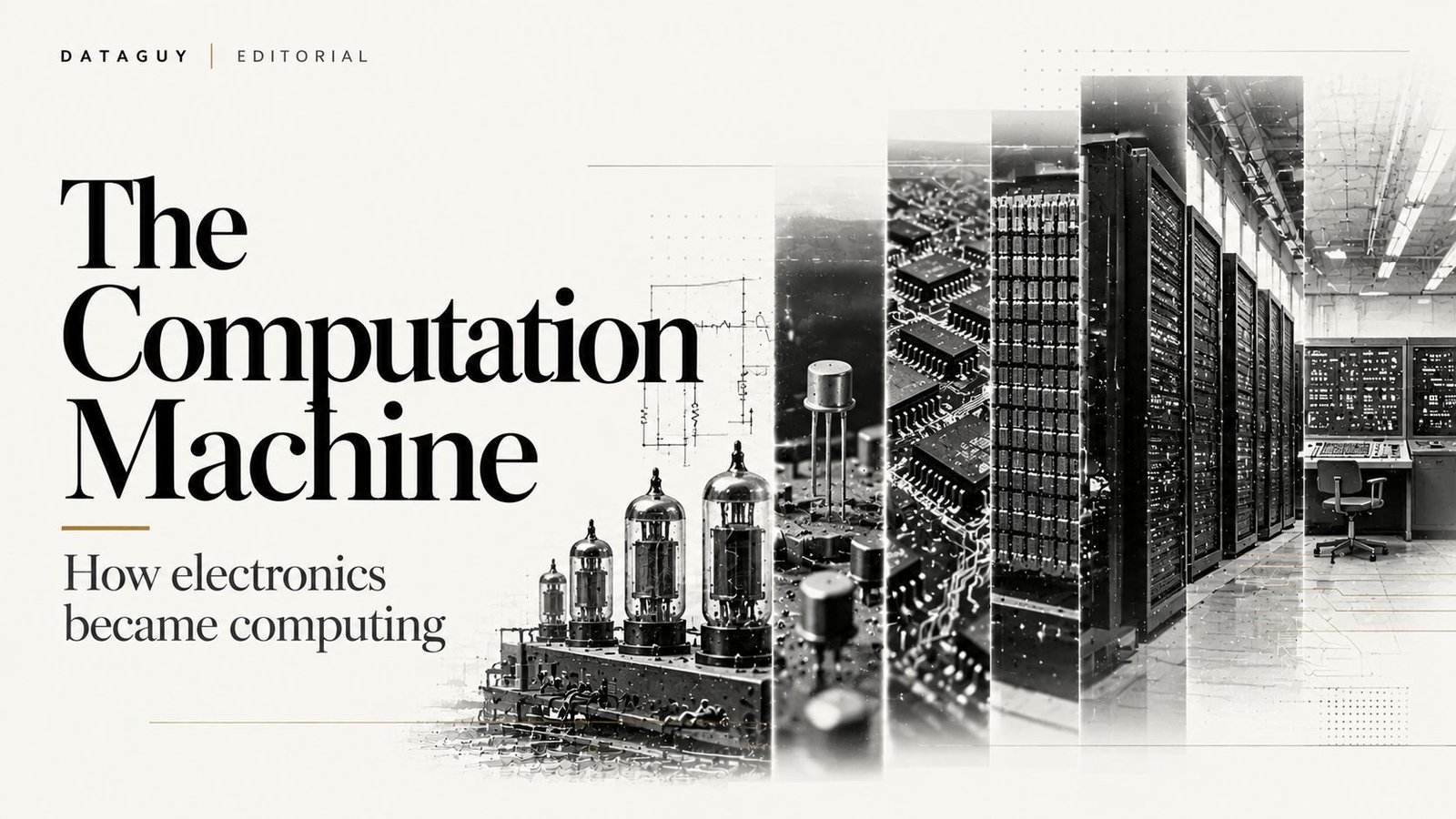
The semiconductor made controlled electronic behaviour increasingly reproducible. But a transistor, however reliable, could not calculate a result on its own. A memory element could retain a state, and a logic circuit could combine signals, yet neither capability alone constituted a general-purpose computer.
The decisive development was the organization of these physical capabilities into a system. Electronic states had to represent information. Circuits had to perform defined operations on those representations. Memory had to preserve information between operations. Control had to coordinate the sequence. Architecture had to make the entire arrangement function as a coherent machine.
Computation emerged from this organization.
This distinction matters because the history of computing is not simply a history of faster components. It is a history of how physical processes were arranged to manipulate information according to defined rules. The individual device supplied a capability. The system gave that capability a computational purpose.
Earlier essays in Beneath Intelligence examined the conditions that made reliable industrial production possible, from controlled energy to precision manufacturing and semiconductor fabrication. This essay follows a different question: how did those material and electronic capabilities become machines that could perform general computation?
The answer lies in several developments that reinforced one another without being the product of a single invention. Digital logic provided a way to organize electronic states. Memory allowed information to persist. Computer architecture coordinated processing and control. Integrated circuits made increasingly complex electronic arrangements reproducible. The stored-program concept established a particularly consequential separation between the physical machine and the instructions directing its behaviour.
Together, these developments made computation a general-purpose capability rather than a property of one specially constructed calculating device.
When a physical state became a logical state
A computer circuit operates physically through voltages, currents and changes in the states of its components. At the logical level, those physical conditions can represent distinctions such as zero and one. Once those distinctions are sufficiently reliable, they can be organized into relationships that implement logical operations.
Digital logic supplies this bridge between electronics and information processing. A circuit can combine inputs, invert a signal, select between alternatives or produce an output according to a defined relationship. More elaborate circuits can be assembled from simpler logical functions. These arrangements allow a physical system to carry out operations whose meaning is described independently of the particular voltages used to implement them.
The separation between physical implementation and logical description is fundamental. The same logical operation can be realized through different technologies, provided the underlying devices preserve the required behaviour. A circuit designer can therefore reason about what a system should do without treating every electronic interaction as a separate problem.
This is an example of abstraction becoming an engineering resource. The physical process remains indispensable, but the designer gains a more general language for organizing it.
The importance of digital logic is not that it removes complexity. Complex circuits still require careful design, testing and coordination. Rather, logic makes complexity manageable by allowing larger systems to be constructed from operations whose behaviour can be specified and understood.
Yet a network of logical operations is not automatically a useful computer. A system must also retain information, coordinate operations over time and arrange its components so that a sequence of computations can be performed. The next layer is therefore not simply more logic. It is the organization of logic into a machine.
The architecture of computation
A computer is best understood as a coordinated arrangement of capabilities rather than as a single component. Processing performs operations on represented information. Memory retains instructions, data and intermediate results. Control determines which operations occur and in what sequence. Input and output allow information to enter and leave the system. Architecture establishes how these elements interact.
The Computation Stack
Controlled electronic states become computational capability when they are organized into systems that can represent, retain and transform information.
Electronic devices change between controlled states.
States are organized into defined relationships and operations.
Information and intermediate results can persist.
Operations are coordinated into sequences.
Processing, memory, control and input/output work as an organized system.
The system executes defined operations on represented information.
The layers are related, but they are not interchangeable. Switching is a physical capability. Logic assigns structure to states. Memory makes persistence possible. Control organizes operations over time. Architecture coordinates the capabilities into a working machine. Computation is the resulting system-level capability.
This framework also explains why the performance of a computer cannot be understood by looking at its processor alone. A processor may execute operations quickly, but the machine still needs to retrieve instructions, access data, preserve results and communicate with other components. If those supporting processes cannot keep pace, the overall system may perform below the limits suggested by its most visible component.
The organization of the machine therefore matters as much as the capabilities of its individual parts. Computation depends on the relationships among components, not merely on their presence.
Memory makes computation persistent
A machine that transforms an input but cannot retain information has limited scope. Useful computation often requires a result from one operation to become an input to another. It may also require the machine to preserve a sequence of values, remember intermediate states or retain information until a later stage of processing.
Memory makes these relationships possible. The history of computer memory includes several technologies, from early electronic and electromechanical arrangements to magnetic storage and semiconductor memory. Their properties differed in speed, capacity, cost, reliability and physical form. No single technology solved every memory problem at once.
The deeper development was architectural. Information could increasingly be represented and retained within a machine in forms that its processing components could use. The computer could work through extended sequences of operations rather than being understood only as a device that performed isolated calculations on externally supplied inputs.
Memory also introduced enduring design trade-offs. Fast memory has historically been more expensive per unit of capacity than slower storage. Large systems consequently developed layers of memory and storage, each serving a different purpose. Modern computers still manage these trade-offs through registers, caches, main memory and persistent storage.
The practical point is that computation depends not only on performing operations but also on making the right information available at the right moment. A system’s capability depends on both. How memory came to hold the instructions governing those operations belongs to the next stage of the story.
The stored-program idea changes the machine
Early computing systems took different forms. Some were designed around particular tasks; others relied on external control arrangements, plugboards or other methods of configuring operations. The historical path toward general-purpose computing was neither uniform nor attributable to one person or machine.
The stored-program concept introduced an influential organizing principle: a computer could hold instructions in memory and retrieve them as part of its operation. John von Neumann’s 1945 First Draft of a Report on the EDVAC became an important description of this approach, within a broader development involving multiple researchers, engineers and computing projects.
The significance for this essay is the architectural separation it enabled. A stable physical machine could carry out different computational tasks when supplied with different instructions and relevant data, rather than requiring its entire physical arrangement to be rebuilt for every problem. Hardware still constrained the available operations, memory, input/output and efficiency, but the task was no longer tied as tightly to a single configuration.
This establishes a boundary between two developments. Here, the focus is the computer as a general-purpose mechanism for representing and transforming information. The next essay examines how instructions themselves became a reusable layer, and how software allowed procedures to be preserved, combined and developed over time.
Integrated circuits change the economics of computation
A computational architecture can be logically elegant and still be difficult to manufacture. When electronic systems were built from many separately produced components, their size, wiring, power requirements, reliability and assembly demands limited how far complexity could be extended economically.
The integrated circuit changed the physical economics of that problem. Developed during the late 1950s and advanced through subsequent decades, integrated circuits allowed multiple electronic components and their connections to be fabricated together on semiconductor material. The precise architectures and manufacturing processes evolved, but the broader consequence was clear: more of a circuit’s complexity could be embodied in a compact, reproducible physical structure.
This was not merely miniaturization. It changed how computational designs could be produced and incorporated into other products.
As integration improved, manufacturers could place more electronic functions into a smaller area. This supported the development of increasingly capable processors and memory devices, while reducing some of the assembly and interconnection burdens associated with earlier systems. The microprocessor later made it possible to place the central processing functions of a computer on a single integrated circuit, although complete computer systems continued to require additional components.
The transition linked the history of computation directly to the precision-manufacturing story established in earlier essays. Semiconductor fabrication made microscopic structures reproducible. Circuit design organized those structures into electronic functions. Computer architecture organized the functions into a machine. Improvements in integration then allowed more of that machine’s capability to be reproduced through industrial manufacturing.
Each layer added something new. None could be explained entirely by the layer beneath it.
The economic consequences were substantial, but they did not make computation universally accessible overnight. Advanced semiconductor production required specialized facilities, accumulated expertise, investment, materials and complex supply chains. The ability to manufacture computational components at scale remained dependent on an extensive industrial system.
The change was that computation increasingly became reproducible as a manufactured capability. It could be embedded in instruments, communications equipment, industrial controls and consumer devices, rather than remaining confined to a relatively small number of dedicated computing installations.
Computation becomes a component of other systems
As computational functions became smaller and more reproducible, computation could be incorporated into products and processes that were not themselves designed primarily as computers.
An industrial instrument might use computation to interpret measurements. A control unit might compare a measured condition with a target and adjust a machine according to defined rules. A household appliance could coordinate a sequence of operations without presenting its user with a general-purpose computer. In each case, computation became part of the product’s operating logic.
This transition depended on more than the processor. Embedded computation required suitable inputs, memory, software, power, interfaces and mechanisms for producing outputs. It also required the surrounding product to be designed around those capabilities.
The broader significance is that a general capability can spread when it becomes reproducible and can be incorporated into other designs. Integrated manufacturing helped make computational functions available in compact forms; engineering choices determined where those functions were useful. The coordination of separate computers and the networks connecting them are a different development, addressed in the next essay.
More computation exposes new constraints
Increasing computational capacity did not eliminate the engineering problems surrounding it. It changed their location.
As processors became faster and systems grew more complex, the movement of information between processing units, memory and other components became a central design concern. A processor can only operate on data that reaches it. Results must be retained or transferred, and instructions must be supplied in the appropriate sequence.
The practical performance of a computer consequently depends on a balance among processing speed, memory capacity, memory access, communication and control.
This balance is not fixed. Improvements in one area can expose limitations elsewhere. A faster processor may spend more time waiting for data. Greater memory capacity may not help if access is too slow. Adding more processors may not improve performance if a task cannot be divided effectively or if communication among the processors becomes a bottleneck.
Computer architecture developed through repeated attempts to manage these relationships. Cache hierarchies, parallel processing, specialized accelerators and different arrangements of memory and communication all respond to particular constraints. Their usefulness depends on the workload and the wider system in which they operate.
This is why a single measure of computational power rarely captures a system’s practical capability. A benchmark may reveal how well a machine performs a particular task under defined conditions, but it cannot by itself describe every workload, cost or operational requirement.
The underlying pattern is familiar from earlier industrial systems. Once one constraint is reduced, another becomes more visible. Progress in computation came through reorganizing the system as well as improving individual components.
Generality and specialization
General-purpose computation provides flexibility, but flexibility does not mean that every operation should be performed by the same kind of processor.
Different workloads place different demands on a computing system. Scientific simulation may require particular numerical operations. Graphics processing may benefit from performing many similar calculations in parallel. Signal processing may depend on predictable timing. Machine learning can involve large numbers of numerical operations and substantial movement of data between memory and processing units.
Specialized processors and accelerators emerged in response to such demands. They can improve the efficiency of selected operations, but they do not replace the larger computational system. They still depend on memory, control, software, data movement and coordination with other components.
Generality and specialization therefore develop together. A flexible computing foundation allows a system to support many tasks, while specialized components can make particular tasks more efficient.
This distinction is important when considering modern AI. Machine learning relies on computation, but the demands of training and running large models have encouraged architectures optimized for parallel numerical work, memory bandwidth and high-throughput data movement. These designs build on the wider history of computer architecture rather than beginning with AI as an isolated invention.
It would be misleading, however, to read the entire history of computation as a predetermined path toward machine learning. Many of these capabilities were developed to solve problems in science, business, engineering, communication and other fields. Their eventual combination made contemporary AI systems possible, but that outcome was not the original purpose of every development.
The more defensible historical argument is that capabilities developed for different reasons can later become compatible and support uses that were not initially anticipated.
What computation made possible, and what it did not
A computer can execute operations on represented information. A general-purpose computer can be directed toward different tasks by changing the operations it performs. These capabilities create conditions for later developments, but they do not explain them on their own.
Computation does not automatically produce a learning system. A machine can execute a precisely specified procedure without deriving that procedure from examples. Learning methods introduce different mechanisms and evaluation questions. Likewise, the availability of digital information does not guarantee that it is accurate, representative or suitable for a particular task. Data can be incomplete, inconsistently measured, poorly labelled or shaped by institutional choices.
The distinction matters across the remaining essays. Programmability makes computational procedures reusable; connected systems allow machines to exchange information and coordinate work; digitization makes more information available in machine-readable form; learning methods derive model behaviour from examples. These developments can reinforce one another, but none is a synonym for computation, and none follows from computation alone.
The emergence of machine intelligence therefore requires us to examine how these capabilities developed and became compatible. The question of how machines learned is taken up in Article 08, after the series considers software, connected systems and the expanding world of digital information.
What lies beneath computation?
The computer presents a powerful abstraction. Information enters, operations are performed and results emerge. The physical complexity of the machine recedes from view because the architecture successfully coordinates processes that would otherwise be difficult to manage.
Beneath that abstraction remains the industrial and material system established in the earlier essays.
Computation depends on electronic devices. Those devices depend on semiconductor materials and precise manufacturing. Semiconductor manufacturing depends on measurement, controlled processes, specialized machinery, reliable energy and organized supply chains. The computational system is a new layer built upon those conditions, not a replacement for them.
The layers also differ in kind. Physical control makes reliable devices possible. Digital logic gives electronic states formal relationships. Memory preserves information. Architecture coordinates processing and control. Manufacturing makes the resulting designs reproducible. Each layer depends on earlier capabilities while introducing a new problem that must be solved.
This is why the computer should not be understood as a single invention or as an immaterial abstraction. Its apparent simplicity is an achievement of engineering. A user can work with a file, run a program or request a calculation because a complex physical system has been organized to behave consistently at a higher level.
The computer made information processing general-purpose. It did not make the underlying conditions disappear.
Computation emerged from organized physical capability
Computation emerged when controlled electronic states were organized into a machine capable of representing, retaining and transforming information according to defined rules. Digital logic made electronic states usable as structured operations. Memory preserved information; control coordinated operations over time; and architecture connected these capabilities into a working system.
Integrated circuits made increasingly complex computational designs more compact and reproducible through industrial manufacturing. General-purpose computation could then be adapted to many tasks and embedded in products whose primary purpose was not computing.
This was a distinct layer in the history of technology. It depended on the precision and material capabilities described earlier in Beneath Intelligence, but introduced a new form of organization: physical states could be arranged into systems that performed formal operations on represented information.
The next question is how instructions became reusable in their own right, allowing computational knowledge to accumulate above the machine.
This essay draws on institutional histories of computing, semiconductor development and the stored-program concept. These sources help situate the emergence of general-purpose computation within a broader sequence of engineering developments rather than attributing it to a single inventor or event.
Computer History Museum: The Silicon Engine Computer History Museum: Timeline of Computer History John von Neumann: First Draft of a Report on the EDVAC