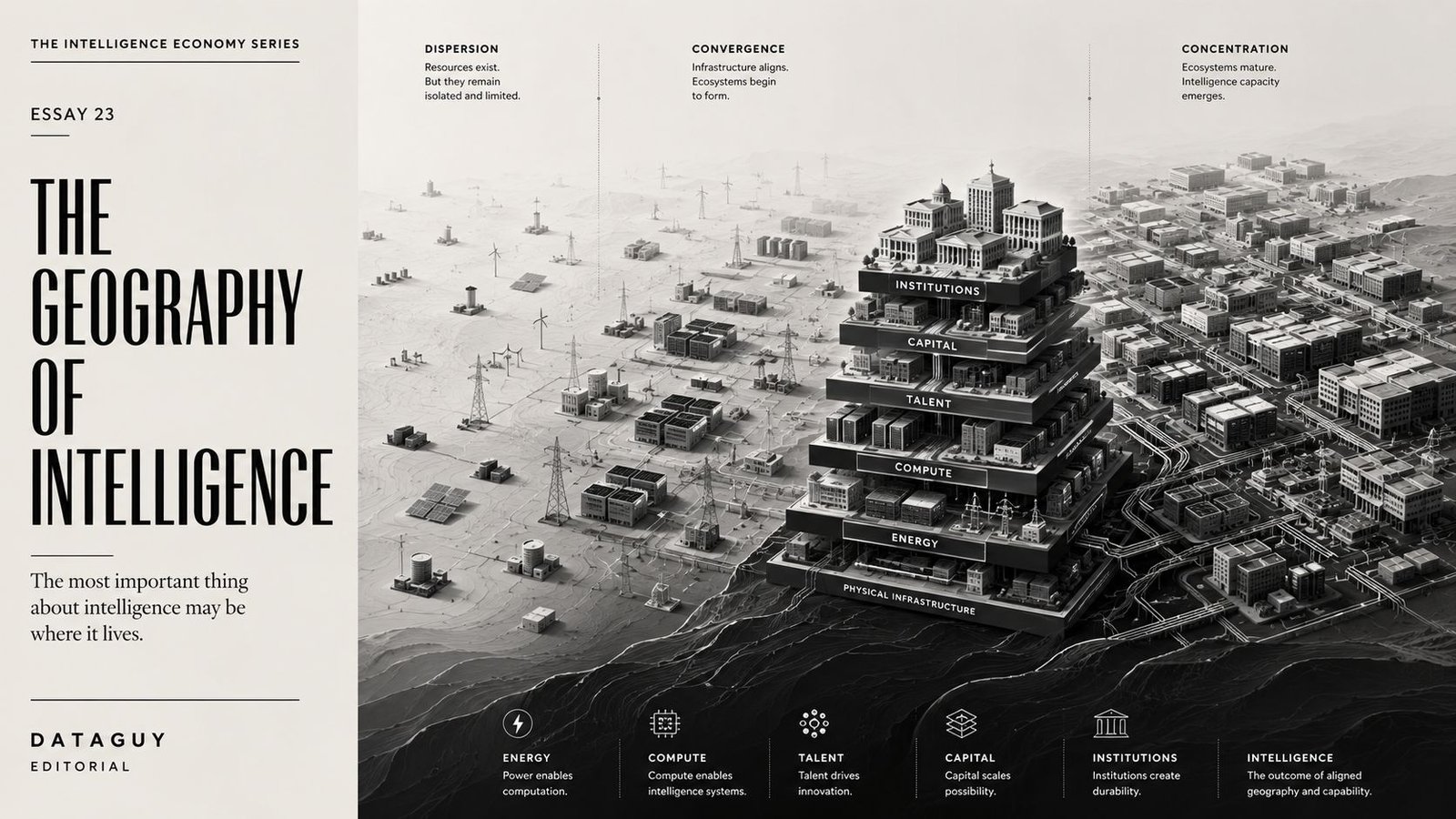
The most important thing about intelligence may be where it lives.
The internet created the impression that geography no longer matters. Information could move instantly across borders. Digital services could be accessed from almost anywhere. Communication networks connected individuals, organizations, and markets across vast distances. The information economy appeared to reduce the importance of place by making information increasingly mobile and accessible.
This perception has shaped much of the public conversation surrounding artificial intelligence. Intelligence often appears similarly weightless. Models are accessed through interfaces. Responses arrive instantly. Capabilities seem available regardless of location. Intelligence appears to exist everywhere and nowhere simultaneously.
Yet appearances can be misleading. Intelligence may be distributed digitally, but it is produced physically. Behind every intelligent system lies a dense network of infrastructure, institutions, talent, energy systems, and capital investments. Intelligence does not emerge from abstraction. It emerges from specific places.
This distinction matters because geography has always shaped economic power. Agricultural economies concentrated around fertile land. Industrial economies concentrated around manufacturing capacity, transportation networks, and energy resources. Information economies concentrated around research institutions, capital markets, and technology ecosystems. Intelligence economies may follow a similar pattern.
The intelligence economy depends upon resources that remain geographically constrained. Data centers require energy. Semiconductor production requires specialized manufacturing ecosystems. Research laboratories require talent. Venture capital requires financial networks. Universities require institutions. Each component exists within physical environments that cannot be replicated instantly or distributed evenly across the world.
As intelligence becomes a foundational economic resource, these geographic realities become increasingly important. The question is no longer simply who controls intelligence infrastructure. The question is where that infrastructure is located and how its concentration shapes economic and geopolitical outcomes.
The previous essay explored the political economy of intelligence and the institutions that govern its distribution. This essay examines the geographic foundations beneath those institutions. If intelligence becomes a strategic resource, geography may become one of the most important variables determining who creates it, who accesses it, and who benefits from it.
The intelligence century may therefore not eliminate geography. It may make geography more important than ever.
The internet reduced the importance of geography for information. The intelligence economy may increase the importance of geography for intelligence because intelligence remains dependent upon physical infrastructure, talent, capital, energy, and institutions.
Why Place Still Matters
The idea that intelligence is placeless emerges from a reasonable observation. Users interact with intelligence through digital interfaces that appear accessible from anywhere. A researcher in one country can access the same model as an entrepreneur in another. A student can query an intelligence system from a remote location as easily as someone in a major city. From the perspective of the user, intelligence appears detached from geography.
This perception mirrors earlier assumptions about the internet itself. During the early years of the information economy, many observers predicted that geography would become largely irrelevant. Digital communication would dissolve distances. Economic activity would become distributed. Physical location would matter less than network connectivity.
Some aspects of this prediction proved correct. Information became more mobile. Communication became global. Digital markets expanded across borders. Yet the information economy ultimately produced its own geographic concentrations. Certain regions became hubs for research, innovation, capital formation, and technological development. Rather than eliminating geography, digital systems often reinforced the importance of particular places.
The same dynamic may emerge within the intelligence economy. Intelligence can be accessed globally, but access is not the same as production. The systems responsible for creating intelligence require highly specialized combinations of infrastructure, expertise, institutions, and investment. These ingredients tend to cluster geographically rather than distribute evenly.
Economic history repeatedly demonstrates the power of clustering. Industrial production concentrated around transportation networks and energy resources. Financial activity concentrated around capital markets and commercial centers. Scientific innovation concentrated around universities, laboratories, and research ecosystems. Geographic concentration often increases productivity because proximity lowers coordination costs and accelerates knowledge exchange.
Intelligence appears particularly susceptible to these dynamics. Advanced intelligence systems depend upon talent pools, computational resources, specialized hardware, energy infrastructure, research institutions, entrepreneurial ecosystems, and financial capital. Each element reinforces the others. The result is the formation of intelligence clusters capable of generating increasing returns over time.
This phenomenon challenges the assumption that intelligence will be evenly distributed simply because it is digitally accessible. Access may become widespread while production remains concentrated. Many societies may consume intelligence. Far fewer may produce it at scale. The distinction between production and consumption becomes increasingly important in understanding the future geography of economic power.
The consequences extend beyond economics. Geographic concentrations of intelligence influence innovation capacity, industrial competitiveness, research leadership, and strategic influence. Regions that successfully attract intelligence infrastructure may benefit from self-reinforcing cycles of growth and capability development.
Viewed through this lens, the intelligence economy begins to resemble previous economic eras. New technologies create new forms of concentration. New forms of concentration create new centers of influence. Geography remains relevant because economic capability remains rooted in physical systems and institutional environments.
The intelligence economy therefore does not abolish geography. It reorganizes geography around a different set of strategic resources.
Intelligence appears globally accessible because its outputs travel digitally. Its production remains geographically concentrated because the infrastructure required to create intelligence exists in specific places.
The Hidden Foundations
The intelligence economy is often discussed in terms of software, algorithms, and models. Yet these visible elements rest upon a vast physical foundation that receives far less attention. Intelligence may appear digital, but its production depends upon infrastructure that is unmistakably physical. Understanding the geography of intelligence therefore requires understanding the systems that make intelligence possible.
Energy sits at the foundation of this system. Intelligence requires computation, and computation requires power. As intelligence systems become more sophisticated, their energy requirements increase dramatically. Data centers consume enormous quantities of electricity. Training advanced models requires sustained access to reliable energy infrastructure. Regions capable of providing abundant, affordable, and stable energy may therefore gain strategic advantages within the intelligence economy.
Compute represents the second critical component. Intelligence depends upon specialized computational resources capable of processing vast amounts of information. These resources are concentrated within data centers, cloud infrastructure, and high-performance computing environments. Building and operating such facilities requires substantial capital investment, technical expertise, and long-term infrastructure planning.
Semiconductor manufacturing forms another essential layer. Intelligence systems ultimately depend upon physical hardware. Advanced chips provide the computational capacity necessary for training and deploying sophisticated models. Semiconductor ecosystems are among the most geographically concentrated industrial systems in the world, requiring specialized knowledge, manufacturing capabilities, supply chains, and institutional coordination developed over decades.
Connectivity infrastructure also plays a critical role. Fiber networks, internet exchanges, cloud platforms, and communications systems allow intelligence resources to move between organizations and regions. Intelligence may be generated in one location and consumed in another, but this process depends upon physical networks connecting both locations.
Beyond infrastructure lies talent. Researchers, engineers, entrepreneurs, scientists, and technical specialists remain essential to the development of intelligence systems. Talent does not distribute itself randomly. It tends to cluster around universities, research laboratories, innovative firms, and dynamic economic ecosystems. Human capital remains one of the most geographically concentrated inputs in the intelligence economy.
Capital represents another foundational element. Intelligence infrastructure requires substantial investment long before economic returns materialize. Venture capital, institutional investment, public funding, and corporate resources all contribute to the creation of intelligence ecosystems. Regions capable of mobilizing capital effectively often gain advantages that compound over time.
Institutions complete the picture. Universities generate research. Governments establish policy frameworks. Legal systems protect intellectual property. Educational systems develop talent. Financial institutions allocate capital. Intelligence does not emerge solely from technology. It emerges from institutional environments capable of supporting long-term innovation and coordination.
Taken together, these components reveal an important reality. Intelligence is not produced by models alone. It is produced by a complex infrastructure ecosystem spanning energy systems, computational resources, talent networks, capital markets, and institutions. Every element remains rooted in geography.
This reality helps explain why intelligence production may become increasingly concentrated even as intelligence consumption becomes increasingly widespread. The infrastructure required to create intelligence remains far more difficult to replicate than the interfaces through which intelligence is accessed.
Intelligence appears at the surface of the economy, but beneath it lies a dense physical infrastructure composed of energy, compute, semiconductors, connectivity, talent, capital, and institutions.
The Architecture Of Intelligence Concentration
If intelligence production remains geographically concentrated, the next question is why concentration occurs in some places and not others. The answer lies in the interaction of multiple reinforcing layers. Intelligence does not emerge from a single resource. It emerges from an ecosystem. Understanding this ecosystem requires a framework that explains how geography shapes intelligence capacity.
One way to understand this structure is through what might be called the Geography Stack. The framework highlights the sequence of capabilities that allow regions to become centers of intelligence production. Each layer supports the next. Weakness at any layer constrains the layers above it. Strength across multiple layers creates self-reinforcing ecosystems capable of generating and sustaining intelligence leadership.
Energy
The stack begins with energy. Intelligence systems require enormous computational resources, and computational resources require electricity. Regions with abundant, reliable, and affordable energy possess structural advantages in supporting intelligence infrastructure. Energy increasingly becomes a prerequisite for intelligence capacity.
Compute
The second layer consists of compute. Data centers, cloud infrastructure, semiconductor resources, networking systems, and computational clusters provide the processing capacity required for intelligence production. Compute transforms energy into usable cognitive infrastructure.
Talent
The third layer is talent. Intelligence systems require researchers, engineers, entrepreneurs, scientists, and technical specialists capable of developing and deploying increasingly sophisticated capabilities. Talent converts computational resources into innovation and practical application.
Capital
The fourth layer is capital. Intelligence infrastructure requires sustained investment. Venture capital, institutional funding, public investment, and corporate resources provide the financial support necessary to scale intelligence ecosystems. Capital enables experimentation, expansion, and long-term development.
Institutions
The fifth layer consists of institutions. Universities, research laboratories, governments, legal systems, educational networks, and financial organizations create the environment within which intelligence ecosystems operate. Institutions coordinate activity, reduce uncertainty, and support long-term capability development.
Intelligence
The final layer is intelligence itself. Intelligence appears at the top of the stack because it depends upon everything beneath it. Advanced intelligence systems emerge where energy, compute, talent, capital, and institutions reinforce one another. Intelligence is therefore not an isolated capability. It is the product of an entire geographic ecosystem.
The significance of the Geography Stack lies in its explanation of concentration. Intelligence does not simply flow to the highest bidder. It accumulates where multiple strategic resources converge simultaneously. Regions that successfully develop several layers of the stack often attract additional investment, talent, and infrastructure, creating powerful feedback loops.
This dynamic helps explain why intelligence ecosystems can become increasingly difficult to replicate once established. New entrants must often build multiple layers simultaneously rather than competing at a single point within the stack. Geography creates barriers because ecosystems are harder to reproduce than technologies.
Viewed through this lens, intelligence leadership is not solely a function of innovation. It is a function of geographic capability. The regions that dominate the intelligence economy may be those capable of aligning energy, compute, talent, capital, and institutions into a coherent ecosystem.
Energy enables compute. Compute attracts talent. Talent attracts capital. Capital strengthens institutions. Institutions support intelligence. Geography determines the layers beneath intelligence long before intelligence appears at the surface.
Why Intelligence Clusters
Economic activity rarely distributes itself evenly across space. Throughout history, industries have tended to cluster in particular regions. Manufacturing concentrated around transportation corridors. Finance concentrated around capital markets. Research concentrated around universities and scientific institutions. The intelligence economy appears likely to follow a similar pattern.
This tendency toward concentration is not accidental. Clusters emerge because proximity creates advantages. Organizations located near one another share access to talent, infrastructure, suppliers, capital, and institutional resources. Information moves more quickly. Collaboration becomes easier. Innovation accelerates. The result is a self-reinforcing ecosystem in which success attracts additional resources that generate further success.
The intelligence economy exhibits many of the characteristics that historically favor clustering. Intelligence production depends upon highly specialized talent, sophisticated computational infrastructure, research institutions, entrepreneurial networks, and investment capital. These resources rarely emerge independently. They tend to accumulate in environments where complementary capabilities already exist.
As a result, intelligence ecosystems may develop increasing returns to scale. Regions possessing strong intelligence infrastructure attract talent. Talent attracts investment. Investment supports additional infrastructure. Infrastructure strengthens institutions. Each component reinforces the others. Over time, intelligence capacity becomes concentrated within a relatively small number of highly capable ecosystems.
This concentration creates a distinction between intelligence consumption and intelligence production. Intelligence may become broadly accessible across the world. Yet the systems responsible for generating new intelligence capabilities may remain concentrated within a smaller set of geographic clusters. Many regions consume intelligence. Far fewer regions produce it at the frontier.
The implications extend beyond economics. Regions that develop intelligence ecosystems often become centers of innovation, entrepreneurship, scientific discovery, and institutional influence. Intelligence capacity generates spillover effects that strengthen broader economic activity. Success in one domain frequently reinforces success in others.
Network effects amplify these dynamics. Researchers prefer locations where other researchers are present. Investors prefer locations where innovative firms emerge. Entrepreneurs prefer locations where talent and capital are accessible. Institutions prefer locations where economic activity is concentrated. Geographic concentration therefore becomes increasingly self-reinforcing.
The intelligence economy may also produce new forms of regional specialization. Some locations may excel at semiconductor manufacturing. Others may specialize in computational infrastructure. Others may emerge as centers of research, entrepreneurship, or institutional leadership. Intelligence ecosystems become interconnected while remaining geographically distinct.
Importantly, these clusters need not correspond to traditional industrial centers. Intelligence depends upon a different set of resources than manufacturing economies. Regions that successfully combine energy, compute, talent, capital, and institutions may emerge as influential intelligence hubs regardless of their historical economic roles.
Viewed through this lens, the geography of intelligence becomes a story about concentration rather than ubiquity. Intelligence may be globally distributed as a service while remaining geographically concentrated as a capability. The distinction between these two realities may shape the economic geography of the intelligence century.
Intelligence ecosystems become powerful because infrastructure, talent, capital, and institutions reinforce one another. Geography matters because proximity creates capabilities that are difficult to replicate elsewhere.
The New Strategic Race
As intelligence becomes a strategic economic resource, competition increasingly shifts toward the capabilities required to produce it. Earlier industrial eras were shaped by competition for land, energy, manufacturing capacity, transportation infrastructure, and technological leadership. The intelligence economy introduces a new dimension of competition centered around intelligence capacity itself.
This competition differs from traditional technology races because intelligence depends upon multiple layers of infrastructure simultaneously. Nations, regions, and institutions do not compete solely for software innovation. They compete for energy systems capable of supporting computation, semiconductor ecosystems capable of producing advanced hardware, talent capable of developing new capabilities, capital capable of financing large-scale investment, and institutions capable of coordinating long-term development.
The result is a broad strategic contest for intelligence capacity. Economic competitiveness increasingly depends upon the ability to create, attract, and retain the components of the Geography Stack. Regions that successfully build these capabilities gain advantages that extend beyond the technology sector. Intelligence influences productivity, research, innovation, defense, education, healthcare, and economic growth more broadly.
This dynamic helps explain why intelligence infrastructure increasingly attracts attention from policymakers, investors, universities, corporations, and public institutions. Intelligence is no longer viewed solely as a commercial opportunity. It is increasingly viewed as a strategic capability with implications for long-term economic resilience and national competitiveness.
Infrastructure investment becomes particularly important in this environment. Data centers, computational resources, energy networks, and connectivity systems represent foundational assets upon which intelligence ecosystems depend. Regions that invest in these capabilities may strengthen their ability to attract higher layers of the Geography Stack over time.
Talent competition becomes equally significant. Researchers, engineers, entrepreneurs, and technical specialists function as critical inputs within the intelligence economy. Educational systems, research institutions, immigration policies, and innovation ecosystems all influence a region's ability to attract and retain these individuals. Human capital becomes a strategic resource in its own right.
Institutional capacity also emerges as a source of advantage. Effective governance frameworks, research institutions, intellectual property systems, financial markets, and regulatory environments influence the long-term viability of intelligence ecosystems. Technology alone rarely determines leadership. Institutions often determine whether leadership can be sustained.
The intelligence economy therefore broadens the definition of economic competition. Success depends not only upon producing better technologies but upon creating environments in which intelligence infrastructure can flourish. The most competitive regions may be those capable of coordinating multiple strategic resources simultaneously.
Importantly, this competition is not necessarily zero-sum. Intelligence ecosystems remain interconnected through trade, research collaboration, investment flows, and knowledge exchange. Yet interconnected systems can still compete for leadership, talent, and influence. Cooperation and competition increasingly coexist within the same environment.
Viewed through this lens, the geography of intelligence becomes a strategic issue rather than merely an economic one. The regions that successfully build intelligence capacity may shape the direction of innovation, economic growth, and institutional development throughout the intelligence century.
The intelligence economy is creating competition not simply for technology, but for the underlying resources that make intelligence possible. Energy, compute, talent, capital, and institutions increasingly become strategic assets.
Why Geography Returns
For much of the digital era, economic thinking assumed that geography would become less important. Information moved globally. Communication became instantaneous. Digital services crossed borders with minimal friction. The prevailing expectation was that economic activity would gradually detach itself from physical location.
The intelligence economy may challenge this assumption. Intelligence appears digital, yet its production depends upon resources that remain deeply physical. Energy is generated in specific places. Data centers occupy physical land. Semiconductor manufacturing requires specialized facilities. Universities, research laboratories, financial institutions, and talent ecosystems remain rooted in geography. The foundations of intelligence are spatial even when its outputs are digital.
This creates a paradox. Intelligence may become one of the most globally accessible resources in history while simultaneously becoming one of the most geographically concentrated capabilities. The ability to use intelligence may spread widely. The ability to create frontier intelligence may remain concentrated within a relatively small number of ecosystems capable of supporting the entire Geography Stack.
The long-term implications are significant. Economic geography has historically evolved around strategic resources. Agricultural economies organized around fertile land. Industrial economies organized around manufacturing infrastructure and energy resources. Information economies organized around technological ecosystems and knowledge networks. Intelligence economies may organize around the geographic concentration of cognitive infrastructure.
This does not imply that intelligence capacity will remain permanently fixed. New regions can build infrastructure. Educational systems can develop talent. Institutions can attract investment. Ecosystems can emerge where none previously existed. Yet the process requires sustained coordination across multiple layers simultaneously. Geography creates inertia because ecosystems are built over decades rather than months.
The intelligence economy therefore introduces a new way of thinking about economic development. Competitive advantage increasingly depends upon the ability to create environments where intelligence infrastructure, talent, capital, and institutions reinforce one another. Economic success becomes linked not only to innovation, but to ecosystem construction.
Viewed through this lens, geography returns to the center of economic analysis. The key question is not simply which organizations develop the most advanced intelligence systems. The more important question is which places develop the conditions necessary for intelligence ecosystems to emerge and persist over time.
The regions that answer this question successfully may become the defining centers of economic activity in the intelligence century. Their influence will derive not only from technology, but from their ability to align the physical, institutional, and human foundations upon which intelligence depends.
Intelligence may travel globally, but intelligence capacity remains rooted in geography. The defining economic ecosystems of the intelligence century may be those that successfully combine energy, compute, talent, capital, and institutions into durable centers of intelligence production.
Conclusion
The intelligence economy is often described as a digital phenomenon. Yet its foundations remain profoundly physical. Intelligence depends upon energy systems, computational infrastructure, semiconductor ecosystems, talent networks, capital formation, and institutions capable of supporting long-term innovation. Every one of these resources exists within geography.
This reality challenges the assumption that intelligence will dissolve the importance of place. Intelligence may be distributed globally as a service, but its production remains concentrated within ecosystems capable of sustaining the Geography Stack. The distinction between access and production may become one of the defining characteristics of the intelligence century.
The Geography Stack provides a framework for understanding this concentration. Energy enables compute. Compute attracts talent. Talent attracts capital. Capital strengthens institutions. Institutions support intelligence. Together, these layers explain why intelligence leadership tends to emerge within specific geographic environments rather than distribute evenly across the world.
As intelligence becomes increasingly important to economic growth, innovation, governance, and competitiveness, geography becomes increasingly important to intelligence itself. The locations that successfully develop intelligence ecosystems may gain advantages that extend far beyond technology, influencing broader patterns of economic and institutional power.
Viewed from a longer historical perspective, the intelligence century may not eliminate geography. It may restore geography to a central role within economic development. Intelligence appears weightless, yet the systems that create intelligence remain firmly anchored in place.
The intelligence century may not reduce the importance of geography. It may increase it. Because intelligence depends upon the concentration of infrastructure, talent, capital, and institutions in specific places.