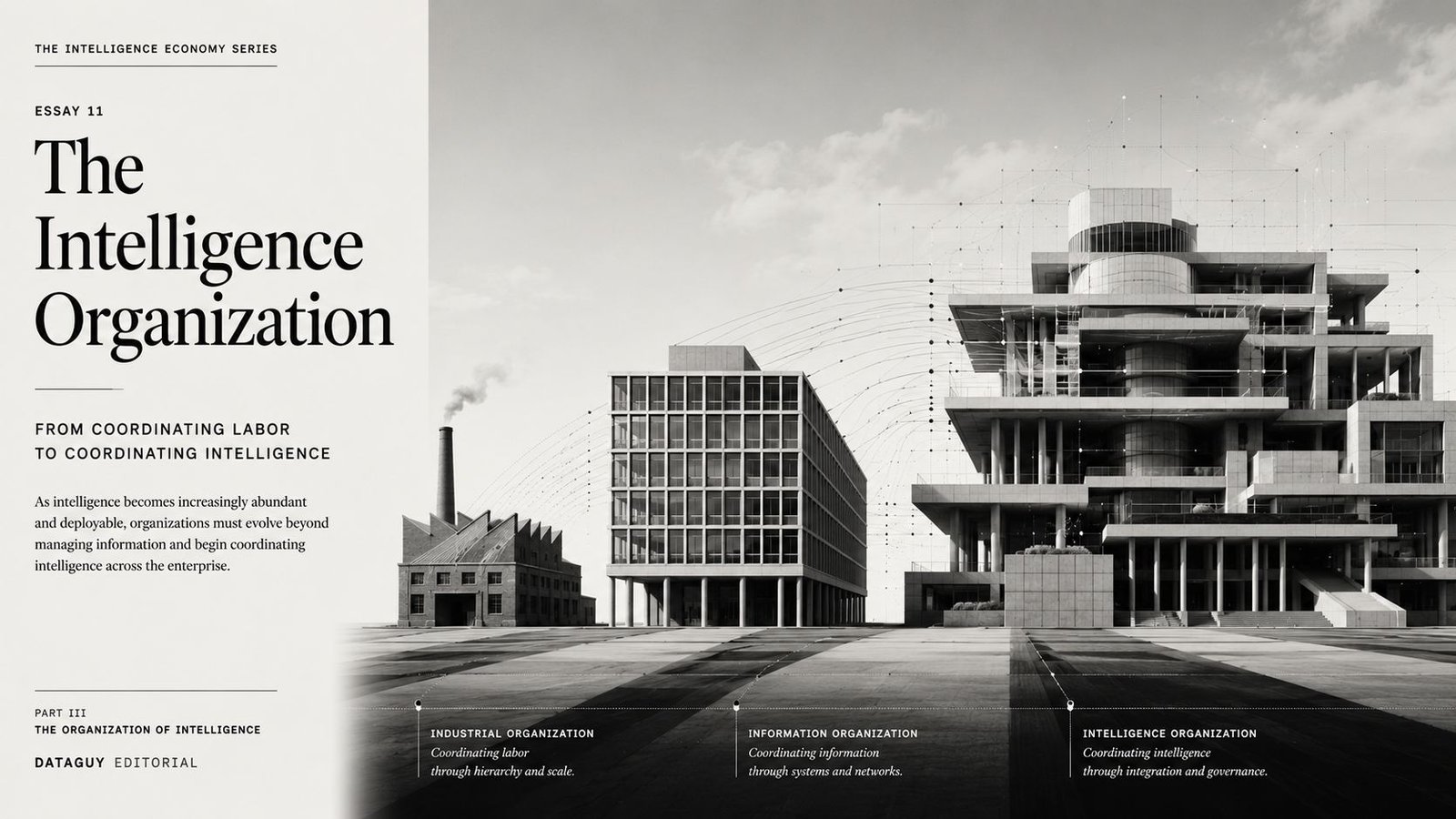
Every economic era eventually produces a characteristic organizational form.
Agrarian economies were organized around land. Industrial economies were organized around factories. The twentieth century belonged to the modern corporation, an institutional innovation that enabled labor, capital, and information to be coordinated at scales previously impossible. These organizational forms were not accidental outcomes of economic progress. They emerged because economic systems changed. New methods of production created new coordination problems, and those coordination problems ultimately produced new institutions. The history of economic development is therefore also a history of organizational evolution. Each era generates structures capable of coordinating its most valuable productive resources more effectively than the structures that came before.
The factory became the defining institution of industrialization because machinery transformed the economics of production. The modern corporation emerged because expanding markets required larger systems of coordination than individual entrepreneurs could manage alone. Later, the rise of computing and digital networks produced the knowledge enterprise, an organization increasingly optimized around information, expertise, and intellectual capital. Each transition reflected the same underlying pattern. When a new productive resource becomes economically important, organizations evolve to coordinate it more effectively. Institutions survive not because they are permanent, but because they remain aligned with the economic realities of their time.
The intelligence economy may be approaching a similar moment. Much of the current discussion focuses on models, agents, automation, and productivity. These developments matter, but they may not represent the most consequential outcome of the intelligence era. The deeper transformation concerns the institution built around intelligence itself. Economic history suggests that technologies become truly significant only when they give rise to new organizational forms capable of deploying them at scale. Steam power mattered because it enabled factories. Computing mattered because it enabled information enterprises. Intelligence may matter because it enables an entirely new category of organization.
The previous chapter examined the emergence of the autonomous enterprise, a model in which governance increasingly replaces supervision as the primary mechanism of coordination. That shift represented a significant departure from the managerial assumptions that shaped organizations throughout the industrial and information eras. Yet autonomy alone does not explain how institutions evolve when intelligence becomes increasingly abundant throughout the enterprise. A more fundamental question begins to emerge. If factories were built around machines, and knowledge enterprises were built around information, what kind of organization emerges when intelligence itself becomes a productive resource?
Answering that question requires looking beyond technology and examining organizational evolution itself. The most important consequence of the intelligence economy may not be artificial intelligence as a tool. It may be the emergence of a new organizational form designed to coordinate intelligence across memory, context, reasoning, decision-making, execution, and governance. Just as previous economic eras produced institutions optimized around labor and information, the intelligence economy may produce institutions optimized around intelligence itself. Understanding that possibility requires understanding how organizations evolved in the first place and why the assumptions that shaped them are beginning to change.
Every major economic era creates a characteristic organizational form designed around its most important productive resource. Industrial organizations coordinated labor. Knowledge organizations coordinated information. As intelligence becomes increasingly abundant and deployable, organizations face a new challenge: coordinating intelligence itself. The intelligence organization represents an emerging institutional form optimized around memory, reasoning, decision-making, execution, and governance as integrated capabilities rather than isolated functions.
Every economic era eventually produces a characteristic organizational form.
Agrarian economies were organized around land. Industrial economies were organized around factories. The twentieth century belonged to the modern corporation, an institutional innovation that enabled labor, capital, and information to be coordinated at scales previously impossible. These organizational forms were not accidental outcomes of economic progress. They emerged because economic systems changed. New methods of production created new coordination problems, and those coordination problems ultimately produced new institutions. The history of economic development is therefore also a history of organizational evolution. Each era generates structures capable of coordinating its most valuable productive resources more effectively than the structures that came before.
The factory became the defining institution of industrialization because machinery transformed the economics of production. The modern corporation emerged because expanding markets required larger systems of coordination than individual entrepreneurs could manage alone. Later, the rise of computing and digital networks produced the knowledge enterprise, an organization increasingly optimized around information, expertise, and intellectual capital. Each transition reflected the same underlying pattern. When a new productive resource becomes economically important, organizations evolve to coordinate it more effectively. Institutions survive not because they are permanent, but because they remain aligned with the economic realities of their time.
The intelligence economy may be approaching a similar moment. Much of the current discussion focuses on models, agents, automation, and productivity. These developments matter, but they may not represent the most consequential outcome of the intelligence era. The deeper transformation concerns the institution built around intelligence itself. Economic history suggests that technologies become truly significant only when they give rise to new organizational forms capable of deploying them at scale. Steam power mattered because it enabled factories. Computing mattered because it enabled information enterprises. Intelligence may matter because it enables an entirely new category of organization.
The previous chapter examined the emergence of the autonomous enterprise, a model in which governance increasingly replaces supervision as the primary mechanism of coordination. That shift represented a significant departure from the managerial assumptions that shaped organizations throughout the industrial and information eras. Yet autonomy alone does not explain how institutions evolve when intelligence becomes increasingly abundant throughout the enterprise. A more fundamental question begins to emerge. If factories were built around machines, and knowledge enterprises were built around information, what kind of organization emerges when intelligence itself becomes a productive resource?
Answering that question requires looking beyond technology and examining organizational evolution itself. The most important consequence of the intelligence economy may not be artificial intelligence as a tool. It may be the emergence of a new organizational form designed to coordinate intelligence across memory, context, reasoning, decision-making, execution, and governance. Just as previous economic eras produced institutions optimized around labor and information, the intelligence economy may produce institutions optimized around intelligence itself. Understanding that possibility requires understanding how organizations evolved in the first place and why the assumptions that shaped them are beginning to change.
Every major economic era creates a characteristic organizational form designed around its most important productive resource. Industrial organizations coordinated labor. Knowledge organizations coordinated information. As intelligence becomes increasingly abundant and deployable, organizations face a new challenge: coordinating intelligence itself. The intelligence organization represents an emerging institutional form optimized around memory, reasoning, decision-making, execution, and governance as integrated capabilities rather than isolated functions.
Why Every Economic Era Creates A New Organizational Form
Organizations are often treated as permanent features of economic life. In reality, they are adaptive institutions that evolve alongside changes in production, technology, and economic structure. The forms that appear natural in one era frequently emerge as responses to constraints that existed at a particular moment in history. Factories, corporations, bureaucracies, professional firms, and digital enterprises were not inevitable outcomes of progress. They were solutions to coordination problems created by changing economic conditions. Understanding organizations in this way shifts attention away from management theory and toward economic necessity. Institutions emerge because economies require mechanisms capable of coordinating increasingly complex systems of activity.
Economic history is often written as a story of inventions. Steam engines transformed manufacturing. Computers transformed information processing. Networks transformed communication. Yet technological breakthroughs rarely reshape economies on their own. Their effects become meaningful only when institutions emerge that can organize these capabilities at scale. A factory is not simply a building containing machines. It is an organizational system designed around the economics of industrial production. Likewise, the modern corporation is not simply a legal structure. It is a coordination mechanism designed to manage complexity across labor, capital, information, and markets. Institutions convert technological possibility into economic reality.
The relationship between productive resources and organizational forms appears repeatedly throughout history. Agricultural societies organized themselves around land because land represented the dominant source of economic value. Industrial societies organized themselves around factories because machinery and production systems became the primary drivers of growth. The information economy organized itself around knowledge enterprises because expertise, communication, and intellectual capital became increasingly important sources of competitive advantage. Each transition reflected a deeper shift in what economies were attempting to coordinate. Organizations changed because the resources they depended upon changed.
Viewed through this lens, organizations can be understood as coordination technologies. Their purpose is not merely to employ people or allocate resources. Their purpose is to coordinate scarce and valuable assets more effectively than alternative arrangements. Hierarchies, reporting structures, management systems, operating procedures, and governance mechanisms all exist because they reduce coordination costs. The structure of the organization therefore reflects the nature of the resource it was designed to coordinate. When the resource changes, the logic of the organization eventually changes with it.
The intelligence economy appears to be entering precisely such a transition. Organizations are rapidly adopting intelligent systems, agentic workflows, digital labor, and increasingly autonomous forms of execution. Most of these developments are currently being integrated into structures originally designed for earlier economic conditions. Enterprises continue to operate through management models, reporting relationships, and organizational assumptions inherited from the information era. Yet beneath these visible structures, a different economic logic is beginning to emerge. Understanding that logic requires examining the constraint that shaped the modern organization for more than a century: the scarcity of intelligence itself.
Why Organizations Were Built Around Limited Intelligence
The modern organization is often described as a management structure. A more accurate description is that it is a system designed to compensate for scarcity. For most of economic history, productive resources were difficult to acquire, difficult to distribute, and even more difficult to coordinate. Labor was limited. Information was fragmented. Expertise was concentrated within relatively small groups of specialists. Decision-making capabilities existed within a narrow segment of the institution. These constraints shaped the architecture of organizations long before management theory emerged as a formal discipline. The structures that define modern enterprises did not appear because leaders preferred bureaucracy or hierarchy. They emerged because economic systems required mechanisms capable of allocating scarce intelligence across increasingly complex environments.
The hierarchy, one of the defining characteristics of the modern enterprise, evolved largely as a response to this reality. Information moved upward because decision-making authority was concentrated at the top. Decisions moved downward because execution required coordination across increasingly large groups of people. Layers of management emerged not because organizations desired complexity, but because complexity became necessary when intelligence itself was scarce. Every additional level of hierarchy represented an attempt to extend the reach of limited expertise across a growing institution. The organizational chart therefore served a purpose far beyond reporting relationships. It functioned as an infrastructure for distributing intelligence throughout the enterprise.
This historical context is frequently overlooked in contemporary discussions about organizational design. Hierarchies are often criticized as inefficient, bureaucratic, or resistant to change. Such criticisms are understandable, but they ignore the economic conditions under which hierarchies emerged. For much of the industrial era, hierarchical management represented one of the most effective coordination technologies ever created. A hierarchy allowed organizations to concentrate expertise, standardize decisions, allocate resources, and align execution across thousands of individuals operating under conditions of uncertainty. What appears cumbersome today was once a highly effective solution to a difficult economic problem.
The modern corporation therefore evolved around a fundamental assumption: intelligence was expensive. Acquiring expertise required years of education, training, and experience. Developing managerial judgment often required decades of exposure to increasingly complex decisions. Strategic reasoning could not be replicated easily, distributed instantly, or scaled efficiently. Organizations responded by concentrating these capabilities within executives, managers, specialists, and professional knowledge workers. Entire management systems emerged to support the efficient allocation of scarce cognitive resources. The institution itself became a mechanism for extending the influence of limited intelligence across larger and more complex systems of production.
The information revolution transformed many aspects of this equation, but it left its central assumption largely intact. Information became dramatically cheaper to produce, store, distribute, and access. Enterprise software connected departments. Databases accumulated institutional knowledge. Communication systems reduced friction across geographic boundaries. Organizations became increasingly sophisticated information-processing systems capable of moving data at extraordinary speed. Yet despite these advances, intelligence itself remained constrained. Information abundance did not eliminate the need for interpretation, judgment, prioritization, and decision-making. The bottleneck simply shifted from access to information toward the ability to transform information into action.
As a result, many organizations entered the twenty-first century surrounded by unprecedented amounts of information while continuing to depend on relatively small groups of individuals to make sense of it. Senior executives became decision bottlenecks. Specialists became knowledge bottlenecks. Managers became coordination bottlenecks. Enterprise systems improved visibility but did not fundamentally alter the distribution of intelligence within the organization. Information could move instantly across departments, yet decisions still accumulated around a limited number of individuals responsible for interpreting complexity and determining action. The knowledge enterprise succeeded in making information abundant, but it left intelligence concentrated.
This distinction helps explain why organizational complexity often increases as institutions grow. Information systems scale more easily than decision systems. Databases expand more easily than judgment. Communication networks grow more easily than organizational alignment. Every increase in scale introduces new coordination requirements that demand additional cognitive effort. Organizations respond by creating new layers of management, additional reporting structures, and increasingly sophisticated governance mechanisms. The larger the institution becomes, the more difficult it becomes to coordinate the intelligence required to operate it effectively. Growth therefore creates a paradox. Organizations accumulate more information while simultaneously struggling to convert that information into coherent action.
For more than a century, enterprises treated these limitations as unavoidable features of economic life. Scarce intelligence was considered a permanent constraint rather than a temporary condition. Management structures, reporting systems, governance models, and operating procedures all evolved around this assumption. The organization itself became a mechanism for allocating limited intelligence across increasingly complex systems of production, coordination, and decision-making. Few institutions questioned this logic because no viable alternative existed. The scarcity of intelligence was simply accepted as a defining characteristic of organizational reality.
The intelligence economy introduces a possibility that previous organizational eras never had to confront. For the first time, intelligence itself is beginning to exhibit characteristics traditionally associated with infrastructure. Reasoning, memory, decision support, planning, and execution are becoming increasingly deployable capabilities rather than exclusively human constraints. This development does not eliminate the value of human expertise, nor does it remove the need for judgment. It changes something more fundamental. It changes the economics that have historically governed how intelligence is distributed throughout the enterprise.
If intelligence begins behaving less like a scarce resource and more like a deployable capability, the assumptions that shaped the modern organization start to weaken. The central question is no longer how institutions allocate limited intelligence. The emerging question is how institutions operate when intelligence becomes increasingly abundant. Just as industrialization transformed the economics of labor and digitization transformed the economics of information, intelligence infrastructure may transform the economics of coordination itself. Understanding that transition requires examining what happens when intelligence stops functioning as a constraint and begins functioning as infrastructure.
The Most Important Shift Is Not Automation
Much of the public discussion surrounding artificial intelligence focuses on automation. Tasks become faster. Processes become more efficient. Costs decline while productivity improves. These outcomes are important, but they represent only the most visible layer of a much larger transformation. Economic history suggests that the most consequential effects of a technology rarely emerge from the technology itself. They emerge when the technology becomes infrastructure. Steam power changed economies because it transformed production systems rather than individual machines. Electricity changed economies because energy became available throughout entire industrial networks rather than remaining confined to isolated applications. Computing changed economies because information processing became embedded throughout organizations rather than existing within specialized departments. The intelligence economy appears to be entering a similar phase.
The significance of intelligence does not lie solely in its ability to automate tasks. Its deeper importance lies in its ability to become an organizational capability. Intelligence is beginning to move beyond individual tools and applications and become a foundational layer within institutions. What matters is not that specific activities can be performed more efficiently. What matters is that reasoning, memory, planning, decision support, and execution can increasingly be deployed across entire systems of activity. This distinction separates a technological upgrade from an institutional transition. A tool improves a process. Infrastructure changes the environment within which all processes operate. The long-term implications of intelligence therefore extend far beyond automation and into the architecture of the organization itself.
The previous essays in this series examined several developments that, when viewed independently, appear distinct. Context emerged as a strategic resource. Memory evolved into infrastructure. Cognitive systems expanded the ability to reason across information. Agentic systems transformed intelligence into action. Execution became increasingly scalable. Digital labor introduced a new category of productive capacity. Delegation evolved from a managerial practice into an economic capability. Autonomous enterprises began separating governance from supervision. Each development appeared to address a different challenge. Viewed collectively, however, they reveal a more significant pattern. They represent the gradual construction of an intelligence infrastructure layer operating beneath the visible structure of the organization.
This infrastructure differs fundamentally from traditional enterprise technology. Earlier generations of enterprise systems were designed primarily to store information, process transactions, and facilitate communication. Their purpose was to improve the movement of data throughout the institution. Intelligence infrastructure serves a different purpose. It exists to generate, preserve, distribute, coordinate, and apply intelligence across increasingly complex organizational environments. Context systems provide situational awareness. Memory systems preserve organizational learning. Cognitive systems support analysis and reasoning. Decision systems transform intelligence into action. Execution systems convert decisions into outcomes. Governance systems maintain alignment across distributed forms of activity. Together these capabilities create something larger than a collection of technologies. They create the foundations of an organizational intelligence layer.
Historically, intelligence entered the enterprise through people. Organizations hired expertise. They recruited specialists. They promoted managers capable of exercising judgment under uncertainty. Intelligence scaled through headcount because human cognition represented the primary mechanism available for interpreting complexity and making decisions. As organizations expanded, additional intelligence required additional people. Growth therefore depended on the ability to recruit, train, coordinate, and retain increasingly large concentrations of expertise. Human intelligence was not simply valuable. It was the central constraint shaping organizational scale.
The intelligence economy introduces a different possibility. Intelligence increasingly scales through systems rather than solely through personnel. This does not diminish the importance of human judgment. Strategic reasoning, creativity, ethics, institutional stewardship, and leadership become even more important as organizations grow more complex. What changes is the distribution of intelligence throughout the institution. Capabilities that were once concentrated within a relatively small number of individuals begin to diffuse across larger organizational systems. The organization becomes capable of preserving, accessing, and applying intelligence in ways that do not depend entirely on individual memory, experience, or availability.
The implications extend beyond efficiency. Organizations no longer need to think exclusively about how information moves. They must increasingly think about how intelligence moves. Information can be transmitted instantly, but intelligence requires context, memory, reasoning, judgment, and execution to operate effectively. The challenge shifts from communication to coordination. Institutions must determine how intelligence is preserved, how it is applied, how it is distributed, and how it remains aligned with organizational objectives. As intelligence becomes more abundant, the ability to coordinate intelligence becomes more important than the ability to acquire information.
This is why the emerging transition should not be understood primarily as an automation story. Automation describes what happens to individual tasks. Infrastructure describes what happens to institutions. The factory transformed labor into an organized production system. The knowledge enterprise transformed information into an organized decision system. The intelligence organization may transform intelligence into an organized coordination system. Such a transition would alter not only how organizations operate, but also why they are structured the way they are.
The consequences of this shift are only beginning to become visible. Existing organizational structures were designed for a world in which intelligence remained scarce and concentrated. Hierarchies evolved to distribute expertise. Management systems evolved to allocate limited decision-making capacity. Governance structures evolved to maintain control over increasingly complex flows of information and activity. As intelligence becomes embedded throughout the institution, these assumptions begin to weaken. The challenge facing organizations is no longer simply acquiring intelligence. The challenge is designing institutions capable of coordinating intelligence at scale.
This distinction marks the beginning of a new phase in organizational evolution. Industrial organizations were designed around labor. Knowledge organizations were designed around information. Intelligence organizations emerge when intelligence itself becomes the resource around which institutions are structured. Understanding what such an organization looks like requires moving beyond technology and examining the institutional form that arises when intelligence becomes a foundational capability rather than a scarce constraint.
When Intelligence Becomes The Resource Being Coordinated
Every major organizational transition begins when an existing institutional model becomes increasingly misaligned with the economic realities it was originally designed to serve. Factories emerged because craft production could no longer satisfy the demands of industrial scale. Modern corporations emerged because entrepreneurial management could no longer coordinate expanding markets and increasingly complex operations. Knowledge enterprises emerged because industrial management structures proved insufficient for economies built around information, expertise, and intellectual capital. In each case, the institution evolved because the resource being coordinated changed. The intelligence organization emerges from the same historical pattern. It is not simply a company adopting intelligent technologies. It is a new organizational response to a new economic condition.
For much of the information era, organizations focused on improving the flow of information. Enterprise systems connected departments. Communication platforms reduced geographical barriers. Databases accumulated knowledge. Analytics tools generated insights. The objective was clear: improve the institution's ability to collect, distribute, and utilize information. These investments produced enormous gains in productivity, but they also revealed a limitation. Information alone does not create outcomes. Information must be interpreted, evaluated, prioritized, and converted into decisions. As organizations became increasingly information-rich, many discovered that their primary challenge was no longer acquiring information. Their challenge was coordinating the intelligence required to act upon it.
This distinction marks the beginning of a different organizational logic. Information organizations optimize access to knowledge. Intelligence organizations optimize the application of intelligence. The difference may appear subtle, yet it changes the structure of the institution itself. Information can be stored within databases. Intelligence must operate across systems of memory, reasoning, decision-making, execution, and governance. Information organizations focus on visibility. Intelligence organizations focus on coordination. The source of competitive advantage gradually shifts from possessing information to deploying intelligence more effectively than competing institutions.
The emergence of the intelligence organization therefore reflects a broader shift in organizational purpose. Historically, enterprises existed primarily to coordinate labor and later to coordinate information. Increasingly, they must coordinate intelligence across growing networks of people, systems, digital labor, autonomous workflows, and governance structures. This challenge cannot be solved merely by adding new technologies to existing management frameworks. It requires a different way of thinking about the institution itself. The organization begins to function less as a hierarchy for distributing authority and more as a system for coordinating intelligence across multiple layers of activity.
This evolution becomes easier to understand when viewed through the lens of economic constraints. Industrial organizations were constrained by labor productivity. Knowledge organizations were constrained by information processing capacity. Intelligence organizations are increasingly constrained by coordination. The challenge is no longer obtaining labor or information. The challenge is ensuring that intelligence remains aligned, accessible, and actionable across increasingly complex systems. Institutions capable of solving this coordination problem gain advantages in adaptability, learning, execution, and strategic responsiveness. The ability to coordinate intelligence becomes a source of organizational leverage in much the same way that industrial efficiency and information productivity served as sources of advantage in previous eras.
The implications extend beyond management. Organizational boundaries themselves begin to change. Traditional enterprises often separate knowledge creation, decision-making, execution, and governance into distinct functions operating across multiple layers of hierarchy. Intelligence organizations increasingly integrate these capabilities into interconnected systems. Memory informs reasoning. Reasoning informs decisions. Decisions guide execution. Execution generates feedback. Governance maintains alignment throughout the process. The organization begins operating as a continuous intelligence cycle rather than a collection of isolated departments and reporting structures.
This transition does not eliminate hierarchy, management, or leadership. Such conclusions misunderstand the nature of organizational evolution. Factories did not eliminate skilled labor. Knowledge enterprises did not eliminate industrial discipline. Likewise, intelligence organizations do not eliminate human judgment. They change where judgment is applied and how intelligence is coordinated. Human attention increasingly shifts toward strategic reasoning, governance, institutional stewardship, and the management of complexity, while operational intelligence becomes embedded throughout larger organizational systems.
The intelligence organization should therefore be understood as an institutional evolution rather than a technological upgrade. It emerges because the economics of intelligence are changing. As memory, reasoning, decision support, and execution become increasingly deployable capabilities, organizations require new structures capable of coordinating these resources effectively. The institution itself begins evolving around intelligence in the same way previous institutions evolved around labor and information. What emerges is not simply a smarter organization. It is a fundamentally different organizational form.
Understanding this new organizational form requires moving beyond broad concepts and examining its internal architecture. If intelligence becomes the resource being coordinated, what capabilities become foundational to the institution? How does intelligence move through the organization? How is it preserved, applied, governed, and transformed into outcomes? Answering these questions reveals the architecture at the heart of the intelligence organization.
From Organizational Structure To Intelligence Architecture
If the factory represented the organizational architecture of industrial production and the knowledge enterprise represented the organizational architecture of information processing, the intelligence organization represents an architecture built around the coordination of intelligence itself. This distinction is more significant than it first appears. Intelligence organizations are often described as traditional enterprises enhanced by artificial intelligence. Such descriptions underestimate the scale of the transformation underway. Factories were not simply workshops equipped with larger machines, and knowledge enterprises were not simply factories equipped with computers. Each represented a fundamentally different method of organizing economic activity around a different productive resource. The same logic applies to the intelligence organization. Its defining characteristic is not the presence of intelligent technologies, but the existence of systems capable of generating, preserving, distributing, coordinating, and governing intelligence across the institution.
Historically, organizations have been structured around information flows. Reports moved upward through management hierarchies. Decisions moved downward through chains of authority. Expertise was concentrated within departments, functions, and professional specializations. Organizational effectiveness depended largely upon how efficiently information could move between individuals capable of interpreting it. This model proved highly effective during the information era because information represented the most strategically important resource available to the enterprise. As long as intelligence remained scarce, institutions focused on ensuring that the right information reached the right people at the right time. The architecture of the organization reflected this objective.
The intelligence organization operates according to a different logic. Information remains important, but information alone no longer represents the critical resource being coordinated. Institutions must increasingly coordinate memory, context, reasoning, decision-making, execution, and governance as interconnected capabilities operating across the enterprise. The organization becomes less dependent on the movement of information and more dependent on the movement of intelligence. This shift changes the purpose of organizational architecture itself. Structures are no longer designed primarily to distribute information. They are designed to coordinate intelligence across increasingly complex systems of activity.
Memory And Context
Every organization accumulates knowledge, yet very few organizations are designed to preserve it effectively. Institutional learning often remains fragmented across departments, databases, documents, workflows, and individual employees. Valuable lessons disappear during reorganizations, leadership transitions, mergers, acquisitions, and employee turnover. Strategic assumptions become disconnected from the circumstances that originally produced them. Decisions are revisited without awareness of previous reasoning. Teams frequently solve problems that have already been solved elsewhere within the institution. This recurring pattern of organizational amnesia imposes substantial costs on productivity, decision quality, and strategic continuity. Most organizations possess far more knowledge than they can effectively access when needed.
The intelligence organization approaches this challenge differently by treating memory as infrastructure rather than storage. Historical decisions, operational experiences, strategic assumptions, institutional knowledge, and accumulated learning become accessible organizational capabilities rather than isolated artifacts. Context performs an equally important role. Information without context creates ambiguity because the same data can support entirely different interpretations depending on the environment in which it is evaluated. Context provides the situational awareness necessary to transform information into understanding. Together, memory and context create continuity across time, allowing institutions to compound intelligence rather than repeatedly reconstruct it. They form the foundation upon which all higher-order organizational capabilities depend.
Reasoning And Decisions
In traditional enterprises, reasoning is concentrated within individuals. Analysts interpret information, specialists evaluate alternatives, managers balance competing priorities, and executives make judgments under uncertainty. The institution's cognitive capacity is therefore constrained by the availability of people capable of performing these functions effectively. As organizations grow, this concentration creates bottlenecks. More information reaches decision-makers than they can reasonably process. Complexity increases faster than cognitive capacity. Strategic opportunities and operational risks accumulate because the institution lacks mechanisms for extending reasoning beyond a relatively small group of individuals.
The intelligence organization begins addressing this limitation by embedding reasoning capabilities throughout larger systems of activity. Intelligence infrastructure supports analysis, synthesis, prioritization, planning, evaluation, and decision support across a broader range of organizational processes. Human judgment remains essential, particularly in areas involving uncertainty, ethics, strategy, and institutional responsibility. What changes is the distribution of cognitive work. Reasoning becomes less dependent upon isolated individuals and more integrated into organizational systems. Decisions increasingly emerge from environments where memory, context, analysis, and governance interact continuously. The institution's ability to reason expands beyond the cognitive limits of any individual participant.
This transition elevates decision-making from a managerial responsibility to a foundational organizational capability. Every enterprise ultimately converts information into decisions and decisions into outcomes. The quality of those decisions determines the quality of organizational performance. As institutions become more complex, the ability to distribute decision-making without sacrificing alignment becomes increasingly important. Decision systems therefore evolve into a critical layer of enterprise architecture. They connect memory, context, reasoning, governance, and execution into a coherent process through which intelligence is transformed into action.
Execution And Governance
The previous chapters examined the emergence of execution as an increasingly scalable resource. Digital labor, agentic systems, delegation architectures, and autonomous operations collectively expand the institution's capacity to act. Historically, execution depended largely upon human labor operating under managerial supervision. The intelligence economy introduces a different model in which execution becomes distributed across human teams, intelligent systems, digital workers, and autonomous workflows. The organization's ability to generate outcomes becomes less dependent upon direct supervision and more dependent upon the effectiveness of its intelligence architecture.
As execution becomes more distributed, governance becomes increasingly important. Traditional management structures relied heavily upon oversight because supervision represented the primary mechanism for maintaining alignment. Intelligence organizations require a different approach. Governance establishes objectives, defines constraints, allocates authority, determines accountability, and ensures that increasingly autonomous systems remain aligned with institutional goals. Governance does not replace execution. Governance enables execution to scale without creating organizational fragmentation. In many respects, governance performs for intelligence organizations the same role that management performed for industrial organizations. It provides the coordinating mechanism through which complexity remains manageable.
Taken together, memory, context, reasoning, decision systems, execution systems, and governance systems form something larger than a traditional organizational structure. They form an intelligence architecture. The institution begins operating less as a hierarchy of departments and more as an integrated system capable of learning, reasoning, deciding, acting, and adapting over time. The future of organizational design may therefore depend less on reporting relationships and departmental boundaries than on the ability to coordinate intelligence itself. Once intelligence becomes embedded throughout the enterprise, an important question emerges. If organizations increasingly function as intelligence systems, how should they be managed, coordinated, and governed in practice?
Why Coordination Becomes More Important Than Information
For more than half a century, management has largely been defined by information. Managers gathered information, interpreted information, distributed information, and ultimately made decisions based upon information. The knowledge enterprise was built upon the assumption that better information produced better decisions and better decisions produced better outcomes. Entire management disciplines emerged around improving the flow of information across increasingly complex organizations. Enterprise software, reporting systems, business intelligence platforms, analytics tools, and communication networks all shared a common objective. They were designed to reduce the friction associated with collecting, processing, and distributing information throughout the institution. The modern management system became, in many respects, an information management system.
This approach made sense within the economic conditions of the information age. Information was expensive to acquire, difficult to distribute, and often fragmented across departments and geographies. Organizations capable of improving information flows gained substantial advantages over competitors. Better information enabled better planning. Better visibility enabled better coordination. Better communication enabled greater organizational scale. The management practices that dominate modern enterprises emerged within this environment because they solved the central problem of the era. They helped institutions coordinate increasingly large volumes of information across increasingly large networks of people.
Many of the structures that organizations take for granted today originated from this logic. Reporting hierarchies existed to move information upward toward decision-makers. Meetings existed to synchronize information across teams. Dashboards existed to provide visibility into organizational performance. Planning cycles existed to transform information into coordinated action. Entire managerial careers were built around the ability to collect, interpret, and distribute information effectively. Information became the operating currency of the modern enterprise, and management evolved as the mechanism through which that currency was allocated.
The intelligence economy introduces a different challenge. Most organizations no longer suffer from a shortage of information. If anything, they suffer from an excess of it. Data accumulates faster than it can be interpreted. Reports proliferate faster than decisions can be made. Communication expands faster than alignment can be maintained. Every year institutions invest in additional systems designed to increase visibility, yet many continue to struggle with decision speed, strategic coherence, and execution effectiveness. Information abundance has not eliminated organizational complexity. In many cases it has amplified it by increasing the volume of inputs competing for limited attention.
The constraint therefore begins shifting away from information and toward intelligence. Organizations possess more information than at any point in history, yet they often struggle to transform that information into coordinated action. The bottleneck increasingly resides within the institution's ability to apply judgment, prioritize effectively, align decisions across functions, and maintain coherence as complexity grows. Information systems scale relatively easily. Intelligence systems do not. As a result, many organizations find themselves operating with twenty-first century information infrastructure and twentieth century decision architectures.
This shift has profound implications for management itself. When information is scarce, management focuses on collecting, distributing, and interpreting information. When intelligence becomes increasingly abundant and deployable, management must focus on coordination. The challenge becomes ensuring that intelligence is applied consistently across decisions, teams, systems, and workflows operating throughout the enterprise. Leadership attention gradually shifts away from information management and toward intelligence orchestration. The central managerial question is no longer whether people possess sufficient information. It becomes whether the institution can coordinate intelligence effectively across increasingly distributed systems of activity.
Viewed from this perspective, many traditional management practices begin to change in meaning. Meetings become less important as mechanisms for sharing information and more important as mechanisms for aligning decisions. Reporting structures become less important as communication channels and more important as systems of accountability. Planning processes become less focused on forecasting and more focused on coordinating intelligence across multiple layers of the organization. Leadership itself becomes increasingly concerned with creating environments in which intelligence can move efficiently between memory systems, reasoning systems, decision systems, execution systems, and governance structures.
The distinction may appear subtle, yet it represents a fundamental shift in organizational philosophy. Information-centric management asks whether the organization has access to the knowledge required to operate effectively. Intelligence-centric management asks whether the organization possesses the capability to coordinate judgment, decisions, and execution across increasingly complex environments. One focuses on information flows. The other focuses on intelligence flows. One treats information as the primary organizational asset. The other treats intelligence as the primary organizational capability.
This transition also changes the role of managers. Industrial managers coordinated labor. Knowledge managers coordinated information. Leaders of intelligence organizations increasingly coordinate systems of intelligence operating across human teams, digital labor, autonomous workflows, institutional memory systems, and governance architectures. Their primary responsibility is no longer supervising activity directly. Their responsibility is maintaining coherence across increasingly distributed forms of intelligence. Leadership becomes less about directing individual actions and more about designing systems capable of producing aligned outcomes across the enterprise.
As organizations continue to evolve, coordination may emerge as one of the most valuable capabilities in the intelligence economy. Institutions will continue competing through products, talent, capital, and technology. Yet increasingly they may also compete through their ability to coordinate intelligence more effectively than their competitors. The organizations that succeed will not necessarily be those with access to the largest datasets or the most advanced technologies. They may be those capable of integrating memory, context, reasoning, decision-making, execution, and governance into a coherent organizational system.
This observation points toward a broader conclusion. The future of organizational advantage may depend less on what an institution knows and more on how an institution decides. Intelligence only becomes economically valuable when it can be translated into coordinated action. Memory without decisions creates archives. Reasoning without decisions creates analysis. Information without decisions creates complexity. Decisions provide the mechanism through which intelligence is transformed into outcomes. As intelligence becomes increasingly distributed throughout the enterprise, decision-making itself begins to occupy a different position within organizational architecture.
The next stage of organizational evolution may therefore depend upon a capability that remains largely invisible inside most enterprises today. Just as roads connect economic activity and digital networks connect information flows, decision systems may emerge as the infrastructure layer that connects intelligence itself. Understanding how decisions evolve from managerial activities into organizational infrastructure represents the next step in understanding the intelligence organization and the economic systems it makes possible.
The Three Eras Of Organizational Intelligence
Every major organizational form emerges in response to the dominant constraint of its era. As economies evolve, institutions evolve alongside them. The intelligence organization is not replacing previous organizational models. It is emerging because the resource that organizations must coordinate is changing once again.
Information Organization
The primary challenge is information scarcity. Organizations compete by collecting, storing, distributing, and managing information more effectively than competitors. Enterprise systems focus on visibility, communication, and information flow.
Knowledge Organization
The primary challenge is expertise scarcity. Organizations compete through specialized knowledge, intellectual capital, and professional judgment. Competitive advantage comes from transforming information into decisions and innovation.
Intelligence Organization
The primary challenge is coordination. Organizations compete through their ability to coordinate memory, context, reasoning, decisions, execution, and governance as a unified intelligence system operating across the enterprise.
The Organization As An Intelligence System
Throughout economic history, institutions have evolved alongside the productive resources they were designed to coordinate. Agricultural systems coordinated land. Industrial firms coordinated labor. Information enterprises coordinated knowledge. The intelligence organization introduces a different possibility. Rather than coordinating a single resource, it coordinates the processes through which intelligence itself is generated, distributed, applied, and governed. This shift may appear organizational in nature, but its implications extend far beyond management theory. It changes the role institutions play within economic systems.
The corporation became one of the defining institutions of the industrial era because it solved a coordination problem that markets alone could not solve. Factories, supply chains, workforces, and capital investments required structures capable of organizing economic activity at scale. The information enterprise later expanded this model by creating institutions optimized around knowledge, communication, and intellectual capital. In both cases, organizational innovation proved just as important as technological innovation. Economic transformation occurred not simply because new technologies emerged, but because institutions emerged that could deploy those technologies effectively.
The intelligence economy may be approaching a similar transition. Organizations are increasingly accumulating capabilities that resemble components of a cognitive system. Memory systems preserve institutional learning. Context systems create situational awareness. Reasoning systems interpret information. Decision systems transform intelligence into action. Execution systems generate outcomes. Governance systems maintain alignment. Viewed independently, these capabilities appear as separate technologies. Viewed collectively, they begin to resemble the architecture of an intelligence system operating at the institutional level.
This observation introduces a different way of thinking about organizational evolution. The intelligence organization is not simply an enterprise that uses artificial intelligence. It is an institution capable of exhibiting properties traditionally associated with intelligence itself. It can preserve memory across time. It can accumulate context across environments. It can reason across information. It can coordinate decisions across functions. It can execute across distributed systems. Most importantly, it can continuously learn from the outcomes it produces. The organization increasingly behaves less like a collection of departments and more like an integrated cognitive architecture.
The strategic implications are substantial. Competitive advantage may increasingly depend on the quality of an institution's intelligence architecture rather than the scale of its workforce, the size of its information assets, or even the sophistication of individual technologies. Organizations that coordinate intelligence effectively may learn faster, adapt faster, decide faster, and execute more effectively than competitors operating with similar resources. Intelligence becomes a capability that compounds over time because each decision improves memory, each outcome improves context, and each cycle strengthens the institution's ability to coordinate future activity.
This shift also changes the nature of economic competition. Previous eras rewarded access to resources. Industrial firms competed through access to labor and capital. Information firms competed through access to knowledge and data. Intelligence organizations increasingly compete through their ability to coordinate intelligence itself. The source of advantage moves from possession to orchestration. Institutions win not because they possess more intelligence, but because they deploy intelligence more effectively across increasingly complex environments.
Viewed at sufficient scale, this transition extends beyond individual enterprises and into the structure of the economy itself. Markets, governments, universities, healthcare systems, and other institutions may eventually confront similar challenges. As intelligence becomes increasingly abundant, the defining question is no longer how institutions acquire intelligence. The defining question becomes how institutions coordinate intelligence. The organizations that answer this question successfully may become the defining institutions of the intelligence economy in the same way corporations became defining institutions of industrial capitalism.
The defining organizations of the intelligence economy may not be those with the largest datasets, the most advanced models, or the greatest computational resources. They may be those capable of transforming intelligence into an institutional capability that operates across the entire enterprise.
Conclusion
The intelligence organization represents the natural continuation of a transformation that has unfolded throughout this series. Context emerged as a strategic resource. Memory evolved into infrastructure. Cognitive systems expanded the ability to reason across information. Agency transformed intelligence into action. Execution became increasingly scalable. Digital labor expanded productive capacity. Delegation evolved into an economic capability. Autonomous enterprises began separating governance from supervision. Each development expanded the role of intelligence within the institution. What appeared initially as a collection of technological advances increasingly reveals itself as a broader process of organizational evolution.
The cumulative effect extends far beyond productivity or automation. Organizations are gradually evolving around intelligence itself. Capabilities that were once concentrated within individuals increasingly become embedded within systems. Memory becomes organizational. Reasoning becomes distributed. Decisions become structured. Execution becomes scalable. Governance becomes the mechanism through which these capabilities remain aligned. The institution itself changes because the economics of intelligence are changing. As intelligence becomes more deployable, organizations require new architectures capable of coordinating it effectively.
The intelligence organization should therefore be understood as more than a management model. It represents an emerging institutional form designed for an economy in which intelligence functions as infrastructure. Just as factories became the defining institution of industrial production and knowledge enterprises became the defining institution of the information economy, intelligence organizations may become the defining institution of the next economic era. Their importance lies not in the technologies they adopt but in the new forms of coordination they make possible.
Yet coordinating intelligence introduces a new challenge. Memory, reasoning, governance, and execution only become organizational capabilities when decisions can move effectively between them. Intelligence becomes economically valuable only when it can be translated into coordinated action. As intelligence becomes increasingly distributed throughout the enterprise, decision-making itself begins to resemble infrastructure. The next stage of organizational evolution may therefore depend less on access to intelligence and more on the systems that transform intelligence into outcomes.
Industrial organizations coordinated labor. Knowledge organizations coordinated information. Intelligence organizations coordinate memory, reasoning, decisions, execution, and governance, transforming intelligence itself into an institutional capability rather than an individual resource.