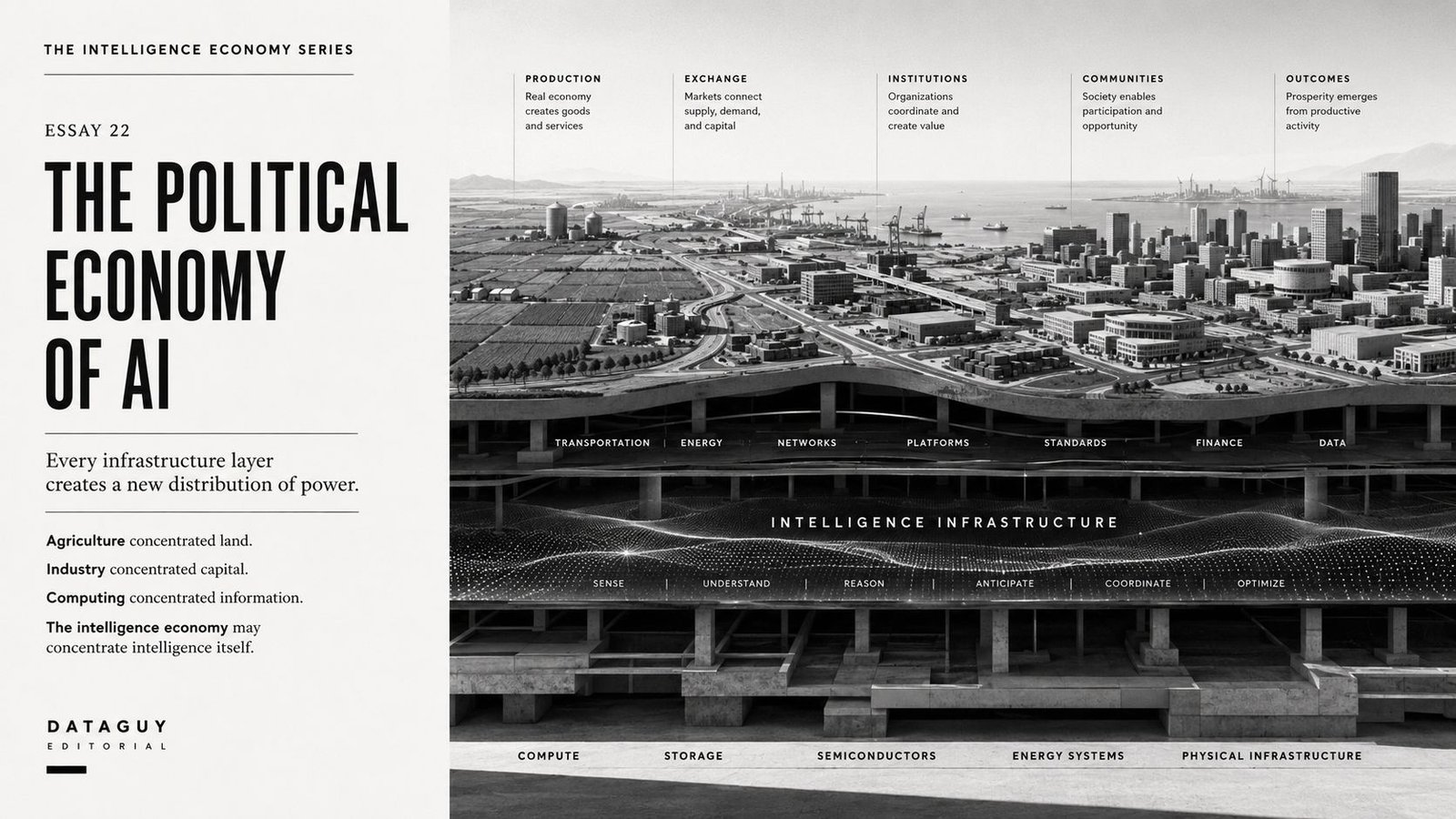
Every infrastructure layer creates a new distribution of power.
Technological revolutions are often described in terms of innovation, productivity, and economic growth. Yet history suggests that their deeper significance lies elsewhere. Every major infrastructure transition reshapes the distribution of power throughout society. New technologies create new forms of wealth. New forms of wealth create new institutions. New institutions create new political and economic arrangements. The most enduring consequences of technological change therefore emerge not from the technologies themselves, but from the systems of power that form around them.
The intelligence economy appears likely to follow a similar pattern. Much of the discussion surrounding artificial intelligence focuses on models, applications, automation, and productivity gains. These developments are important, but they represent only part of the story. Beneath the visible technological transformation lies a deeper economic question. Who controls intelligence infrastructure? Who benefits from it? Who captures the value it creates? And who determines how intelligence is distributed throughout society?
These questions belong to the domain of political economy. Political economy examines how economic resources are produced, allocated, governed, and distributed. It recognizes that markets do not operate independently of institutions, incentives, and power structures. The same principle applies to intelligence. Intelligence may become abundant, but the benefits created by intelligence depend upon the systems that govern access to it.
This perspective becomes increasingly important as intelligence evolves into infrastructure. Infrastructure rarely remains politically neutral. Transportation networks influence commerce. Communication networks influence information flows. Financial systems influence capital allocation. Intelligence infrastructure may similarly influence decisions, opportunities, productivity, and economic participation across society.
The emergence of intelligence infrastructure therefore introduces a new distribution question. Technological progress can create enormous value, but value does not distribute itself automatically. Economic outcomes depend upon ownership structures, institutional design, market organization, governance systems, and public policy. Intelligence may prove no different.
The previous essay argued that intelligence is becoming a civilizational layer embedded throughout institutions and infrastructure. This essay examines the implications of that transition. If intelligence becomes foundational to economic and social activity, understanding the future requires understanding the political economy emerging around intelligence itself.
The defining challenge may not be whether intelligence becomes abundant. The defining challenge may be determining how the benefits and power created by intelligence are distributed throughout society.
Agriculture created land economies. Industry created capital economies. Computing created information economies. The intelligence economy creates new systems for producing, distributing, and governing intelligence itself.
Why Infrastructure Creates Power
Infrastructure occupies a unique position within economic systems because it influences activity far beyond its immediate function. Roads move goods, yet they also shape commerce, settlement patterns, labor mobility, and regional development. Communication networks transmit information, yet they also influence media, markets, politics, and social coordination. Infrastructure matters because it affects the behavior of entire systems rather than isolated activities.
This characteristic explains why infrastructure often becomes a source of economic and political power. Control over critical infrastructure creates influence over the activities that depend upon it. Throughout history, societies have repeatedly witnessed this pattern. Land ownership shaped agricultural economies. Industrial capital shaped manufacturing economies. Telecommunications networks shaped information economies. Infrastructure creates leverage because other forms of activity increasingly organize around it.
The relationship between infrastructure and power becomes more pronounced as dependency increases. A road network becomes economically significant when commerce relies upon transportation. Electrical grids become strategically significant when industry relies upon power. Digital networks become politically significant when societies rely upon information systems. Infrastructure gradually evolves from a supporting asset into a strategic resource.
The intelligence economy may be entering a similar phase. Intelligence increasingly functions as a general-purpose capability embedded across organizations, markets, governments, and public institutions. Businesses depend upon intelligence for decision-making. Markets depend upon intelligence for allocation. Governments depend upon intelligence for administration. Individuals depend upon intelligence for navigation, learning, and problem-solving. As dependency grows, intelligence infrastructure becomes increasingly important.
This transition creates new forms of economic influence. Intelligence is not merely another digital service. Intelligence affects decisions. Decisions influence resource allocation. Resource allocation shapes economic outcomes. The institutions that develop, distribute, and govern intelligence therefore acquire influence over increasingly large portions of economic activity.
History suggests that such transitions rarely remain confined to technology. Infrastructure eventually shapes institutions. Institutions shape incentives. Incentives shape economic behavior. Over time, entire systems emerge around critical infrastructure layers. Railways transformed national economies. Electricity transformed industrial organization. The internet transformed information flows. Intelligence may similarly transform the organization of economic activity.
The significance of this transformation lies not simply in the concentration of technological capability. The deeper issue concerns how intelligence influences opportunity itself. Access to transportation affects economic participation. Access to communication affects information access. Access to intelligence may increasingly affect productivity, education, innovation, and economic mobility.
Viewed through this lens, intelligence becomes more than a technological resource. It becomes an economic infrastructure layer whose distribution influences broader patterns of wealth, opportunity, and power. Understanding the intelligence economy therefore requires understanding the historical relationship between infrastructure and influence.
The political economy of intelligence begins with a simple observation. Infrastructure creates power because infrastructure shapes the possibilities available to everyone else.
Infrastructure becomes politically significant when society depends upon it. As intelligence becomes infrastructure, questions of ownership, access, and control become increasingly important.
The Economics Of Cognitive Infrastructure
Power emerges wherever control over scarce resources influences outcomes. In agricultural economies, land created power because food production depended upon it. In industrial economies, capital created power because production depended upon it. In information economies, data and networks created power because communication and information processing depended upon them. Intelligence economies introduce a similar dynamic centered around cognitive infrastructure.
The significance of intelligence lies in its relationship to decision-making. Decisions determine how resources are allocated, which opportunities are pursued, which risks are avoided, and which priorities receive attention. Intelligence influences decisions by reducing uncertainty and improving understanding. Control over intelligence therefore creates indirect influence over a growing number of economic outcomes.
This influence differs from traditional forms of infrastructure power. Transportation infrastructure shapes the movement of goods. Communication infrastructure shapes the movement of information. Intelligence infrastructure increasingly shapes the movement of decisions. Its importance stems from its ability to affect how individuals, organizations, and institutions interpret the world around them.
As intelligence becomes more embedded throughout society, this influence expands. Organizations rely upon intelligence to guide strategy. Financial markets rely upon intelligence to allocate capital. Governments rely upon intelligence to design policy. Scientific institutions rely upon intelligence to accelerate discovery. Intelligence increasingly becomes a general-purpose input into decision-making across multiple domains.
The result is the emergence of cognitive infrastructure. Just as physical infrastructure supports economic activity, cognitive infrastructure supports decision-making activity. Intelligence systems help institutions evaluate options, anticipate outcomes, identify opportunities, and manage complexity. They function as a layer that shapes how societies process uncertainty.
This creates an important distinction between intelligence and information. Information expands awareness. Intelligence influences interpretation. Two institutions may possess access to the same information while reaching different conclusions because they possess different intelligence capabilities. Intelligence therefore affects not only what societies know, but how societies think.
The economic consequences of this distinction are significant. Institutions with superior intelligence infrastructure may allocate resources more effectively, adapt more quickly, and coordinate more efficiently than competitors. Entire economies may benefit from improved decision-making capacity. Intelligence becomes productive not because it replaces economic activity, but because it improves the quality of economic activity.
At the same time, the concentration of intelligence infrastructure introduces new questions regarding influence and dependency. If intelligence increasingly shapes decisions, then the institutions that develop, distribute, and govern intelligence acquire growing significance. Their role extends beyond technology provision toward shaping the cognitive environment within which decisions occur.
This dynamic explains why the political economy of intelligence differs from traditional technology debates. The issue is not simply who owns technology. The issue is who shapes the decision-making infrastructure upon which society increasingly depends.
Viewed through this lens, intelligence creates power because intelligence influences choices. As societies become more dependent upon intelligence infrastructure, the governance of that infrastructure becomes increasingly important to economic and social outcomes.
Transportation infrastructure moves goods. Communication infrastructure moves information. Intelligence infrastructure increasingly shapes decisions. This makes intelligence one of the most consequential forms of infrastructure in modern economies.
Where Power Accumulates
Discussions about artificial intelligence often focus on models because models represent the most visible component of the ecosystem. Yet political economy rarely centers on what is most visible. It focuses on where power accumulates. Understanding the intelligence economy therefore requires examining the layers beneath intelligence itself and identifying the points at which influence, control, and value concentrate.
One way to understand this structure is through what might be called the Intelligence Power Stack. The framework highlights how intelligence moves from technical capability to economic influence. Each layer contributes to the creation of value, yet not all layers capture value equally. Some layers become strategic bottlenecks through which the broader intelligence economy operates.
Infrastructure
The foundation of the stack consists of infrastructure. Data centers, energy systems, semiconductor manufacturing, cloud computing platforms, and network infrastructure provide the physical base upon which intelligence systems depend. Intelligence may appear digital, but its operation remains deeply dependent upon physical infrastructure. Control over foundational infrastructure creates leverage because every higher layer relies upon it.
Models
The second layer consists of models. These systems transform computational resources into intelligence capabilities. Models perform reasoning, prediction, generation, classification, and decision-support functions. While models attract significant public attention, their economic significance depends heavily upon the infrastructure beneath them and the distribution systems above them.
Distribution
The third layer concerns distribution. Intelligence creates value only when it reaches users. Platforms, applications, enterprise systems, operating environments, and service providers determine how intelligence is delivered throughout the economy. Distribution often becomes strategically important because it shapes access, adoption, and user relationships.
Institutions
The fourth layer consists of institutions. Governments, regulatory bodies, educational systems, financial organizations, corporations, and public institutions determine how intelligence integrates into society. Institutions establish rules, incentives, standards, and governance mechanisms that shape the behavior of the broader intelligence ecosystem.
Power
The final layer is power itself. Power emerges from the interaction of all preceding layers. It reflects the ability to influence resource allocation, decision-making, opportunity creation, and economic outcomes. Power is not a separate resource. It is the consequence of controlling critical positions within the stack.
The significance of the Intelligence Power Stack lies in its ability to reveal where strategic influence accumulates. Public debates frequently focus on models because they are visible and accessible. Yet the deepest forms of influence often emerge from infrastructure, distribution, and institutional control. The entities that govern these layers frequently shape the long-term evolution of entire ecosystems.
This pattern is not unique to intelligence. Railways created powerful infrastructure owners. Broadcasting created powerful distribution networks. The internet created powerful platform operators. Intelligence may generate similar dynamics as value increasingly concentrates around key layers of the ecosystem.
The framework also helps explain why intelligence economies are likely to produce complex forms of competition. Organizations compete for technological leadership. Governments compete for strategic influence. Institutions compete to establish standards and governance mechanisms. Economic power emerges from multiple layers simultaneously rather than from a single source.
Viewed through this lens, the political economy of intelligence is ultimately a question of structure. The most important issue is not who possesses intelligence. The more important issue is who controls the layers through which intelligence is produced, distributed, and governed.
Infrastructure enables intelligence. Models create intelligence. Distribution delivers intelligence. Institutions govern intelligence. Together, these layers determine how power is created and exercised within the intelligence economy.
Who Captures The Value?
Every technological revolution creates value. The more difficult question is how that value is distributed. Industrialization generated enormous wealth, yet its benefits flowed unevenly across workers, firms, investors, and governments. The information economy created unprecedented prosperity, yet it also concentrated significant economic power within a relatively small number of institutions. The intelligence economy is likely to confront a similar distribution question.
At first glance, intelligence appears unusually democratic. Intelligence can be replicated at low marginal cost, distributed digitally, and accessed from nearly anywhere in the world. These characteristics create the impression that intelligence will naturally produce broad-based benefits. Yet economic history suggests that abundance alone does not determine distribution. Institutions determine distribution.
The distinction is important because intelligence generates value across multiple levels simultaneously. Workers may become more productive. Organizations may become more efficient. Consumers may gain access to better services. Governments may improve administrative capacity. Investors may benefit from increased profitability. The challenge lies in determining how the gains created by intelligence are allocated across these groups.
One possibility is that intelligence functions primarily as a productivity multiplier. In this scenario, intelligence enhances the capabilities of individuals and organizations throughout the economy. Productivity gains become widely distributed because intelligence improves performance across many sectors simultaneously. Economic growth expands and benefits are shared broadly across society.
A second possibility is that intelligence functions as a concentration mechanism. Organizations with superior access to intelligence infrastructure, computational resources, talent, and distribution networks may capture disproportionate shares of the value created. Economic gains become concentrated among those controlling critical layers of the intelligence ecosystem.
The likely outcome lies somewhere between these extremes. Intelligence creates opportunities for both diffusion and concentration. Access becomes broader while strategic advantages remain unevenly distributed. The institutions governing intelligence infrastructure therefore play a crucial role in determining how value flows throughout the economy.
Labor markets illustrate this tension clearly. Intelligence can enhance worker productivity, allowing individuals to accomplish more with fewer resources. At the same time, intelligence may alter the relative value of different forms of labor. Some skills become more valuable when paired with intelligence systems. Others may become less scarce. The distribution of economic gains depends not only on technology itself but on how labor markets adapt to these changes.
The same dynamic appears in markets and industries. Intelligence lowers barriers in some areas while increasing scale advantages in others. Smaller organizations gain access to capabilities that were previously unavailable. Larger organizations gain access to greater resources for deploying intelligence at scale. The resulting balance between democratization and concentration remains one of the central questions of the intelligence economy.
Public institutions also play a role. Educational systems influence who can effectively utilize intelligence. Regulatory frameworks influence market structure. Competition policy influences concentration. Public investment influences access to infrastructure. Distribution outcomes emerge from the interaction between technology and institutions rather than technology alone.
Viewed through this lens, the distribution question is not a secondary issue. It is one of the defining issues of the intelligence economy. The long-term significance of intelligence depends not only on how much value it creates, but on how that value is shared across society.
Intelligence may become abundant, but abundance does not determine distribution. The benefits of intelligence depend upon the institutions, incentives, and market structures that govern its use.
The Institutional Response
If intelligence becomes infrastructure, governance becomes unavoidable. Infrastructure shapes economic outcomes, social opportunities, and institutional behavior. Roads require transportation policy. Financial systems require regulation. Communication networks require governance frameworks. Intelligence infrastructure will similarly require institutions capable of managing its economic and societal consequences.
The challenge begins with the recognition that intelligence differs from many previous technologies. Intelligence increasingly participates in decision-making rather than merely supporting it. It influences how organizations allocate resources, how markets process information, how governments design policy, and how individuals navigate complexity. As intelligence becomes embedded throughout society, its governance becomes a question of systemic importance rather than technical oversight.
This reality creates a new institutional responsibility. The objective is not simply regulating technology. The objective is governing a foundational economic resource. Intelligence increasingly affects productivity, competitiveness, education, innovation, public administration, and national development. Managing such a resource requires institutions capable of balancing innovation, competition, resilience, and public interest simultaneously.
One area of focus concerns access. Historically, societies have invested in infrastructure because broad access generates widespread economic benefits. Transportation systems, electrical grids, communication networks, and educational institutions all expanded participation within the economy. Intelligence infrastructure may require similar considerations. Uneven access to intelligence could amplify existing economic inequalities while limiting broader societal gains.
Competition policy represents a second challenge. Infrastructure industries often exhibit tendencies toward concentration because scale creates advantages. Intelligence ecosystems may display similar dynamics. Large-scale infrastructure, computational resources, data access, and distribution networks can reinforce the position of dominant actors. Governance frameworks may therefore play an important role in maintaining competitive and innovative markets.
Standards and interoperability become equally important. Economic systems function more effectively when participants can coordinate through shared rules and common frameworks. Financial systems depend upon standards. Communication systems depend upon standards. Intelligence economies may increasingly depend upon standards that facilitate trust, compatibility, transparency, and cooperation across institutions.
International coordination introduces another dimension. Intelligence infrastructure operates across national boundaries while governance systems remain largely national. This creates tensions between global technological ecosystems and fragmented regulatory environments. Managing intelligence economies may therefore require new forms of international cooperation comparable to those that emerged around trade, finance, communications, and digital infrastructure.
Public institutions also face a strategic question regarding capability. Governments increasingly rely upon intelligence to perform core functions ranging from service delivery to policy analysis. Effective governance may therefore require governments to develop their own intelligence capabilities rather than depending entirely upon external providers. The governance of intelligence becomes intertwined with the intelligent governance of society itself.
The broader lesson is that technological progress alone does not determine outcomes. Institutions shape outcomes. Economic history repeatedly demonstrates that societies benefit most from transformative technologies when governance systems evolve alongside them. Intelligence appears unlikely to be an exception.
Viewed through this lens, governing intelligence economies is not primarily about restricting innovation. It is about building institutions capable of ensuring that intelligence contributes to economic dynamism, societal resilience, and broadly shared prosperity.
The defining institutional challenge of the intelligence economy is not how to regulate intelligence, but how to govern a foundational resource upon which increasingly large portions of society depend.
Power In The Intelligence Century
Every major economic era ultimately develops its own political economy. Agricultural societies organized around land. Industrial societies organized around capital. Information societies organized around data, networks, and computational infrastructure. The intelligence economy appears likely to generate its own institutions, incentives, and systems of power built around the production, distribution, and governance of intelligence itself.
This transition extends beyond technology. The emergence of intelligence infrastructure changes the resources that societies consider strategically important. Economic competitiveness increasingly depends upon access to intelligence capabilities. Institutional effectiveness increasingly depends upon the ability to utilize intelligence productively. National development increasingly depends upon the ability to integrate intelligence throughout economic and social systems.
The significance of this shift lies in the growing relationship between intelligence and coordination. Intelligence influences decisions. Decisions influence resource allocation. Resource allocation shapes economic outcomes. As intelligence becomes embedded throughout society, it increasingly affects how entire systems function. The result is a political economy in which cognitive resources become central to economic performance.
This evolution may reshape traditional understandings of economic power. Historically, influence often derived from control over physical resources, industrial capacity, financial capital, or information networks. These resources remain important. Yet intelligence increasingly acts as a multiplier that enhances the effectiveness of all other resources. Societies capable of generating, distributing, and utilizing intelligence effectively may gain advantages that extend across multiple domains simultaneously.
The implications reach beyond economics. Public institutions, educational systems, scientific organizations, and governance frameworks all become participants in the intelligence economy. The question is no longer whether intelligence matters. The question is how societies organize themselves around intelligence as a foundational capability.
This creates both opportunities and responsibilities. Intelligence can expand productivity, improve decision-making, accelerate innovation, and increase adaptive capacity. At the same time, intelligence can concentrate influence, reshape market structures, and alter the distribution of opportunity. The future depends not only on technological progress but on the institutions that govern its deployment.
Viewed through this lens, the intelligence economy should be understood as more than a technological transformation. It represents the emergence of a new political economy centered around cognitive infrastructure. The defining debates of the coming decades may increasingly concern access, governance, competition, distribution, and legitimacy within intelligence-driven systems.
The societies that navigate this transition most effectively may discover that intelligence functions much like previous forms of infrastructure. Its value lies not merely in its existence but in the institutions that organize its benefits. Intelligence creates possibilities. Political economy determines how those possibilities are distributed.
The intelligence century may be defined not by the creation of intelligence alone, but by the institutions that determine who controls intelligence, who benefits from intelligence, and how intelligence shapes economic and social outcomes.
Conclusion
Every infrastructure revolution creates a corresponding political economy. As new resources become central to economic activity, societies develop institutions, incentives, and governance systems to organize them. Land shaped agricultural economies. Capital shaped industrial economies. Information shaped digital economies. Intelligence increasingly appears positioned to shape the next stage of economic development.
The intelligence economy is therefore not solely a story about technological capability. It is a story about ownership, distribution, governance, and power. Intelligence may become abundant, yet abundance alone does not determine outcomes. Economic and social consequences depend upon the structures through which intelligence is produced, distributed, and governed.
The Intelligence Power Stack provides one framework for understanding this transition. Infrastructure enables intelligence. Models create intelligence. Distribution delivers intelligence. Institutions govern intelligence. Together, these layers shape how power accumulates and how value flows throughout the intelligence economy.
The distribution question remains particularly important. Intelligence has the potential to increase productivity, expand opportunity, and improve societal coordination. Yet its benefits are not guaranteed to spread automatically. Distribution depends upon market structures, governance frameworks, educational systems, and public institutions capable of translating technological progress into broadly shared prosperity.
Viewed from a broader perspective, the political economy of intelligence represents one of the defining challenges of the intelligence century. The central issue is not whether intelligence becomes a foundational resource. The central issue is how societies organize themselves around that resource once it does.
The defining question of the intelligence economy is not whether intelligence becomes abundant. It is how the benefits and power created by intelligence are distributed throughout society.