System Drift in Trusted Systems
How trusted systems continue to operate while gradually becoming misaligned.
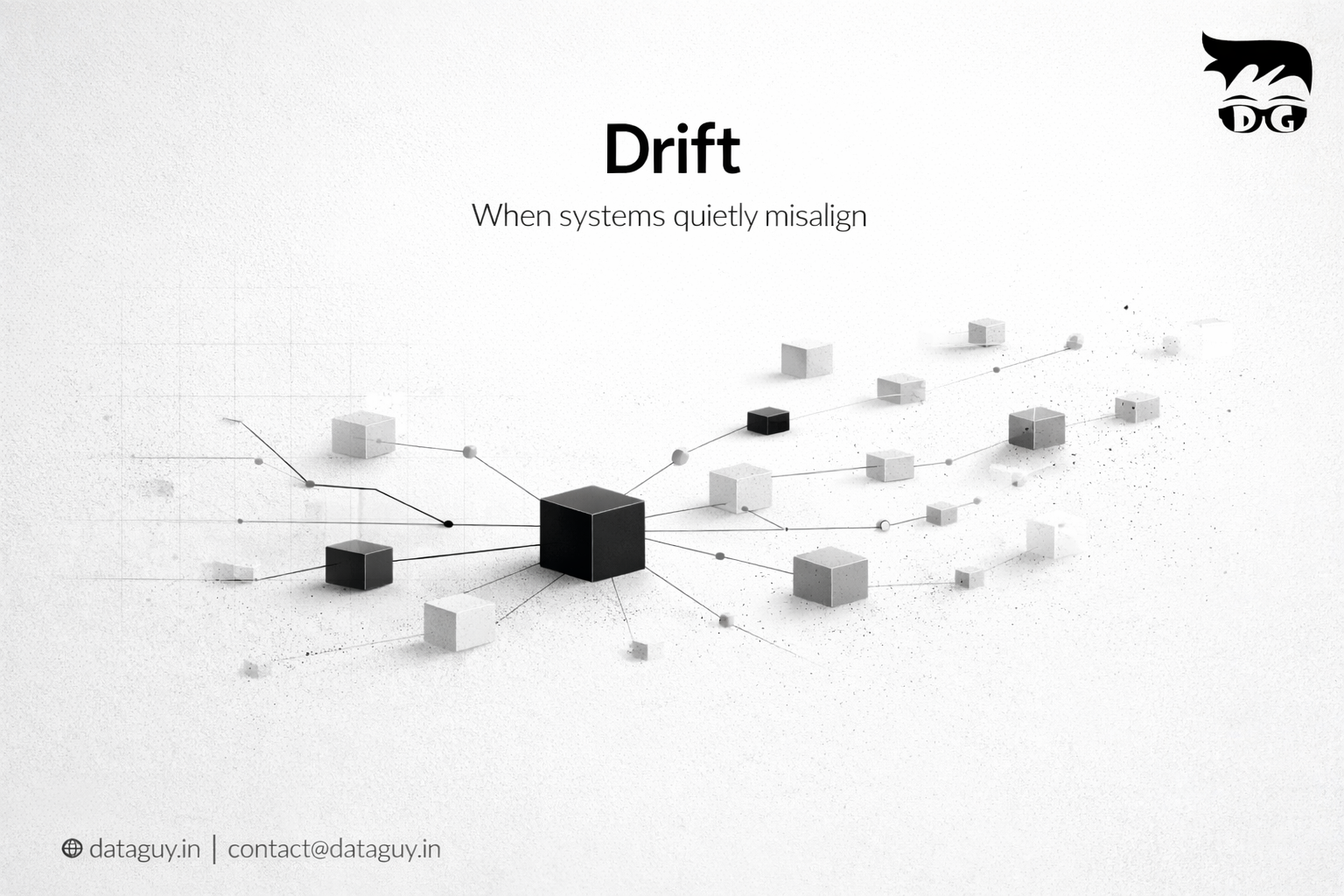
The system had been running for months without incident.
No alerts. No escalations. Performance metrics remained stable. From the outside, it appeared reliable. It even appeared mature. The team that built it had shifted focus, confident that the system was operating as intended.
Then a small inconsistency appeared.
A recommendation that felt slightly off. A decision that required a manual override. Not enough to trigger concern, but enough to raise a question.
Nothing had failed.
Something had shifted.
What Drift Actually Means
Drift is not failure. It is not an anomaly. It is not a system breaking under pressure.
Drift is the gradual divergence between a system’s behavior and its original intent, while the system continues to operate within acceptable performance boundaries.
This distinction matters.
Most systems are designed to detect failure. They rely on thresholds, alerts, and deviations that exceed predefined limits. Drift does not behave this way. It operates within those limits.
A system experiencing drift can:
- Meet performance targets
- Pass validation checks
- Produce outputs that appear reasonable
And yet, over time, it may:
- Optimize for outdated objectives
- Misinterpret changing inputs
- Introduce subtle inconsistencies across decisions
Drift is not about correctness in isolation. It is about alignment over time.
Why Drift Is Inevitable
Drift is not an edge case. It is a structural outcome of systems operating in dynamic environments.
1. Data Changes Without Signaling
User behavior evolves. External conditions shift. Upstream systems change assumptions. These changes rarely trigger explicit failures.
The system continues to process inputs correctly, but those inputs no longer represent the same reality.
2. Objectives Remain Fixed While Context Moves
Systems optimize defined metrics such as conversion, risk, and efficiency, but the meaning of those metrics evolves.
The system continues optimizing the same target, even when the organization has redefined what that target represents.
3. Human Scrutiny Decreases Over Time
Early in deployment, systems are closely examined. Over time, review becomes periodic, then partial, and then implicit trust.
When scrutiny fades, drift accelerates. This does not happen because the system changes faster. It happens because observation weakens.
Why Drift Is Hard to Detect
Drift persists because it aligns with how organizations define success.
If metrics remain stable, the system is assumed to be correct.
This creates a blind spot.
Performance is treated as a proxy for alignment.
Performance measures output quality within a frame. Drift changes the frame itself.
By the time drift becomes visible, it is rarely localized. It is embedded across data, models, workflows, and decisions.
The Cost of Drift
The impact of drift is gradual, which makes it easy to ignore and difficult to attribute.
Over time, it leads to:
- Increased manual overrides
- Growing inconsistency across decisions
- Loss of confidence in system outputs
- Fragmentation of decision-making processes
The system continues to operate, but it is no longer trusted in the same way.
Designing Systems That Surface Drift
Drift cannot be eliminated, but it can be surfaced earlier.
Distinguish Performance from Alignment
Systems must track signals beyond performance, including:
- Consistency across similar decisions
- Behavior at edge cases
- Frequency and nature of overrides
Make Assumptions Explicit
Every system is built on assumptions about data, users, and trade-offs. These assumptions must be documented and revisited.
Enable System Interrogation
Systems must support tracing decisions, inspecting intermediate states, and replaying scenarios.
Maintain Structured Human Involvement
Oversight should focus on areas where drift is most likely:
- Edge cases
- Policy-sensitive decisions
- Periodic deep reviews
System Implications
- Monitoring must include alignment signals, not just performance metrics
- Decision systems must support traceability and replay
- Assumptions must be versioned and revisited over time
- Human oversight must be structured, not symbolic
- Drift detection must be treated as a core system capability
Closing Thought
Drift is not a failure condition.
It is a natural property of systems operating without continuous interpretation.
The risk is not that systems will break. The risk is that they will continue to work while becoming progressively misaligned.
Governable intelligence begins when systems are designed to make that misalignment visible early enough to act on it.
This article is part of the Governable Intelligence series, which examines how systems behave after they are trusted.
Before systems can be governed, they must first earn trust through clarity, constraint, and consistent behavior over time.