Last updated on November 5th, 2026 at 09:07 pm
Insights Index
ToggleSoftware is beginning to organise itself around work
For decades, business software has been organised around applications. People open a spreadsheet to analyse information, a project management platform to coordinate tasks, a customer relationship management system to manage accounts, and a communication tool to exchange updates. Each application provides a defined environment for a particular kind of work.
The arrangement has become so familiar that its underlying assumption is rarely questioned: people remain responsible for moving work between applications, carrying information across systems, coordinating intermediate steps and verifying what has been completed.
Consider the preparation of a quarterly business review. The work might involve retrieving sales figures, reconciling financial information, examining customer activity, reviewing operational performance, identifying significant changes, preparing charts and assembling a presentation. Each activity may take place in a different application. The final deliverable depends not only on the quality of individual tools but also on the coordination between them.
The applications are connected, but the work remains fragmented.
Machine intelligence introduces a different possibility. Instead of asking people to operate every application and coordinate every intermediate step, a user can describe an intended outcome and delegate a sequence of activities to an agent. The agent can gather information, use connected tools, manipulate files, perform intermediate operations and return a deliverable for review.
The significant change is not simply that software can perform more tasks. It is that the organising principle of interaction begins to shift from application operations towards delegated outcomes.
This is the context in which the agent workspace is emerging.
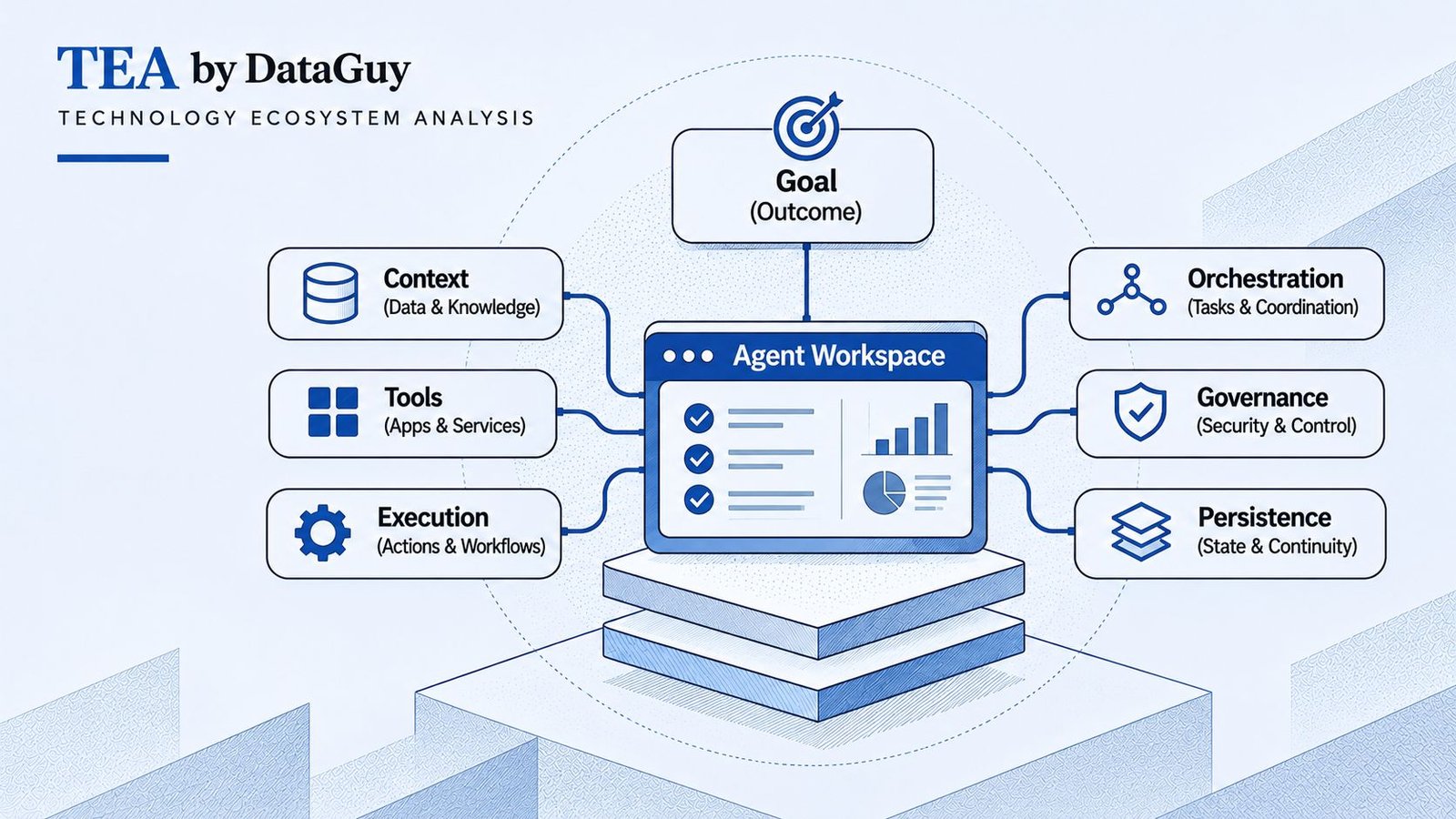
An agent workspace is an environment through which people delegate objectives to intelligent software systems that can access relevant context, coordinate tools, execute multi-step activities and produce work for human review. It combines capabilities that have traditionally been distributed across assistants, applications, automation platforms and execution environments.
The category is still developing. Its boundaries are not settled, and commercial products implement different combinations of these capabilities. Nevertheless, the direction is becoming increasingly visible: software is beginning to organise itself around the work people want completed, rather than only the applications they need to operate.
From assistant to agent workspace
The distinction between an assistant, an agent and an agent workspace is important because these terms are frequently used interchangeably.
An assistant primarily responds to a request. It may explain a concept, draft a document, analyse supplied information or recommend an action. An agent is expected to pursue an objective through a sequence of activities, using tools and responding to intermediate results. An agent workspace provides the environment in which that activity can be initiated, managed, observed and governed.
The difference becomes clearer when the same business requirement is approached through each model.
A user asking an assistant to prepare a market analysis might receive a suggested research structure or a draft based on information supplied in the conversation. An agent could be instructed to investigate the market, retrieve information from specified sources, organise findings, compare competitors and prepare an initial report. An agent workspace would provide the surrounding environment: access to approved sources, connected applications, task history, execution capabilities, progress visibility and the controls required to review or approve consequential actions.
The workspace is therefore not simply a larger conversational interface. It is the operational environment that allows delegated work to take place.
Seven responsibilities help explain its structure:
- Goal interpretation: Translate a broad request into a defined objective and a sequence of activities.
- Context management: Retrieve relevant documents, records, instructions, organisational knowledge and task history.
- Tool connectivity: Interact with applications, services, APIs, browsers and other operational systems.
- Task orchestration: Coordinate activities, dependencies, interruptions, retries and completion conditions.
- Execution: Perform operations that produce tangible changes or deliverables.
- Observation and control: Allow people to inspect progress, intervene, redirect work and approve consequential actions.
- Persistence: Retain sufficient task state to continue work across multiple steps or sessions.
These responsibilities do not necessarily correspond to seven separate software components. A commercial product may combine several of them behind a single interface. The distinction is architectural: each responsibility must be addressed if a system is expected to complete work beyond a single interaction.
The model is also different from traditional robotic process automation. Scripted automation typically follows predefined rules and structured paths. Agentic systems introduce a degree of model-driven interpretation and adaptation. They can respond to instructions, select tools and adjust their approach when intermediate results differ from expectations.
That flexibility creates opportunity, but it also introduces uncertainty. A scripted workflow is generally easier to predict when its conditions are known. An agent must be evaluated not only for whether it can complete a task, but also for how it behaves when the task is ambiguous, the information is incomplete or the execution environment changes.
The agent workspace must accommodate both sides of this equation: the ability to adapt and the need to remain controlled.
Four approaches competing to define the workspace
The emerging market is not developing through one uniform product category. Technology companies are approaching the opportunity from different starting points, each bringing its own distribution advantages, infrastructure and commercial incentives.
Conversational platforms expanding into execution
This approach begins with an established assistant interface and extends it towards multi-step work.
OpenAI's development illustrates this direction. In April 2026, the company introduced workspace agents for ChatGPT Business, Enterprise and Edu, describing shared agents that could operate across organisational tools, follow workflows and continue working in the cloud. In July 2026, OpenAI introduced ChatGPT Work, positioning it as an agent for longer tasks involving research, analysis, connected applications and the production of finished documents, spreadsheets and presentations. [1], [2]
The strategic advantage is distribution. Users already interact with the assistant, and organisations may already have established relationships with the platform. Extending the interface towards execution can reduce the friction involved in adopting a new working environment.
The challenge is turning conversational capability into dependable operational software. The system must manage permissions, task continuity, execution failures and organisational accountability. A familiar interface does not automatically make delegated work reliable.
Desktop and file-centred work environments
A second approach places the agent closer to the material people already use to perform knowledge work: files, folders, documents, spreadsheets and desktop applications.
Anthropic's Claude Cowork initially represented this direction. Its product capabilities included work across selected folders and connected tools, browser interaction, parallel task execution and the preparation of deliverables. In September 2026, Anthropic announced that Cowork and chat were being brought together into a unified Claude experience. [3], [4]
The strategic advantage is proximity to the user's existing working environment. The agent can work with the documents and resources that form part of everyday knowledge work rather than requiring every task to begin with manually supplied information.
The challenge is managing access and context across different files, services and devices. A workspace that operates close to the user's working environment must make its permissions, actions and boundaries particularly clear.
Enterprise agent platforms
A third approach treats agents as organisational resources rather than individual productivity assistants.
The emphasis shifts towards enterprise identity, permissions, workflow integration, reusable processes, monitoring and governance. The objective is not merely to give employees a more capable assistant. It is to introduce agents into the operating structure of the organisation.
Microsoft's Frontier Firm thesis provides an example of this strategic direction. Its 2025 Work Trend Index described the emergence of human-agent teams and reported that 46% of surveyed leaders said their organisations were using agents to fully automate workstreams or business processes. This is a survey finding reported by Microsoft, not independent confirmation that those processes were consistently successful or economically beneficial. [5]
The enterprise opportunity is substantial because valuable business workflows often cross departmental and application boundaries. However, enterprise deployment introduces requirements that consumer-oriented experiences may not need to address at the same level: role-based access, data residency, audit trails, approval structures, integration with legacy systems and responsibility for operational outcomes.
Open and extensible agent environments
The fourth approach is developing through agent frameworks, developer platforms, tool protocols and configurable execution environments.
Rather than beginning with a finished workplace product, this ecosystem provides the building blocks for technical teams to assemble their own agent environments. Developers can combine models, memory systems, orchestration logic, connectors, execution environments and governance mechanisms.
The advantage is flexibility. Organisations can adapt the architecture to specialised workflows and retain greater control over implementation choices.
The disadvantage is operational responsibility. Teams must build or integrate the components, evaluate the resulting system, manage permissions, monitor performance and maintain the infrastructure over time.
These approaches are not mutually exclusive. An organisation may use a conversational platform for general delegation, an enterprise platform for governed workflows and open frameworks for specialised applications.
The competition is therefore not limited to which company develops the most capable agent. It also concerns which environment becomes the preferred place where people and organisations delegate, supervise and complete work.
The architecture behind delegated work
An agent workspace can be understood as a layered system. The layers are conceptually distinct even when a commercial product combines them.
Intelligence layer
This includes the models responsible for interpreting instructions, reasoning through problems, generating plans and evaluating intermediate results. Different activities may require different models or specialised capabilities. The workspace should not assume that one model is optimal for every task.
Context layer
The agent needs access to the information that makes a task meaningful. This may include documents, organisational policies, historical interactions, structured data, user preferences and task-specific instructions.
Context is not simply a memory store. It includes the selection, retrieval, interpretation and updating of information relevant to the current objective. Poor context can undermine an otherwise capable model, while excessive or outdated context can introduce errors.
Connectivity layer
Agents need a way to interact with external systems. APIs, application connectors, browser interfaces and tool protocols provide access to information and operations beyond the model itself.
Connectivity is not equivalent to unrestricted access. A workspace must determine which resources an agent can discover, read or modify, and under what conditions.
Orchestration layer
This layer manages the sequence of work. It decomposes objectives into steps, tracks dependencies, coordinates specialised processes, handles failures and determines whether a task is complete.
For complex workflows, orchestration may involve several agents. However, introducing additional agents does not automatically improve performance. Coordination introduces its own costs, including communication overhead, duplicated work, inconsistent outputs and more complicated failure diagnosis.
Execution layer
Reasoning must eventually produce an action. This layer provides the environment in which agents interact with files, software, browsers, code, data and other operational resources.
Execution environments may include controlled browsers, sandboxes, local desktop environments or cloud-based computers. Their design influences what an agent can access and what risks an organisation must manage.
Control and governance layer
This layer establishes identity, permissions, approvals, auditability, monitoring and intervention. It determines which actions can happen independently, which require human confirmation and how responsibility is maintained.
The control layer should not be treated as a final security feature added after the agent has been built. It affects the design of every other layer, from context retrieval to execution.
The workspace is therefore not simply a model connected to a collection of tools. It is an operating environment that coordinates intelligence, information, connectivity, execution and control.
The quality of this architecture determines whether an agent can move from producing plausible responses to completing useful work within real organisational constraints.
The economics of the agent workspace
The commercial opportunity becomes clearer when the agent workspace is examined as an economic system rather than as a productivity feature.
Traditional enterprise software is generally monetised through subscriptions, seats, usage or a combination of these models. The customer pays for access to an application or a defined set of capabilities. The software helps people perform work, but people remain responsible for most of the coordination and execution.
An agent workspace changes the potential unit of value. The customer may increasingly pay for access to an environment that can complete defined portions of work.
This creates several economic questions.
The value being purchased
The value of a workspace is not determined by how many tasks an agent can attempt. It is determined by the difference between the cost and quality of the existing process and the cost and quality of the delegated process.
A useful evaluation must consider:
- Human time spent performing the original work.
- Time required to supervise and correct the agent.
- Model inference and tool execution costs.
- Integration, maintenance and infrastructure costs.
- Errors, rework and operational disruption.
- Changes in speed, quality, consistency and capacity.
A task that takes an employee two hours may appear attractive to automate. But if the agent requires substantial preparation, repeated correction and extensive verification, the economic advantage may be smaller than the demonstration suggests.
The relevant measure is not the amount of work an agent can perform. It is the amount of useful work it can complete at an acceptable total cost.
The emerging revenue models
Several commercial models are possible.
Subscription and seat-based pricing
The workspace is sold as part of an individual or organisational subscription. This model benefits from existing software procurement practices and predictable recurring revenue. However, traditional seat pricing may become less representative when a small number of employees supervise many agents.
Usage-based pricing
Customers pay according to model consumption, execution time, tool calls, task volume or other measurable usage. This aligns revenue more closely with infrastructure consumption, but can make costs difficult to forecast for long-running or complex workflows.
Outcome-oriented pricing
The provider charges for a completed deliverable, transaction or measurable business outcome. This can align the commercial relationship with customer value, but it introduces difficult questions about attribution, quality standards, exceptions and responsibility when an outcome is not achieved.
Enterprise platform licensing
Organisations pay for the workspace as an operating environment, including administration, identity, governance, integrations, monitoring and deployment controls. This model may become particularly important where agents are shared across departments and embedded in business processes.
These models can coexist. A provider may combine subscriptions with usage charges, enterprise licensing and specialised workflow services.
Where the economic value may accumulate
The workspace economy will involve several participants.
The model provider supplies intelligence. The workspace provider coordinates the user experience and execution environment. Enterprise software vendors control important systems of record and operational applications. Infrastructure providers supply compute, storage and connectivity. Integration and security providers help agents operate within organisational boundaries.
The distribution of value between these participants is not yet settled.
A model provider may capture value through inference consumption. A workspace provider may capture value through the relationship with the user and organisation. An enterprise software provider may retain value through proprietary data, workflows and system access. Infrastructure providers may benefit from increased demand for compute and execution.
This creates an important strategic possibility: the most valuable company in the agent workspace economy may not necessarily be the company with the strongest model. It may be the company that controls the environment through which work is delegated, completed and verified.
The risk of economic leakage
Agent workspaces also introduce new forms of cost.
Long-running tasks can consume substantial inference and tool resources. Multi-agent systems may multiply coordination overhead. Poorly designed workflows may repeatedly call tools or models without producing proportional value. Unrestricted execution can create unexpected cloud expenses or operational disruption.
A 2026 survey by Redwood Software, conducted with Leger Opinion among 300 senior technology, risk and AI leaders and practitioners, reported that 77% of respondents had experienced a negative consequence from an ungoverned AI agent, with unexpected cloud costs among the most common. The study is vendor-sponsored and should be interpreted accordingly, but it illustrates the operational costs that may accompany agent deployment. [10]
The economics of agent workspaces will therefore depend on cost visibility, usage controls, workflow design and the ability to measure completed work rather than raw activity.
The infrastructure and ecosystem forming around the workspace
The agent workspace does not exist independently of the wider technology ecosystem. Its emergence creates demand for capabilities that may become important infrastructure markets in their own right.
Identity and agent permissions
An agent needs an identity that can be distinguished from the person who initiated its task. Organisations need to know which agent accessed a resource, under whose authority it acted and what permissions it exercised.
This raises questions about delegated identity, credential management, least-privilege access and the lifecycle of agents that operate across multiple systems.
Integration and tool infrastructure
The usefulness of an agent depends partly on the systems it can access. Connectors, APIs, tool protocols and integration platforms become essential to the workspace's ability to operate across organisational boundaries.
The quality of these connections matters. A connector that exposes a tool without clear permissions, error handling or observability may increase operational risk rather than create value.
Context and knowledge infrastructure
Agents require access to organisational knowledge, but enterprise information is often distributed across documents, databases, communication systems and specialist applications.
Retrieval, indexing, access-aware search, data quality and context management therefore become important components of the workspace ecosystem.
Execution and compute infrastructure
Long-running agents require environments in which tasks can execute, maintain state, interact with tools and recover from interruptions. Cloud computers, sandboxes, secure runtimes and workload orchestration may become increasingly important.
Observability and evaluation
Organisations need to understand what an agent did, which tools it used, what information it accessed and where a failure occurred.
Evaluation must extend beyond the quality of a single model response. It should examine end-to-end task completion, policy compliance, cost, reliability and the consequences of actions.
Security and governance infrastructure
Agent systems combine model-generated decisions with software capabilities that can affect real systems. This creates risks that extend beyond conventional application security.
NIST's Center for AI Standards and Innovation issued a request for information in January 2026 specifically addressing the secure development and deployment of AI agent systems. NIST highlighted the security challenges that arise when model outputs are combined with software functionality capable of taking actions in real-world systems. [9]
These infrastructure categories are interdependent. Better models cannot compensate for unreliable data access. More connectors do not create value without appropriate permissions. More autonomy does not improve an organisation if actions cannot be observed or corrected.
The workspace becomes useful when these capabilities function as a coherent operating environment.
What determines adoption?
The commercial opportunity is significant, but adoption will depend on whether agent workspaces can meet the operational requirements of real organisations.
Reliability must be measured across complete workflows
A successful individual action does not establish that an entire workflow is reliable. A process involving multiple dependent steps may fail even when each step appears reasonably capable in isolation.
Organisations need to evaluate end-to-end completion, error recovery, consistency, policy compliance and the quality of the final deliverable.
METR's task-completion time-horizon research provides a useful example of how agent capabilities can be measured under defined evaluation conditions. Its September 2026 methodology estimates the duration of tasks, measured by human expert completion time, at which agents are predicted to achieve specified success probabilities. The current task suite draws primarily from software engineering, machine learning and cybersecurity. METR explicitly cautions that its time horizon is a measure of task difficulty, not the duration for which an agent can operate autonomously. It also notes that results cannot be generalised to all forms of intellectual work. [6]
This distinction matters. A system's ability to complete a defined technical task does not establish its ability to manage an ambiguous business process involving organisational context, tacit knowledge and changing requirements.
Quality is a production requirement
An agent may generate a plausible deliverable while introducing subtle factual errors, omitting important information or applying inconsistent assumptions.
The relevant standard is not whether the output appears convincing. It is whether the work can be validated against the requirements and evidence.
LangChain's 2026 State of Agent Engineering survey of more than 1,300 professionals reported that 57% of respondents had agents in production, while 32% identified quality as a leading barrier. The survey also reported widespread adoption of agent observability, although its findings represent the experiences of survey respondents rather than a census of the global market. [7]
Permissions must reflect organisational responsibility
Agents need access to information and tools, but access should be limited to what their assigned tasks require.
An agent preparing a financial report may need permission to read financial data and create a document. It may not need permission to change accounting records or approve payments.
Permission design must reflect the consequences of an action, not merely the technical ability to perform it.
Human oversight must be meaningful
A human approval button is not sufficient if the person cannot understand what the agent intends to do, what information it used or what consequences may follow.
Effective oversight requires visibility into the process, clear escalation conditions and the ability to intervene at appropriate points.
The degree of autonomy should therefore vary according to the risk and reversibility of the action. A low-risk information retrieval task may require limited intervention. A financial transaction, external communication or modification of a critical business record may require explicit approval.
Errors must be detectable and recoverable
Agents will encounter incomplete information, unavailable systems, ambiguous instructions and unexpected application behaviour.
A dependable workspace needs logging, monitoring, exception handling, clear ownership and mechanisms to reverse or correct actions where possible.
The economics must survive real operating conditions
The cost of model inference, tool usage, integration, supervision, evaluation and exception handling must be considered alongside the value of completed work.
Gartner's June 2025 prediction that more than 40% of agentic AI projects could be cancelled by the end of 2027 because of escalating costs, unclear business value or inadequate risk controls is a forecast, not an observed cancellation rate. It nevertheless highlights the gap between experimentation and sustainable deployment. [8]
The conditions for adoption are therefore broader than model capability. They involve reliability, permissions, integration, accountability, recoverability and measurable economic value.
The organisational implications
The agent workspace may change more than the software interface. It may influence how organisations distribute work, coordinate responsibilities and measure operational capacity.
In traditional software environments, employees often coordinate the movement of work between systems. They retrieve information, update records, communicate with colleagues, prepare intermediate outputs and monitor progress.
As agents assume responsibility for selected activities, some of this coordination may shift towards software. Employees may increasingly define objectives, provide context, supervise execution, evaluate results and handle exceptions.
This does not imply that organisations will simply replace employees with agents. The distribution of work will depend on task complexity, risk, industry requirements and the quality of the available systems.
Three organisational changes deserve particular attention.
The emergence of human-agent teams
Work may increasingly be organised around teams that combine employees, specialised agents and existing software systems. The manager's responsibility may extend beyond coordinating people to allocating work between human and machine capabilities, setting boundaries and evaluating results.
The changing economics of organisational capacity
An organisation may be able to increase the volume of work it can process without expanding its workforce at the same rate. However, this capacity is not free. It depends on infrastructure, model consumption, supervision, governance and the ability to redesign existing processes.
The changing definition of software productivity
Traditional software productivity is often associated with how efficiently people use an application. An agent workspace introduces another measure: how much verified work can be completed through the coordinated use of people, agents and applications.
The distinction is important because a system can increase the number of tasks attempted without improving the quality or value of completed work.
The organisational challenge is to redesign workflows around the capabilities and limitations of agents rather than simply inserting them into existing processes.
A new layer of software organisation
The emergence of the agent workspace points towards a change in how software is organised around human activity.
Traditional applications provide environments in which people perform operations. Agent workspaces are being designed to coordinate intelligence, information, tools and execution around an intended outcome. The user increasingly specifies what needs to be accomplished, while the system manages more of the intermediate work.
This does not make applications irrelevant. Data systems, communication platforms, business software and specialist tools remain the operational foundations on which many workflows depend. The workspace introduces a layer that can coordinate activity across them.
Its long-term position will depend on where it sits in the technology stack and how much control it gains over the relationship between people, agents and applications.
If the workspace becomes the primary interface through which work is delegated, it may influence software distribution, enterprise purchasing decisions and the economics of application usage. If it remains dependent on fragmented integrations and inconsistent execution, its value may be limited to selected workflows.
The outcome is not predetermined.
The next stage of competition will be shaped by the companies that can combine intelligence with context, connectivity, execution and control in a way that organisations can trust. The strongest systems will not necessarily be those that promise the greatest autonomy. They will be those that can demonstrate dependable completion, transparent operation and sustainable economics.
The next generation of software may not be defined only by the applications people open. It may increasingly be defined by the work they can confidently delegate.
Research notes and references
The following sources inform the article. Product announcements are used to establish market direction and stated capabilities. Independent research, industry surveys and evaluation work are used to examine adoption, reliability and operational constraints. Survey findings are identified by their source and should not be interpreted as universal market measurements.
1. OpenAI. Introducing workspace agents in ChatGPT. 22 April 2026.
https://openai.com/index/introducing-workspace-agents-in-chatgpt/
2. OpenAI. ChatGPT Business release notes: Introducing ChatGPT Work. 9 July 2026.
https://help.openai.com/en/articles/11391654-chatgpt-business-release-notes
3. Anthropic. Claude Cowork. Product documentation.
https://claude.com/product/cowork
4. Anthropic. Claude Cowork and chat are now one Claude. 16 September 2026.
https://claude.com/blog/cowork-is-now-claude
5. Microsoft. The 2025 Annual Work Trend Index: The Frontier Firm is born. 23 April 2025.
https://blogs.microsoft.com/blog/2025/04/23/the-2025-annual-work-trend-index-the-frontier-firm-is-born/
6. METR. Task-Completion Time Horizons of Frontier AI Models. Updated 8 September 2026.
https://metr.org/time-horizons/
7. LangChain. State of Agent Engineering. 12 June 2026.
https://www.langchain.com/state-of-agent-engineering
8. Gartner. Predicts Over 40% of Agentic AI Projects Will Be Canceled by End of 2027. 25 June 2025.
https://www.gartner.com/en/newsroom/press-releases/2025-06-25-gartner-predicts-over-40-percent-of-agentic-ai-projects-will-be-canceled-by-end-of-2027
9. NIST. CAISI Issues Request for Information About Securing AI Agent Systems. 12 January 2026.
https://www.nist.gov/news-events/news/2026/01/caisi-issues-request-information-about-securing-ai-agent-systems
10. Redwood Software. Enterprise Benchmarks in AI and Agentic Orchestration 2026. 22 October 2026.
https://www.redwood.com/press-releases/ai-and-agentic-orchestration-benchmarks-report/