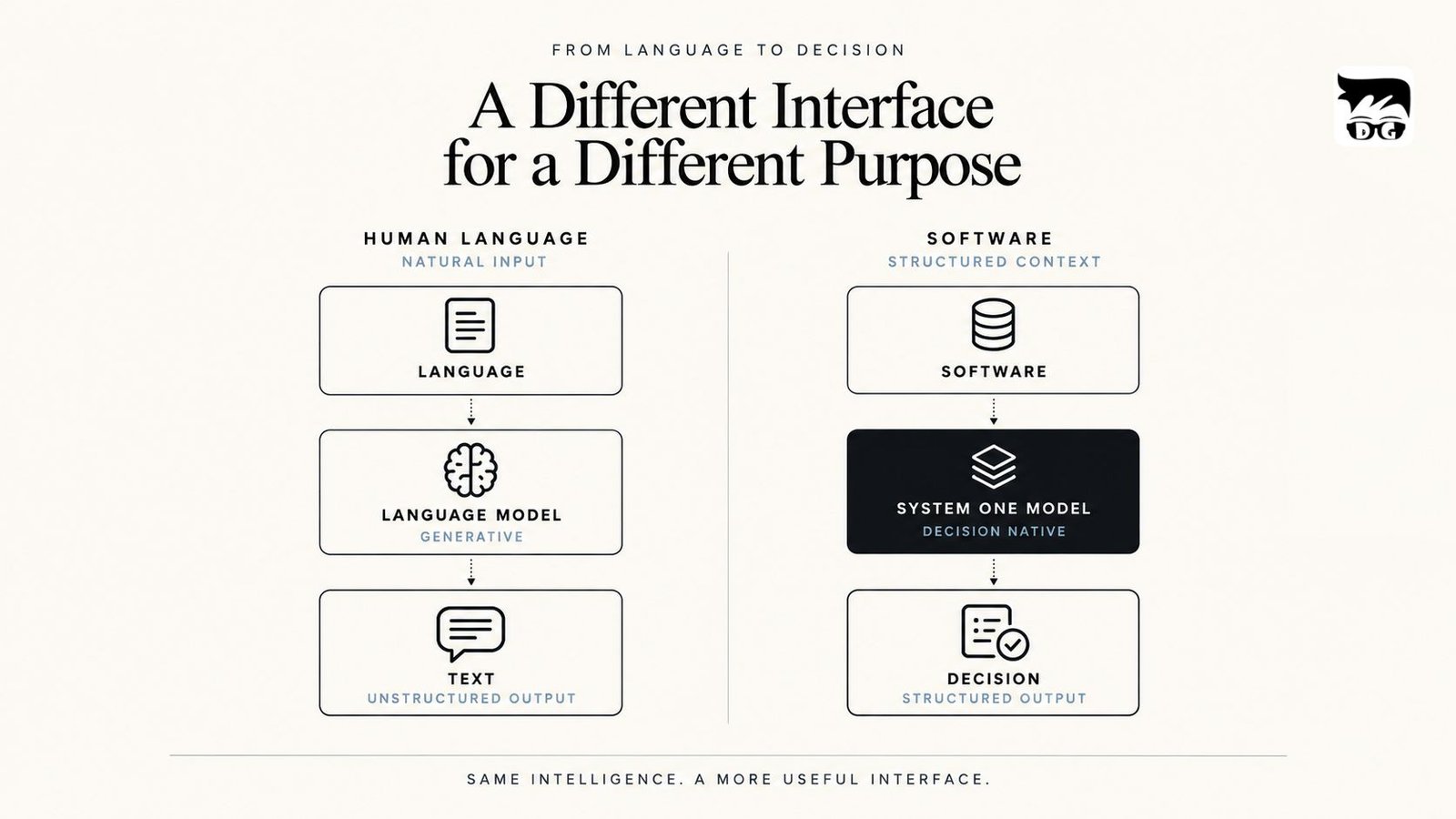
Large language models have become remarkably capable at understanding instructions, generating text, writing code, and reasoning through complex problems. Yet most of that intelligence is still exposed through an interface designed around one primary consumer: the human being.
TypeSafe AI is exploring a different direction. The company calls its approach System One Models, a new class of AI models designed to make fast, structured decisions that software can use directly. Its first public model, Jev, is presented not as another conversational model, but as an intelligence primitive designed specifically for automation.
The distinction is important because the goal is not simply to make another model smaller, faster, or cheaper. The goal is to change what the model is designed to produce.
From models that talk to models that decide
The dominant interface for modern AI is language. A developer sends information to a model, describes what needs to be done, and receives a sequence of generated tokens in return. The flexibility of this interface is one of the reasons language models have become so useful. The same interface can support conversation, writing, coding, analysis, and many other forms of interaction.
Software has different requirements.
A program does not need an explanation when it needs to classify an event. It needs a value it can use.
It does not necessarily need a paragraph when it needs to decide which route to take. It needs a decision.
It does not need an eloquent answer when it needs to determine whether a condition is satisfied. It needs a result that can become part of the execution logic.
TypeSafe's central argument is that this difference between human consumption and machine consumption deserves a different model interface. System One Models are designed around that idea.
The model therefore becomes less like a conversational endpoint and more like a computational component inside a larger software system.
Models do not always need to produce something a person can read.
Sometimes they need to produce something software can use.
What does "System One" mean?
The name comes from Daniel Kahneman's distinction between System 1 and System 2 thinking in Thinking, Fast and Slow. System 1 describes fast, intuitive judgments, while System 2 describes slower and more deliberate reasoning. TypeSafe uses the distinction to describe models designed around fast operational decisions rather than extended reasoning or conversational generation.
There is an important difference, however.
TypeSafe is not simply attempting to recreate human System 1 thinking inside a smaller model. The term describes the intended role of the model.
A System One Model is designed to receive state from software and produce a structured decision that software can act upon. TypeSafe describes Jev in particularly direct terms:
Unstructured state in → typed probabilistic decisions out
That definition provides the clearest starting point for understanding the category.
The name also carries another idea from TypeSafe's explanation. The company argues that the conventional association of System 1 thinking with error-prone intuition does not necessarily describe what a purpose-built System One Model has to be. Its claim is that a model designed around structured decisions and calibrated probabilities can approach reliability differently from a conventional language model.
A different consumer changes the model
The most useful way to understand System One Models is to start with their intended consumer.
A conventional language model is optimized around communication with people. Its output space is language, which gives it enormous flexibility. The model can produce an explanation, a code block, a list, an argument, or almost anything else that can be expressed through text.
That flexibility is valuable when the output needs to be interpreted by a human.
It becomes less useful when the output immediately enters another software component.
In that setting, the surrounding program already knows what kind of answer it needs.
If the program needs one of five possible routes, there is little value in generating a paragraph and asking another piece of software to interpret it. If the program needs a score, generating prose around that score creates another layer between the model's judgment and the application's logic.
System One Models start from the opposite assumption.
The software already defines the shape of the decision. The model supplies the intelligence required to make that decision.
TypeSafe describes this as typed outputs that software can act on. Its current product positioning centers on structured decisions accompanied by probabilities and confidence, rather than treating generated text as the primary output.
This is why System One Models are better understood as a model category rather than simply another model variant.
The difference is not only what the model knows.
It is what the model is built to do with what it knows.
Intelligence as a software primitive
A useful way to think about this shift is to compare intelligence with other components already used in software.
A programming language provides developers with constructs that perform specific operations. Those constructs can then be combined into larger programs. Databases provide structured state. APIs expose capabilities. Functions encapsulate operations.
TypeSafe is positioning System One Models in a similar role for intelligence.
Instead of treating intelligence as a complete conversational experience, the model becomes a component that can be placed inside application logic.
A workflow might contain deterministic rules, databases, APIs, and conventional software functions. A System One Model can occupy another position inside that workflow where the system needs a judgment that is difficult to express through fixed rules.
The surrounding software remains responsible for the workflow.
The model supplies the judgment.
This distinction becomes particularly important when a workflow contains decisions that are semantic rather than purely mathematical.
Consider a customer support system. A conventional rule might determine whether a transaction exceeds a fixed monetary threshold. But determining whether a message represents a refund request, whether an incoming request appears urgent, or whether a particular piece of information satisfies a business criterion may depend on language and context.
Those decisions are difficult to encode completely with traditional conditional logic.
A System One Model is designed to provide the missing judgment while allowing the surrounding program to retain control over what happens next.
TypeSafe describes these applications as AI-powered workflows and smart if-statements, where structured decisions can become part of ordinary software logic.
Traditional software:if condition: execute()
System One software:if semantic_decision: execute()
System One is not a smaller LLM
One of the most important questions is whether a System One Model is simply a smaller language model optimized for speed.
TypeSafe's answer is no. The company describes System One as a new model class built specifically for decisions inside software, with a different architecture, sampler, and training method.
The distinction matters because reducing the size of a language model does not automatically change its fundamental interface.
A smaller language model can still produce strings.
It can still require parsing.
It can still be asked to imitate a structured output format.
It can still produce an answer that software must interpret.
System One Models begin somewhere else.
Their output space is designed around structured decisions from the beginning. TypeSafe describes Jev as producing typed values accompanied by calibrated probabilities and confidence scores, allowing those outputs to be used directly by surrounding software.
That architectural decision creates the foundation for the capabilities that TypeSafe associates with the category, including type safety, calibrated confidence, parallel sampling, and integration into software workflows.
Those individual mechanisms deserve closer examination, but they are consequences of the larger design decision.
The model is being designed for software first.
The model is designed around the decision
This leads to a useful distinction between general intelligence and general output.
A language model can express an enormous range of answers because language itself is flexible. That flexibility is powerful, but it also means the receiving software has to determine what the generated response means before it can safely act on it.
A System One Model takes the opposite approach. The application defines the decision space first, and the model operates within that space.
If an application needs to choose between several possible routes, the possible routes can define the output space. If it needs to evaluate a continuous quantity, the decision can be represented as a score. If it needs to determine whether a proposition is true, the result can be represented as a probability.
The important point is not the individual output types themselves. Those deserve a separate examination later in this series.
The important point is that the model and the software share a defined interface.
The application does not need to ask the model to behave like a function.
The model is designed to behave like one.
Where System One Models fit
System One Models are not positioned by TypeSafe as replacements for every task currently handled by language models.
Language models remain useful when the system needs open-ended generation, conversation, coding, explanation, or extended reasoning. Those capabilities depend on the flexibility of language.
System One Models target a different part of the software stack.
TypeSafe identifies use cases such as classification, routing, scoring, extraction, verification, guardrails, real-time applications, and other workflows where a model needs to make a structured decision that can immediately influence program execution.
This creates a more complementary relationship than a simple replacement story.
Language Models: Generate flexible outputs for humans and general-purpose software tasks.
System One Models: Generate structured decisions for software execution.
A larger application could therefore contain both.
A language model might handle an open-ended reasoning or generation task. A System One Model could classify the resulting state, verify an output, determine a route, score an outcome, or decide whether another action should occur.
The boundary between the two is not necessarily a competition between models. It is a question of which interface fits the task.
The emerging definition
At this stage, the simplest working definition is also the most useful:
A System One Model is an AI model designed to make fast, structured, probabilistic decisions that software can use directly.
This definition separates the concept from the implementation.
System One Models describe the model category.
TypeSafe AI is the company developing the approach.
Jev is the first public implementation.
The three terms should therefore not be treated as interchangeable.
Jev is an example of a System One Model. TypeSafe is the company building it. System One Models are the broader concept.
That distinction will become increasingly important as the category develops and as other approaches to machine-native intelligence emerge.
The bigger shift
The significance of System One Models is not that software can call an AI model. Software has been calling AI models for years.
The more interesting shift is that the model itself is being designed around the requirements of software execution.
That changes the relationship between the model and the application.
Language-centric interface:
Software → Language Model → Generated Text → Interpretation → Action
Decision-centric interface:
Software → System One Model → Structured Decision → Action
The first article in this series examined why the traditional interface creates friction.
This article establishes the concept that TypeSafe is proposing in response: a model category designed around structured decisions rather than open-ended language generation.
The next question is more technical.
If System One Models are designed differently from language models, what does that architecture actually look like?
What remains to be understood
System One Models are still an emerging category. TypeSafe's first public implementation, Jev, entered early access in September 2026, so the broader model class does not yet have the long production history associated with conventional language models.
Several questions therefore remain open.
- Model architecture: What changes internally when a model is designed for structured decisions rather than string generation?
- Decision primitives: How do the available output forms shape what the model can express?
- Calibration: How should software interpret and act on the probabilities returned with each decision?
- Training: Why does a decision-native model require a different reinforcement learning approach?
- Workflow design: What happens when many small model decisions are composed into a larger software process?
- Generalization: How well does this approach transfer across domains, data distributions, and production environments?
These questions move the discussion from the definition of System One Models to the engineering decisions behind them.
That is where the next stage of the investigation begins.
AI Developments Database
Follow emerging model architectures, machine-native protocols, and production developments directly on our live tracking repository at the DataGuy AI Developments Hub.
Sources List
- TypeSafe AI: Introducing System One Models & Jev
- TypeSafe AI: System One Models and Jev