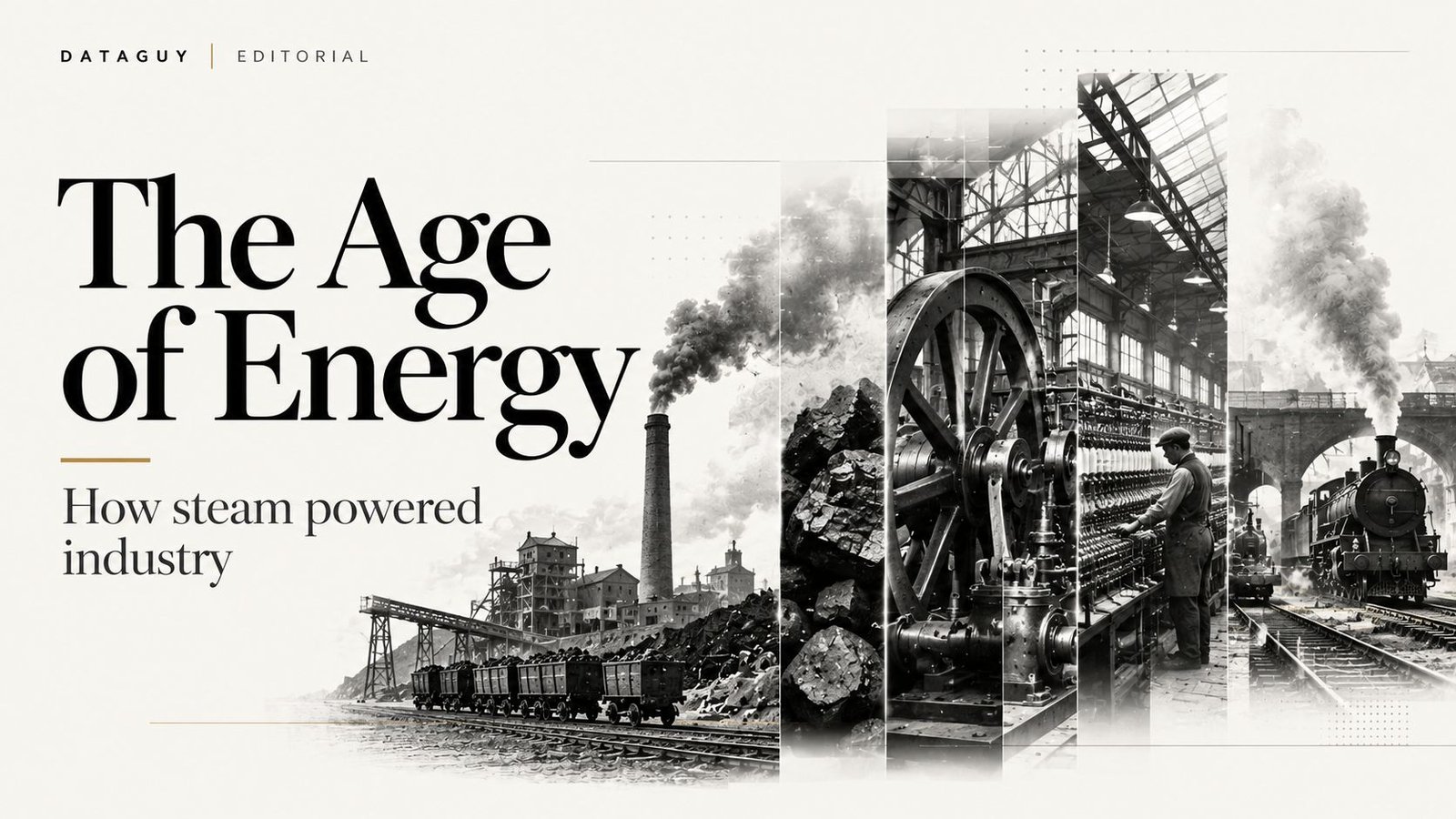
Humanity did not begin the industrial age by learning how to use energy. Humans had always used energy. Fire provided heat. Animals provided mechanical power. Water and wind could turn wheels. The constraint was different: useful energy was difficult to control, locate and reproduce at the scale required for continuous industrial production.
For most of history, productive activity was closely tied to the energy available in a particular place. A waterwheel depended on a suitable river. A windmill depended on local conditions. Animal power depended on biological limits and continuous care. Human muscle could be organized with remarkable sophistication, but it remained limited by the energy an individual body could generate and sustain.
The industrial transition changed this relationship. The important development was not the discovery of a new form of energy in isolation. It was the growing ability to convert concentrated energy into mechanical work that could be controlled, repeated and incorporated into organized production. Steam power became important because it turned fuel into a more controllable source of mechanical power, while coal provided a dense source of energy that could be extracted, transported and used within an expanding industrial system.
Energy was always available. Productive power was not.
Before industrialization, societies already possessed substantial technological knowledge. They built cities, ships, roads, irrigation systems and large structures. They organized agriculture, trade and manufacturing across considerable distances. The limitation was not an absence of ingenuity. It was the amount and form of mechanical power that could be brought reliably into production.
Water and wind were useful precisely because they could be converted into mechanical motion, but their usefulness was geographically and physically constrained. Water power required suitable terrain and dependable flow. Wind power was inherently variable. Animal power was more mobile, but animals converted biological energy into mechanical work within narrow limits. These sources could support sophisticated economies, yet they did not provide a general mechanism for placing large amounts of mechanical power wherever production required it.
This distinction is important because energy is not the same thing as useful work. A society may have access to an energy source without having an efficient way to convert that source into controlled mechanical activity. Industrialization depended on closing that gap.
Steam changed the relationship between energy and production
Steam engines emerged from practical industrial problems before they became symbols of the Industrial Revolution. Early engines were used particularly to pump water from mines. That application mattered because mining itself was becoming constrained by the difficulty of removing water from deeper workings. The engine was therefore part of a larger system in which one industrial capability created demand for another.
Thomas Newcomen's atmospheric engine, introduced in the early eighteenth century, could perform work by using steam and atmospheric pressure to move a piston. It was inefficient by later standards, but it provided a new way to turn fuel into mechanical action. The significance was not that steam suddenly replaced every existing source of power. Water, wind, human and animal power remained important for a long time.
James Watt's improvements changed the economics and versatility of steam power. His separate condenser reduced wasted heat and improved efficiency. Later developments allowed steam engines to produce rotary motion suitable for driving machinery. The Library of Congress documents Watt’s 1769 patent for improvements intended to reduce steam and fuel consumption, while museum records trace how later engines were adapted to drive industrial machinery. Library of Congress; Science Museum Group Collection.
The resulting change was gradual but consequential. Mechanical power no longer had to be tied as closely to a particular river, wind regime or biological source. Steam could be produced where fuel and industrial activity could be brought together. The geography of production began to change.
From energy to industrial capacity
Steam power by itself did not create industrialization. The deeper transformation occurred when energy conversion became part of an organized production system. Engines had to be built. Boilers had to be manufactured. Fuel had to be extracted and transported. Metals had to be processed. Machines had to be installed and maintained. Workers had to be organized around them. Capital had to finance equipment and infrastructure.
The system can be understood as a progression:
The Productive Energy Chain
Energy becomes economically transformative when it can be converted into repeatable mechanical work and embedded in organized production.
A concentrated source of usable energy such as coal.
An engine or mechanical system converts energy into controlled motion.
Power becomes usable for pumping, driving machinery and moving materials.
Machinery, labour, fuel, transport and factories coordinate the work.
Productive power becomes a repeatable capability that can be expanded.
This is where the historical argument moves beyond the steam engine. Coal powered steam engines, but coal also increased demand for metals and minerals. The Library of Congress notes that greater use of coal expanded iron production and contributed to new industrial uses for iron and steel. Energy therefore did not simply feed an existing industrial system. As its use expanded, it strengthened demand for the materials, machinery and transport systems needed to expand production further.
The industrial system became increasingly self-reinforcing. More power made more production possible. More production created demand for better machinery. Better machinery increased the usefulness of available power. Transport systems extended the movement of fuel and materials. Metallurgy improved the machines themselves. Capital financed larger and more interconnected installations.
Scale changed what production could become
Once mechanical power became more controllable and repeatable, the question was no longer simply how to make an object. It became possible to ask how much could be produced, how consistently it could be produced and how the production system could be expanded.
That change created new technological requirements. Larger production systems needed machines that could be built and maintained reliably. Machines with more moving parts required better measurement and manufacturing. More complex machinery created greater demand for suitable materials. Expanding factories required transportation systems capable of moving fuel, components and finished goods. Production at greater scale therefore created pressure for greater precision.
This is the important transition between the first two essays in the series. Industrial capacity made production larger and more repeatable. But scale alone could not reproduce physical complexity reliably. The next problem was precision.
What lies beneath the steam engine
A steam engine can look like a single invention when viewed from a distance. Seen from beneath, it is a system.
It depends on fuel extraction, metallurgy, boilers, machining, transport, skilled labour, industrial organization and capital. Each of these capabilities has its own history. The engine becomes possible at scale because those histories have begun to converge.
This is the first appearance of the question that will recur throughout Beneath Intelligence: what had to exist beneath the visible technology for it to work at scale?
The answer is rarely another single invention. It is usually a layer of capabilities that have become reliable enough to support one another. Industrial capability was itself manufactured from other capabilities.
The same pattern will become more visible as the series moves forward. Precision will depend on machine tools and measurement. Semiconductors will depend on materials, chemistry and extraordinarily controlled manufacturing. Computation will depend on electronics. Learning will depend on mathematics, data and computation. The visible capability is repeatedly supported by a deeper system.
Energy became a reproducible capability
The long-term importance of industrial energy was therefore not simply that civilization gained access to more power. It was that power could increasingly be converted into useful mechanical work in ways that were controllable, repeatable and expandable.
That distinction helps explain why the Industrial Revolution cannot be reduced to a list of inventions. Energy, machinery, fuel, factories, transport, metallurgy, labour organization and capital formed a connected production system. The resulting capacity could then support the development of new machines and new forms of production.
Historical energy estimates help place the transition in perspective. Traditional biomass remained a dominant source of energy into the nineteenth century, while coal expanded with industrialization. Oil, gas, hydropower, nuclear power and modern renewables diversified the energy system over subsequent periods. These long-run estimates are reconstructions, not a complete record of every region or form of energy use. Our World in Data: Global Energy over 200 Years; Energy Production and Consumption.
The deeper story is therefore one of capability. Civilization learned first to harness energy, then to convert it into mechanical power, and then to embed that power in systems capable of repeatable production. Industrial capacity became something that could itself be reproduced.
Industrialization was the moment energy became productive capacity
The important change was not the discovery of energy. Energy had always surrounded human societies. The change was the growing ability to convert concentrated energy into dependable mechanical work and place that work inside organized systems of production.
Steam mattered because it altered the relationship between energy and production. Coal mattered because it supplied a dense source of fuel. Factories, machinery, metallurgy, transport, labour organization and capital mattered because they turned mechanical power into a system that could produce repeatedly and expand.
Once that capability existed, a new problem appeared. Production could become larger, but increasingly complex machines also needed to be made accurately and consistently. Industrial capacity created the conditions for the next layer.
The next question was no longer how to produce more. It was how to produce with enough precision that complexity itself could become reproducible.
The evidence combines long-run energy estimates, museum histories of steam engines, institutional histories of industrial materials, and economic-history research on the adoption of steam power. Steam was consequential, but its diffusion was uneven and depended on local production systems.
Explore Energy Data Explore Steam Power History Explore a Historic Steam Engine Read the Economic History Reassessment of Steam Power Explore Coal, Iron and Steel History