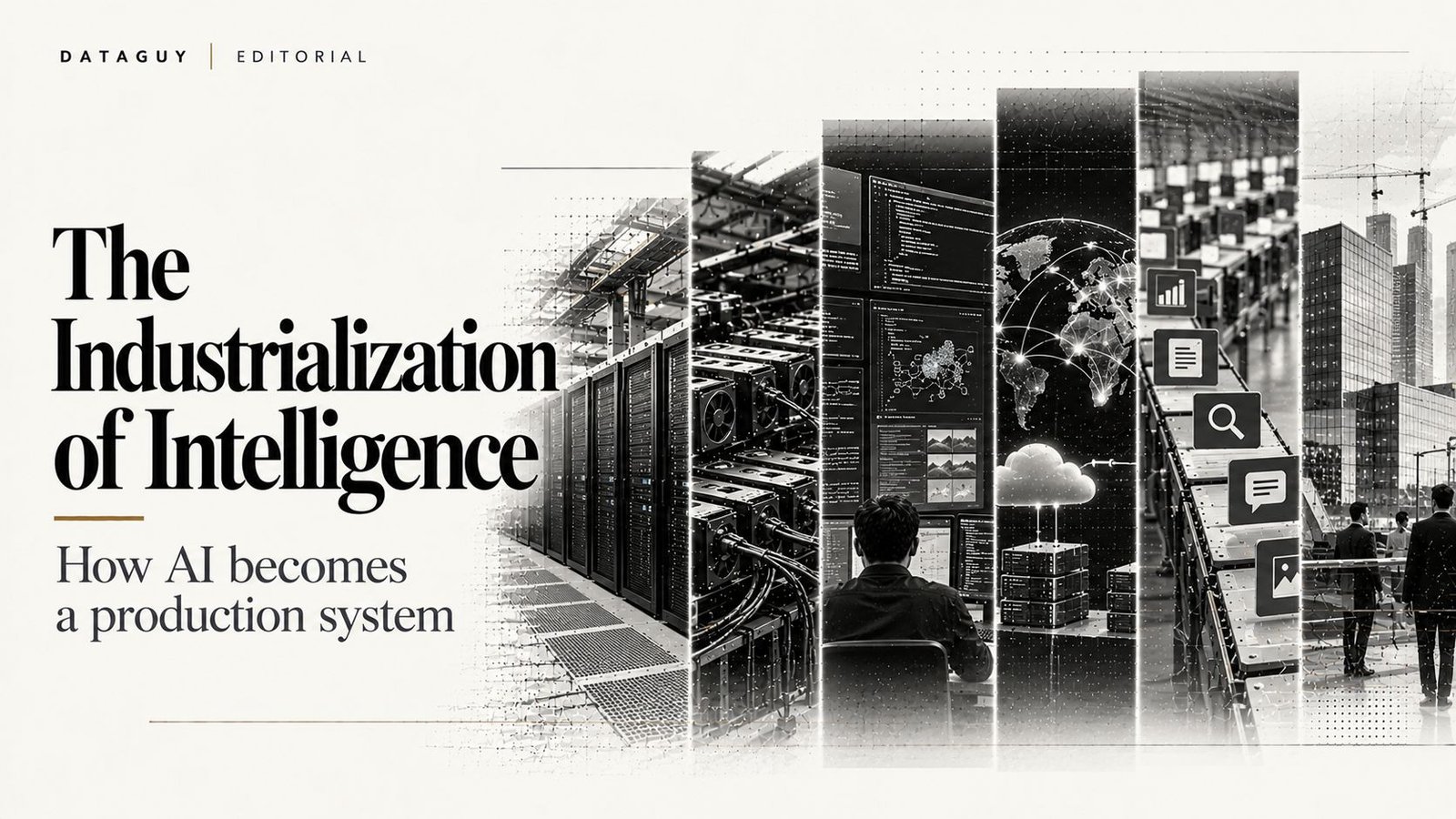
The previous essay, The Infrastructure of Learning, established the infrastructure required to scale learning. Algorithms could operate across large collections of data, specialized processors could execute the computation, distributed systems could coordinate the workload, and physical infrastructure could sustain it. But scalable learning still leaves open a larger question: what is actually being produced by this industrial system?
The answer changes when a trained model becomes more than a solution to one narrow task. A sufficiently general learned system can be reused across many problems, adapted to different contexts and embedded inside different applications. The output of training is no longer simply a model for one purpose. It is a computational capability that can become a layer for many purposes.
This is the transition from scalable machine learning to industrialized intelligence. Learning becomes production. Production becomes reusable capability. Reusable capability becomes an economic layer that can support many downstream uses. The infrastructure beneath the model consequently becomes part of a system for producing increasingly general forms of cognitive work.
Learning becomes production
Earlier machine learning systems were often evaluated primarily as models for particular tasks. A model might classify images, recognize speech or predict a defined outcome. The training process produced a capability closely associated with the task for which it had been designed.
Large-scale learning changed the economics of that relationship. The cost of training could become substantial, but the resulting model could also contain capabilities that were not limited to one narrow application. Once trained, the model could be used repeatedly without reproducing the entire training process for every downstream task.
Training therefore begins to resemble production. Computation, data, infrastructure and research inputs are transformed into a learned artifact with capabilities that can subsequently be deployed many times.
The model is no longer simply the output of an experiment. It becomes the output of an industrial process.
From one task to many uses
The important change is not simply that models became larger. It is that sufficiently broad training can produce representations that support many downstream tasks. The model becomes useful partly because the expensive process of learning has already been performed before each individual application begins.
This creates an asymmetry between training and use. Training concentrates computation and resources into the production of a general capability. Once that capability exists, many users and applications can draw on it without repeating the full process of learning from scratch.
Foundation models formalized this pattern. The Stanford-led study that introduced the term describes foundation models as models trained on broad data at scale and adaptable to a wide range of downstream tasks. Their central characteristic is therefore not merely size, but reuse across tasks and applications. The original Stanford-led study sets out this framing.
Reuse changes the economics of intelligence because one production process can support many forms of work. The capability becomes more valuable as the number of contexts in which it can be applied increases.
The Industrial Intelligence Loop
The emergence of industrialized intelligence becomes clearer when the production process is treated as a reinforcing loop. Each stage creates conditions for the next while increasing the value of the infrastructure supporting the system.
The Industrial Intelligence Loop
Research and infrastructure produce learned capability, reusable capability creates applications and value, and that value can support further investment in the capacity required to produce more capability.
Scientific and engineering work improves learning methods, architectures, representations and training procedures.
Computational resources execute increasingly demanding training workloads across specialized systems.
Data, algorithms and infrastructure are combined to produce learned computational capability.
The resulting model contains reusable representations and behaviours that can support more than one narrow task.
A trained capability can be adapted, integrated and invoked across many downstream contexts without repeating full training.
General capability enters products, services, organizations and workflows where it can perform useful cognitive tasks.
Reusable capability creates economic and organizational value that can justify further investment.
Investment expands the computational and physical capacity available for subsequent research and training.
The framework matters because the industrialization of intelligence is not a single technological event. It is a reinforcing production system. The model sits inside a chain connecting research, computation, infrastructure, applications and capital.
The loop also explains why generality matters. A capability that can be reused across many applications can support a larger downstream system than a capability tied permanently to one task.
The capability becomes a layer
A trained model becomes infrastructure when other systems can build on it without needing to reproduce the process that created it. The model sits between the underlying computational infrastructure and the applications that use its capabilities.
This creates a new abstraction layer. An application can ask a model to perform a task without implementing the entire learning process itself. The model encapsulates learned representations that can be invoked through a relatively stable interface.
The significance is similar to earlier transitions in the series. Programmability placed a software layer above physical computation. Networking placed a communication layer above individual machines. Data systems placed a structured information layer above storage. Foundation models introduce a learned capability layer above the infrastructure that trained them.
Each abstraction allows a higher layer to reuse a capability without reconstructing everything beneath it.
Scale becomes a production variable
Article 09 examined how computation, data, software and physical infrastructure made large-scale training possible. This essay begins after that achievement. The question is no longer only how much learning a system can perform, but what kind of capability the process produces and how that capability can be used.
Scaling research made the relationship among compute, data, model size and performance more measurable. That work remains important, but here it serves as context: once a model can be produced at scale, its value depends increasingly on what can be done with the resulting capability.
The production question shifts from allocating resources to training a model toward determining whether the capability produced can support a broad range of useful work.
Scale is not simply more of the same
A larger training run does not automatically produce a more useful system. Compute must be allocated in relation to model capacity, training data and the objective being optimized.
Compute-optimal training research showed that model size and training data need to be considered together under a fixed compute budget. This matters to the industrialization argument because the output is not raw scale. It is capability that can perform useful work under real constraints.
The relevant measure is therefore not simply how much computation has been consumed, but what reusable capability the production process has yielded.
The economics of reuse
Training and application use have different economic structures. Training concentrates substantial resources into creating a model. Reuse allows that initial investment to support many subsequent tasks without repeating the full learning process each time.
The economics depend on how much useful work the model can support, how reliably it performs, and what additional adaptation or oversight each application requires. Reuse does not make downstream use costless; it changes where costs occur and how the original training investment can be distributed across uses.
A model becomes economically consequential when its learned capability can be applied across enough contexts to justify the cost of producing, adapting and operating it.
Inference creates a second production system
Training is the process through which a model acquires its learned parameters. Inference is the process through which those parameters are used to produce outputs for individual requests. The two processes have different computational patterns and different economic roles.
Training concentrates resources into creating capability. Inference distributes that capability across users and applications. A model that is expensive to train can still become economically valuable if the resulting capability can be invoked repeatedly at acceptable cost.
This creates a second production system beneath applications. The model is not simply stored after training. It must be served, monitored, scaled and operated whenever users request its capabilities.
The industrial system therefore has two linked phases. Training produces the reusable capability. Inference converts that capability into repeated computational services.
Efficiency multiplies scale
Reuse creates value only when the capability can be delivered at a viable cost. Efficiency therefore matters not as another account of training infrastructure, but as a condition governing how widely a learned capability can be used.
Improvements in model design, inference software, hardware utilization and serving systems can reduce the resources required for each useful output. Different applications may still face trade-offs among cost, latency, reliability and quality.
The economic effect is cumulative: lower serving costs can make additional uses viable, while broader use can increase the value extracted from the original training investment. Efficiency connects a trained capability to the range of settings in which it can be practically deployed.
The model becomes part of a larger production system
At this stage, it becomes difficult to treat the model as the entire technological object. The model depends on training data, computational hardware, software, cloud and data-centre infrastructure, and the organizational systems required to operate all of them.
The Bank for International Settlements describes the contemporary AI supply chain through layers including hardware, cloud infrastructure, training data, foundation models and AI applications. The structure is important because it makes visible the dependencies between the learned model and the industrial systems beneath and above it.
The model therefore occupies a middle position. It is produced by infrastructure below it and becomes infrastructure for applications above it.
This is the defining characteristic of an industrialized intelligence stack. Capability is no longer contained in one artifact. It is distributed across a production system whose layers reinforce one another.
Infrastructure becomes part of intelligence
A model does not operate independently of the systems that produce and serve it. Compute, memory, networking, energy and cooling constrain what can be trained and delivered, while research, data and model design shape the capability those resources can support.
The point here is not to repeat the infrastructure account from the previous essay. It is to recognize the model's position in a wider production arrangement: infrastructure enables training, the trained model packages learned capability, and applications turn that capability into particular services or outcomes.
Industrialized intelligence is therefore neither the model alone nor infrastructure alone. It is the relationship between a reusable learned capability and the systems that make it available for use.
Capital closes the loop
Producing and deploying advanced models requires investment before the full value of their applications is known. Capital supports research, training and deployment capacity, accepting uncertainty about which capabilities will prove useful and which markets will develop.
If applications create sufficient revenue, productivity gains or strategic value, those outcomes can support further investment. If adoption or returns disappoint, the same fixed commitments can become a source of financial and operational pressure.
The feedback loop is therefore not guaranteed growth. It is a capital allocation system in which expected demand finances capability production, and realized value influences the next round of investment.
Research changes its relationship with industry
As training becomes an industrial production process, the location of research and the location of large-scale model production can begin to diverge. Academic research remains essential to the development of methods and understanding, while the physical and computational requirements of frontier-scale training can concentrate production in organizations able to assemble substantial resources.
The contemporary research environment therefore contains two complementary forms of capability. Universities and public research institutions contribute fundamental ideas, theoretical understanding and highly cited scientific work. Industrial research environments can combine those ideas with large computational systems and engineering resources to train and deploy increasingly capable models.
The distinction is important because industrialization does not mean that knowledge creation has become exclusively industrial. It means that some forms of experimentation and model production now depend on infrastructure whose scale changes the economics of who can perform them.
Intelligence is becoming industrial without becoming reducible to industry. The production system is expanding around a research ecosystem that remains distributed across institutions.
Generality creates leverage
Generality is the central source of leverage in this production model. A capability trained once can support many downstream applications, although each application may still require instructions, tools, additional training, evaluation or human oversight.
Foundation models can provide a shared capability layer on which more specialized systems are built. This changes the division of work between model production and application development: applications can begin from an existing learned capability rather than recreating every capability from the beginning.
The leverage is conditional. A model's broad usefulness must be demonstrated in a particular context, and adaptation, integration, verification and governance still carry costs. Reuse expands the possible return on training; it does not guarantee that every use is valuable.
What lies beneath industrialized intelligence?
The model now appears to be the central object of the system. Yet the recursive stack reveals that the visible intelligence is the output of many accumulated layers extending back through computation, electronics, industrial precision and energy.
The recursive question has now reached almost the entire historical sequence. Industrialized intelligence depends on learning infrastructure. Learning infrastructure depends on computation. Computation depends on semiconductors. Semiconductors depend on precision, materials and industrial systems. Those systems depend on energy, machinery, knowledge, institutions and capital.
The modern intelligence system is therefore not a separate technological layer floating above history. It is the latest expression of a stack that civilization has been constructing for generations.
The stack starts feeding itself
The series has traced layers that emerged at different times and for different purposes: energy, industrial precision, semiconductors, computation, programmability, networks, digital information, learning and learning infrastructure. Their convergence made contemporary machine intelligence possible, but the sequence was not designed in advance to produce it.
Industrialized intelligence adds feedback between these layers. Models can assist software development; software can improve resource allocation; new methods can alter hardware requirements; and applications can create demand for further capability. These interactions may reinforce progress, but they can also expose new constraints, costs and risks.
The stack is therefore becoming more interconnected, not self-sustaining or inevitable. Its direction still depends on engineering choices, institutions, incentives and the value people can actually derive from the systems.
Intelligence becomes increasingly provisionable
A capability becomes infrastructure when other people and organizations can access it without recreating the entire system that produced it. Learned models are moving in this direction through hosted services, APIs, open-weight releases and integration into existing products.
Provisioning remains uneven. Models differ in capability and cost; some systems require substantial infrastructure; and access can be shaped by price, licensing, geography, security and institutional control. Intelligence is not a fully interchangeable commodity.
The structural change is narrower but important: learned capability can increasingly be produced centrally and made available to many users and applications. That makes deployment, reliability and access part of the economics of intelligence, not merely final steps after research.
The final question is beneath the entire stack
The series began with machine intelligence as the visible object. Looking beneath it revealed learning; beneath learning, computation; beneath computation, semiconductors and precision; and beneath those, industrial capacity, energy, institutions and accumulated knowledge.
These layers were not built as stages in a predetermined plan. They developed through separate technical, economic and institutional histories, then became compatible enough to support a new kind of capability.
The final essay steps back from the industrial production of intelligence to consider the larger inheritance: the systems civilization assembled before it knew what they would eventually make possible.
Intelligence became industrializable when learning became a reproducible production process
The decisive shift was not simply the appearance of larger models. It was the emergence of a production system in which research, data and computation could create learned capabilities that were reusable across many tasks.
Article 09 described the infrastructure required to scale learning. This essay has examined what changes when the resulting capability can be reused: training and inference take on distinct roles, foundation models become a layer for applications, and economic value depends on usefulness across contexts as well as the cost of producing and serving it.
Industrialization does not make intelligence automatic, uniform or universally valuable. It makes learned capability reproducible and provisionable through systems whose outcomes depend on technical performance, integration, governance and economics.
The final essay looks across the full historical stack, asking what civilization inherited when these independently developed layers began to operate together.
These foundational research and institutional sources support the discussion of foundation models, scaling relationships, compute-optimal training and the layered AI supply chain.
Bommasani et al.: On the Opportunities and Risks of Foundation Models (2021) Kaplan et al.: Scaling Laws for Neural Language Models (2020) Hoffmann et al.: Training Compute-Optimal Large Language Models (2022) Bank for International Settlements: The AI Supply Chain (2025)