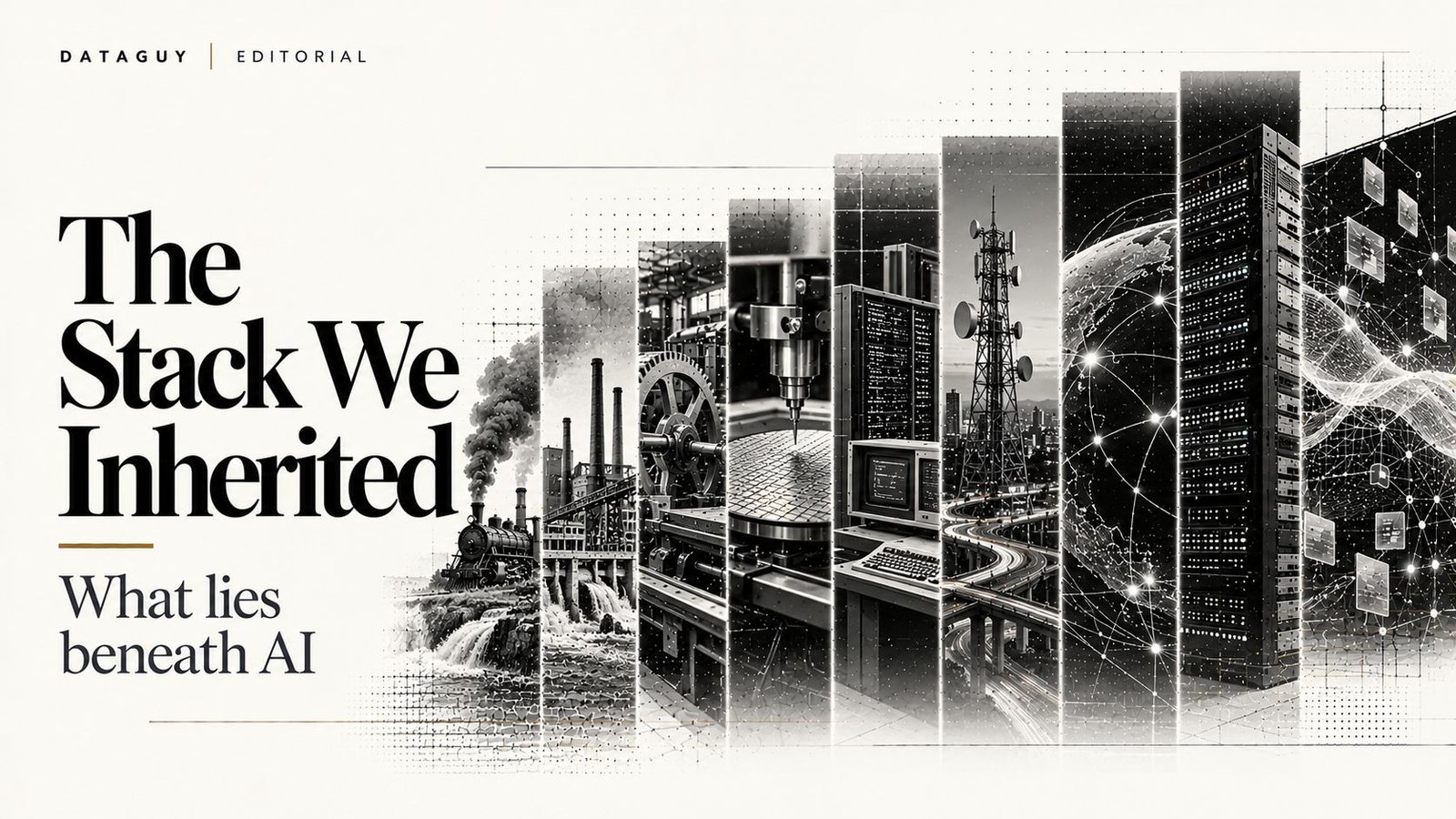
A user asks a question and a model produces an answer. The interaction can feel almost self-contained because the interface hides nearly everything required to make it possible. Behind that moment sits a long chain of physical and informational systems, accumulated across generations, that transformed energy into productive power, materials into precise structures, electronic switching into computation, computation into programmable systems, networks into shared infrastructure, activity into digital information and data into learnable representations.
The history traced through Beneath Intelligence produces a different starting point for understanding machine intelligence. The visible system is new, but the conditions beneath it are not. They were developed for different purposes, at different times and in different places. Their significance emerges from the fact that they eventually became compatible.
This final essay does not introduce another technological layer. It steps back from the sequence and asks what the complete accumulation reveals. The deeper subject of the series is not artificial intelligence itself. It is the process through which civilization repeatedly turned capabilities that were once narrow, fragile or difficult to reproduce into systems that could be controlled, repeated, connected, improved and scaled.
The visible machine hides the system
Modern machine intelligence is unusually easy to experience and unusually difficult to see in its entirety. A person can interact with a model through a simple interface while remaining almost completely unaware of the infrastructure beneath the interaction.
The interface conceals computation, memory, networking, data storage, software, training systems, physical facilities, energy supply and the manufacturing systems that produced the hardware. It also conceals the mathematics, accumulated scientific knowledge and institutional structures that made the learning process possible.
The apparent simplicity of the interaction is therefore a property of the interface, not of the system itself. The easier the capability becomes to access, the more of its underlying stack disappears from view.
Beneath Intelligence began by asking what was beneath the thing we thought was doing the work. The final essay can now ask the same question of the entire system.
The historical accumulation of capability
Before machines could learn from examples, computation had to become possible. Before computation could become sufficiently general and scalable, electronic switching had to become reliable and manufacturable. Before increasingly complex electronic systems could be produced, civilization had to acquire control over materials, manufacturing processes and microscopic structures.
Those capabilities themselves rested on earlier transformations. Industrial production required controllable energy. Reproducible industrial production required precision. Precision required measurement, machine tools, standards and increasingly sophisticated systems for controlling physical variation.
None of these developments was created with modern machine intelligence as its destination. Each emerged in response to problems that existed at the time. Their later significance came from the fact that the capabilities they created could be inherited by subsequent systems.
The historical path toward machine intelligence is better understood as accumulation than invention. Its visible capabilities depend on foundations whose origins often lie far outside computing.
The Civilization Capability Chain
The series can now be read as a connected history of expanding capabilities. The sequence highlights dependencies and accumulated conditions, not an inevitable path toward artificial intelligence.
The Civilization Capability Chain
Civilization repeatedly transformed constrained capabilities into systems that could be controlled, reproduced, reused, connected and scaled.
Concentrated energy became controllable productive power.
Production became repeatable at increasing scale.
Physical complexity became increasingly reproducible.
Switching and control became manufacturable.
Electronic systems became capable of general information processing.
Machine behaviour became separable from fixed physical configuration.
Computational resources became connected and interoperable.
Increasing portions of activity and reality became machine-readable.
Computation became capable of deriving useful patterns from examples.
Learned capability became increasingly reproducible, provisionable and industrialized.
The chain is not a claim that history followed a predetermined plan. The transitions emerged from different problems and different forms of knowledge. What connects them is the repeated expansion of what civilization could make reliable and reproducible.
The historical spine is therefore better understood as a sequence of capability expansions than as a sequence of inventions. Each layer reduced a constraint that limited the next one.
The physical and informational stacks
The first half of the sequence is fundamentally physical. Before information could become the central object of computation, civilization had to acquire extraordinary control over matter and energy.
The visible computational system therefore inherits a physical stack that extends far beyond computing. The processor depends on semiconductor manufacturing. Semiconductor manufacturing depends on precision. Precision depends on industrial systems. Industrial systems depend on energy and the infrastructure that makes energy usable.
What looks like an information technology is consequently inseparable from a long history of increasing physical control.
The informational stack
A second accumulation occurred above the physical foundations. Computation became more useful as machines gained the ability to represent, manipulate, connect and learn from information.
Programmability separated instructions from the physical machine. Networking connected individual machines into larger computational systems. Digitization transformed increasing amounts of information and activity into representations that machines could store and process. Search and databases made those representations more structured and accessible.
Machine learning introduced another transformation. Instead of requiring every useful relationship to be explicitly specified, computational systems could derive patterns from examples. Information was no longer merely something machines stored and processed. It became material from which machines could acquire behaviour.
The informational stack therefore expanded from representation to computation, from computation to connection, from connection to data and from data to learning.
The institutional, knowledge and economic foundations
Physical and informational capabilities do not accumulate automatically. Knowledge has to survive beyond individual people, move between institutions and become available for further work.
Universities, laboratories, research organizations, standards bodies, industrial firms and public institutions all contribute to this persistence. Their importance is not that any one institution created machine intelligence. Their importance is that they provide environments in which knowledge can be produced, tested, recorded, transmitted and extended.
The same pattern appears across the series. Precision required standards and measurement practices. Computing required mathematical and engineering knowledge. Networking required protocols and shared conventions. Machine learning required accumulated mathematics, statistics, algorithms and research traditions.
Institutions therefore form a layer around the visible technology. They allow capabilities to become cumulative rather than disappearing with the individuals who first developed them.
The knowledge stack
The physical stack explains what civilization learned to control. The informational stack explains what machines learned to represent and manipulate. The knowledge stack explains how the understanding required for both could accumulate.
Mathematics provided abstractions that could travel across problems. Scientific methods provided ways to test claims against observation. Engineering transformed principles into reliable systems. Documentation and standards made technical knowledge portable. Education reproduced specialized competence across generations.
Machine intelligence therefore inherits not only machines and infrastructure but also a vast body of externalized knowledge. Algorithms, equations, architectures, specifications, datasets, manuals and research papers allow capabilities to be reconstructed and improved by people who did not participate in their original creation.
Civilization became increasingly capable partly because it learned how to store intelligence outside individual minds.
The economic stack
Large systems also require mechanisms for assembling resources before their benefits are fully realized. Capital performs this function by allowing future expected value to support present investment in infrastructure, research and production capacity.
The role of capital appears repeatedly beneath modern technological systems. Industrial machinery required investment before its productive capacity could be realized. Semiconductor manufacturing required increasingly specialized facilities and equipment. Computing infrastructure required large physical systems. Modern machine learning requires computational capacity that can be built before all of its downstream uses are known.
Capital is therefore not simply an external financial layer. It is one of the mechanisms through which capabilities move from possibility into infrastructure.
Once the resulting systems create useful outputs, economic value can support another cycle of investment. The stack becomes capable of reinforcing itself.
The layers were developed separately
One of the most important conclusions of the series is that the stack was never designed as a single project. Energy systems were developed for productive power. Precision engineering emerged from manufacturing problems. Semiconductors emerged from the need for better electronic control. Networks emerged from communication and resource-sharing problems. Digital information systems emerged from information-management problems. Machine learning emerged from attempts to make computation derive useful patterns from data.
These developments were not waiting for one another in a predetermined sequence. Their compatibility emerged gradually.
That distinction matters because it changes how technological history should be understood. The current system is not the result of a single line of invention. It is the result of capabilities developed independently becoming increasingly interoperable.
The historical event is not the invention of intelligence itself. It is the convergence of systems that make increasingly general machine capabilities possible.
From accumulation to reinforcement
Scale has appeared throughout the series, but its meaning changes as the layers accumulate. Energy became useful when it could support industrial production. Precision became transformative when it could be reproduced across manufacturing. Computation became powerful when electronic operations could be repeated at enormous speed.
Later layers add another dimension. Networks allow resources to be shared across distance. Digital information allows representations to be copied and processed. Machine learning allows patterns to be extracted from large collections. Infrastructure allows learning workloads to expand beyond individual machines.
Scale therefore becomes cumulative. Each layer increases the scale at which another capability can operate, while the new capability creates demand for more capacity below it.
The system is no longer simply growing upward. Its layers are beginning to reinforce one another horizontally and vertically.
The constraint becomes recursive
The series began with a recurring pattern. A capability becomes possible, its use exposes a new constraint, and solving that constraint creates the next capability.
Industrial capacity exposed the need for precision. Precision exposed the need for better materials and manufacturing control. Computation exposed the need for programmability and memory. Networks exposed the need for shared protocols. Digital systems exposed the need for better ways to organize information. Machine learning exposed the need for more data and computation. Scalable learning exposed the need for infrastructure.
At the current stage, the relationship becomes recursive because the capability being produced can help improve the systems that produce it. Better software can improve computational efficiency. Better models can assist engineering and research. New applications can create economic demand for additional infrastructure. Additional infrastructure can support larger learning systems.
The historical mechanism that once moved the system from one layer to the next is beginning to operate within the stack itself.
From accumulation to reinforcement
The complete stack can now be understood as a reinforcing system rather than a simple ladder. Earlier capabilities remain embedded inside later ones, while later capabilities create new demand for earlier infrastructure.
The Reinforcing Capability Loop
This loop describes a possible reinforcing dynamic, not a guarantee of progress. Energy, capital, access to infrastructure, regulation and social choices can accelerate, redirect or constrain it.
Accumulated capabilities increasingly create feedback between physical infrastructure, computation, learning, applications and investment.
Energy, materials, machinery and industrial capacity make advanced infrastructure possible.
Programmable electronic systems provide general information-processing capacity.
Networks and digital systems make increasing amounts of information available to computation.
Algorithms derive useful patterns and behaviours from accumulated information.
Compute, data centres, networks and capital expand the scale at which learning can operate.
Learned systems become increasingly general, reusable and provisionable.
Learned capability enters organizations, products, services and workflows.
New value and demand support further research, infrastructure and computational capacity.
The loop does not imply automatic progress. Constraints, failures, competing priorities and institutional choices continue to shape the system. Its significance is structural: capabilities that once accumulated mostly in sequence are increasingly capable of reinforcing one another.
Capability and reproducibility
The recursive question can now be answered directly. Beneath the model is machine learning. Beneath machine learning are mathematics, data and computation. Beneath computation are programmable electronic systems. Beneath those systems are semiconductors. Beneath semiconductors are materials, chemistry, precision manufacturing and measurement. Beneath precision is industrial capacity. Beneath industrial capacity is controllable energy.
Around this physical sequence sit other systems that cannot be reduced to a single vertical layer. Networks connect the stack. Institutions preserve and coordinate knowledge. Capital assembles resources. Supply chains connect specialized production across geography. Human expertise develops, operates and repairs the systems.
The stack is therefore not purely vertical. Some dependencies run downward. Others run sideways. Some are physical. Others are mathematical, informational, institutional or economic.
What appears from the outside as a single intelligent machine is actually the convergence of many systems that have been accumulating capabilities for generations.
The important word is capability
Intelligence is the visible subject of the present moment, but capability is the deeper historical unit.
Civilization repeatedly encountered things it could do only within narrow limits. It learned to make energy controllable. It learned to make production repeatable. It learned to make physical complexity precise. It learned to manipulate matter at microscopic scales. It learned to represent information electronically. It learned to make computation general-purpose. It learned to connect computational systems.
It then learned to turn increasing portions of the world into machine-readable information, to derive patterns from that information and to build infrastructure capable of scaling the resulting learning.
The common mechanism is not a particular technology. It is the repeated conversion of constrained capability into reproducible capability.
Reproducibility is the hidden thread
The series began with energy because productive power became transformative when it could be controlled rather than remaining dependent on local biological or environmental conditions. It moved to precision because industrial production became more powerful when complex physical forms could be reproduced reliably.
Electronics extended this principle into microscopic structures. Computation extended it into information processing. Programmability allowed procedures to be reproduced through instructions rather than by rebuilding the machine. Networks allowed computational resources and information to be reproduced and shared across systems.
Digital information made representations copyable and processable. Machine learning made useful behaviour derivable from examples. Infrastructure made the learning process repeatable at increasing scale. Industrialized intelligence now makes learned capability increasingly reusable across contexts.
Reproducibility is therefore one of the quietest but most persistent threads connecting the entire history.
From control to scale
Another pattern becomes visible when the series is viewed from a distance. Civilization first learned to control processes that were difficult to control. It then learned to reproduce them. It then learned to connect them. Finally, it learned to scale them.
Energy became controllable. Industrial production became repeatable. Precision became measurable and reproducible. Electronic behaviour became manufacturable. Computation became programmable. Networks became interoperable. Information became digital and searchable. Learning became computational. Intelligence became increasingly scalable.
Each transition moved a capability from a condition of scarcity or constraint toward a condition of greater availability.
That does not mean the underlying resources disappeared. Scale often creates new dependencies and new constraints. It means that civilization became increasingly capable of organizing those constraints into systems that could support much larger quantities of useful work.
Why convergence matters
The present generation of machine intelligence feels historically sudden because many previously separate capabilities have become compatible at the same time.
Computation is sufficiently powerful to process large quantities of information. Digital systems have produced enormous collections of machine-readable data. Learning algorithms can extract useful structure from those collections. Networks allow computational resources and information to move across systems. Specialized infrastructure allows training and inference to operate at industrial scale. Capital can assemble the physical and organizational systems required to sustain the process.
None of these conditions appeared simultaneously. Their convergence did.
That convergence is the deeper historical event behind the current moment. Machine intelligence is visible because the underlying layers have finally become mutually reinforcing enough for the capability to emerge at scale.
The stack we inherited
The title of this final essay refers to something more precise than a technological stack. Civilization inherited physical systems, scientific knowledge, manufacturing capabilities, computational architectures, information systems, institutions and economic mechanisms that were built over long periods for different reasons.
Those inheritances matter because later generations rarely begin from zero. They begin with capabilities that already exist. New systems can therefore be constructed on top of old ones, using earlier infrastructure as a foundation for new forms of activity.
The modern intelligence system is built on such inheritance. It does not need to recreate electricity, precision manufacturing, semiconductor fabrication, networking, digital storage or mathematical knowledge each time a new model is trained. The stack already exists.
What appears to be a new capability is therefore partly an inheritance effect. The visible system can become possible because generations before it solved problems that were not originally understood as prerequisites for intelligence.
The technology is new. The conditions are not.
This distinction is the central conclusion of the series. Machine intelligence is genuinely new as a technological capability. The conditions that make it possible are not.
Some of those conditions were built centuries ago. Others emerged through industrialization, electronics, computing and networking. Others became available only recently through large-scale digital information, machine learning infrastructure and capital-intensive computation.
Their histories are uneven, geographically distributed and often unrelated. What connects them is not their origin but their eventual compatibility.
The suddenness of the current moment is therefore partly an illusion created by convergence. The visible capability appeared quickly because the invisible prerequisites had accumulated slowly.
The series, seen again
The eleven essays can now be read as one argument rather than eleven historical episodes. Each essay identifies a capability that civilization learned to make increasingly controllable, reproducible or scalable, and each capability creates conditions for the next.
The sequence begins with energy because productive power had to become controllable. It moves through industrial capacity and precision because scale required reproducibility. It reaches semiconductors because electronic control had to become manufacturable. It reaches computation because electronic switching had to become organized into general information processing.
Programmability separates behaviour from fixed machinery. Networks connect machines into systems. Digital information makes increasing portions of activity available to computation. Machine learning makes behaviour derivable from examples. Learning infrastructure makes that process scalable. Industrialization turns scalable learning into reusable production.
The final essay reveals that these were never isolated transformations. Together they form an accumulated system.
The stack we inherited
The recurring question of the series now has a fuller answer. Beneath the model is computation. Beneath computation are programmable electronic systems. Beneath electronics are semiconductors. Beneath semiconductors are materials, chemistry and precision. Beneath precision is industrial capacity. Beneath industrial capacity is controllable energy.
Alongside that physical stack are mathematics, software, networks, digital information, institutions, accumulated knowledge, supply chains and capital. These systems cannot be reduced to a single vertical ladder because many of them support several layers simultaneously.
And beneath all of them is a much older human process: the repeated effort to turn constrained capabilities into systems that can be reproduced, improved, connected and passed forward.
That is what lies beneath intelligence.
Machine intelligence is the visible emergence of a capability from beneath a very old stack
Today's machine intelligence is not the product of a single technological breakthrough. It is the convergence of physical, mathematical, industrial, informational, institutional and economic capabilities accumulated across generations.
Energy made productive power controllable. Industrial capacity made production repeatable. Precision made complexity reproducible. Semiconductors made electronic control manufacturable. Computation made information processing general. Programmability made machine behaviour reusable. Networks made computation connected. Digital information made increasing portions of the world machine-readable. Learning made behaviour derivable from examples. Infrastructure made learning scalable. Industrialization made learned capability increasingly reusable.
This is not a straight line from steam engines to artificial intelligence. It is an accumulation of capabilities that eventually became compatible.
That compatibility is what makes the present moment possible. The technology is new, but the conditions are inherited. The intelligence is new, but the civilization beneath it is not.
Beneath Intelligence is therefore not ultimately a history of machines. It is a history of how civilization learned to make increasingly complex things possible.
Machine intelligence did not arrive from nowhere. It arrived from beneath.
This synthesis draws on foundational research and institutional sources for the technical, historical and economic conditions beneath machine intelligence. The sources below support the argument at different levels: the development of foundation models, long-run AI research and investment, the physical energy requirements of AI, and the history of computing. The preceding essays provide the more detailed historical source trails for individual layers.
Bommasani et al., Stanford CRFM: On the Opportunities and Risks of Foundation Models (2021) Stanford HAI: 2026 AI Index Report, research, infrastructure and economic context Kaplan et al.: Scaling Laws for Neural Language Models (2020) Hoffmann et al.: Training Compute-Optimal Large Language Models (2022) International Energy Agency: Key Questions on Energy and AI (2026) International Energy Agency: Energy and AI (2025) Computer History Museum: Timeline of Computer History Computer History Museum: Memory and Storage Timeline Our World in Data: Energy Production and Consumption Beneath Intelligence: Series overview and all eleven essays