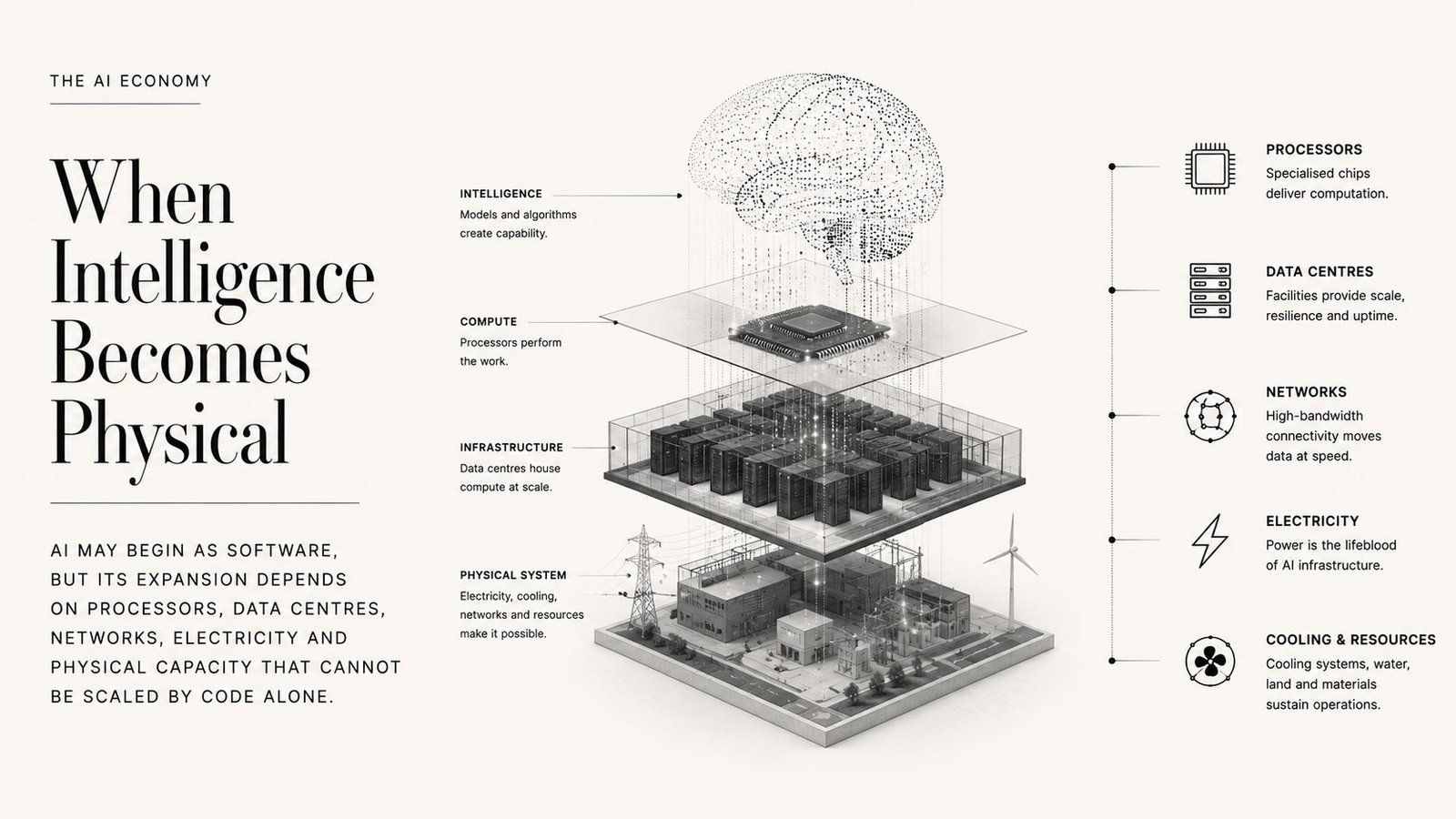
Artificial intelligence is usually experienced as software. A person enters a request, a model produces an answer and the interaction appears to take place entirely on a screen. The physical system that makes the interaction possible remains largely invisible.
The physical dependency becomes harder to ignore as AI grows more capable and more widely used. Larger models require more computation, while more complex reasoning increases inference demand. Broader adoption adds further workloads, which in turn require processors, data centre capacity, network infrastructure and electricity.
The economic significance of this shift is substantial because software can scale only as fast as the physical system beneath it allows. AI therefore introduces a different relationship between digital capability and physical resources. Intelligence may be delivered through software, but the capacity to produce that intelligence is constrained by machines, energy, land, connectivity and the infrastructure required to connect them.
The central argument is that AI is becoming a physical economic system because every expansion of machine intelligence creates a corresponding demand for physical capacity. The limits of that capacity increasingly influence where AI can be built, how quickly it can scale and who can afford to operate it.
Software has acquired a physical dependency
Traditional software can often expand across users with relatively little change to the physical resources required for each additional user. AI is different because the system must perform computation whenever intelligence is generated or applied.
Training requires large concentrations of computing resources for extended periods. Inference creates a continuing requirement because models have to process requests whenever users or applications call them. As AI systems become part of business processes, this demand becomes persistent rather than occasional.
AI demand cannot be satisfied by software distribution alone. A new model can reach millions of users quickly, but every interaction still depends on physical machines somewhere in the system. The apparent scalability of the software therefore rests on infrastructure that must expand with it.
Compute becomes an economic input
The growing importance of compute can be seen in the scale of infrastructure commitments made by the largest technology companies. Amazon has planned around $200 billion in capital expenditure, with AI workloads a major component of the investment. Alphabet has indicated capital expenditure of up to $185 billion, with AI models, cloud infrastructure and data centres among the principal uses.
These investments are not simply technology budgets. They are commitments to physical productive capacity. Data centres, processors, cooling systems, networks and power connections determine how much computation can be supplied and where that computation can be delivered.
The economic implication is that compute is becoming an input into production. Organisations increasingly depend on access to computation in the same way that industrial production depends on equipment, logistics and energy.
The Physical Intelligence Stack
The physical system beneath AI can be understood as a stack of interdependent layers. Each layer enables the capacity above it, so a constraint at one level can limit the system as a whole.
The stack explains why a shortage in one physical layer can become a constraint on the entire AI system. Additional processors have limited value if data centre capacity is unavailable. A new data centre cannot operate at full capacity without sufficient electricity and network connectivity. Additional power generation does not solve the problem if transmission capacity cannot connect it to the required location.
AI infrastructure therefore behaves as a system rather than as a collection of independent assets. Scaling one component without expanding the others can leave capacity unused or create bottlenecks elsewhere.
Physical bottlenecks shape compute capacity
Advanced processors require memory, networking and specialised facilities. They generate heat that has to be removed. They require reliable electricity and supporting infrastructure. Large clusters require high-speed connections between machines because distributed computation depends on moving data quickly across the system.
The result is a growing physical chain around each unit of compute. The economics of AI therefore depend on the ability to assemble all of these components in sufficient quantity and in the right locations.
A processor shortage can constrain AI growth, but so can a shortage of power, cooling capacity, suitable sites or network connections. The physical system has multiple potential bottlenecks.
As data centre capacity expands, access to electricity becomes a condition for expansion. This creates a relationship between AI investment and energy infrastructure that did not carry the same importance for earlier generations of software.
The constraint is not simply the amount of electricity produced. Location matters because data centres need reliable connections to the grid, and transmission capacity determines whether available generation can reach the facility. Power pricing also affects the operating economics of compute because electricity becomes a recurring cost rather than a one-time infrastructure expense.
Computation produces heat, and large data centres require cooling systems to maintain operating conditions. Depending on the technology and location, cooling can involve substantial water use as well as electricity.
Water availability introduces another constraint on the expansion of AI infrastructure. A location with abundant power may not provide the same advantages if environmental conditions or local infrastructure restrict the operation of large facilities.
Growing AI demand can significantly increase data centre power and water consumption. The significance extends beyond environmental impact because these resources can become direct constraints on the location and cost of future compute capacity.
Geography and access become part of compute strategy
Software can be distributed globally, but physical infrastructure has to exist somewhere. This makes geography increasingly important to the economics of AI.
Similar investments are taking place in Europe and other regions as countries seek greater access to compute and the economic activity associated with it. The location of infrastructure influences latency, data residency, energy costs, network access and the ability to serve local demand.
Compute is consequently becoming a geographic asset. The distribution of AI capability increasingly depends on where the physical infrastructure exists and who controls access to it.
The cloud therefore acts as a bridge between physical scarcity and digital access. A company can rent compute capacity instead of owning the machines that produce it. That lowers the barrier to adopting AI, but it does not eliminate the underlying physical constraint.
Someone still has to build the data centre, purchase the processors, provide the electricity and operate the network. Cloud access changes who bears the capital cost, not whether the physical capacity is required.
As demand grows, the distinction becomes more consequential. When physical capacity is constrained, cloud economics can reflect that scarcity through pricing, availability and allocation.
Control over infrastructure can provide advantages in cost, reliability and scale. A company with substantial compute capacity can potentially run more workloads, train larger systems or serve more users without depending entirely on external capacity.
The advantage can extend to geography. Infrastructure located close to customers can reduce latency. Facilities connected to reliable and competitively priced energy can improve operating economics. Infrastructure built under appropriate regulatory and data residency conditions can support workloads that cannot be handled through a generic global service.
Physical infrastructure therefore becomes part of competitive strategy rather than remaining a background utility.
Physical infrastructure changes the speed of AI scaling
Software development can move quickly because code can be changed and distributed rapidly. Physical infrastructure follows a different timetable. Data centres take time to plan and construct. Grid connections require coordination. Energy projects require long development cycles. Semiconductor manufacturing requires specialised facilities and supply chains that cannot be expanded instantly.
Software progress and physical capacity expansion move at different speeds. A new model can create demand for substantially more computation before the infrastructure required to satisfy that demand is ready.
The resulting gap can become a constraint on deployment. Technical capability may exist before the physical system can deliver it at the required scale and cost.
The future pace of AI adoption will therefore depend partly on an infrastructure system whose expansion is slower, more capital intensive and more geographically constrained than software development.
AI demand creates a wider industrial system
The physical requirements of AI create demand beyond the technology sector. Semiconductor manufacturing, construction, power generation, transmission, cooling equipment, networking and real estate all become connected to the expansion of computation.
The relationship is visible in the scale of infrastructure commitments being made around the world. Large AI projects require equipment suppliers, engineering capacity, construction services and long-term energy arrangements. The expansion of compute therefore creates economic activity in industries that do not produce AI models themselves.
An important distinction emerges between the digital economy and the physical economy supporting it. AI may generate value through software, but the investment required to expand its capacity spreads across a much wider industrial system.
The economic footprint of AI is consequently larger than the companies that develop models or applications. It includes the industries that make computation possible.
Capital-intensive infrastructure naturally favours organisations capable of making large, long-term investments. Compute capacity can consequently become concentrated among hyperscalers, specialised infrastructure companies and governments with the resources to support large projects.
Concentration can create efficiencies because large facilities can spread fixed costs across substantial workloads. It can also create dependencies because organisations that do not control physical capacity may rely on a small number of providers for critical computation.
The resulting structure is different from the concentration created by software ecosystems alone. Physical concentration is shaped by land, energy, hardware supply, connectivity and capital requirements. These constraints can make infrastructure advantages more durable because they cannot be replicated simply by writing better software.
Infrastructure becomes an economic and strategic question
Once AI depends on physical capacity at this scale, infrastructure decisions become part of economic policy and corporate strategy. Governments have to consider whether their electricity systems, networks and industrial capabilities can support expanding compute demand. Companies have to determine whether infrastructure investment will generate sufficient utilisation and economic return.
AI readiness therefore has two dimensions. Access to advanced models is one component, while sufficient physical capacity to use those models at scale is another.
An economy can adopt AI rapidly through imported models and cloud services without owning much of the underlying infrastructure. That creates access, but it also creates dependence on external physical systems.
The distinction between using intelligence and controlling the capacity that produces intelligence becomes increasingly important as compute becomes a strategic economic input.
Intelligence has acquired a physical economy
AI changes the relationship between software and physical infrastructure because every increase in machine intelligence creates a corresponding requirement for computation. That requirement travels through processors, data centres, networks, electricity, cooling and the physical resources needed to build and operate them.
AI capacity therefore has to be understood as a production system rather than as software alone. Its scale depends on material constraints, geographic boundaries and investment cycles that cannot be accelerated simply by improving code.
This changes where economic advantage can accumulate. Access to advanced models matters, but access to the physical capacity that produces and delivers computation can influence who is able to develop, deploy and scale AI at competitive cost.
The deeper implication is that the AI economy cannot be understood through models and applications alone. The software defines what the machine can do. The physical system determines how much of that capability the economy can actually use.
The underlying AI developments and source material are available through the DataGuy AI Developments database.
Explore AI Developments