

In Part 1, we explored the foundations of Datadog: observability pillars, core modules, and integrations. Now, in Part 2, we shift focus to advanced capabilities that make Datadog more than just a monitoring tool. From LLM observability and Bits AI automation to SRE workflows and pricing strategy, this guide uncovers how Datadog powers the next generation of AI-driven operations and reliability engineering.
1. AI & Advanced Analytics
Datadog is extending observability into AI-native territory. Its LLM & AI Agent Observability tools trace decision paths, token costs, and compliance events for large language models and agentic workflows. This is complemented by the Bits AI Suite, which automates code remediation, incident handling, and even pull request generation.
- LLM & AI Agent Observability — Full-stack monitoring of prompts, responses, tokens, and safety checks.
- Bits AI Suite — Intelligent copilots for investigation, remediation, and workflow automation.
- ML-based Monitoring — Automated anomaly/outlier detection across telemetry.
- Data Notebooks & Sheets — Collaborative, conversational analytics integrated directly into Datadog.
2. Deep Dive into APM & Observability Metrics

Datadog’s APM platform goes beyond distributed tracing by providing code-level diagnostics, latency analysis, and AI-driven recommendations. For engineers, this translates into a guided workflow that pinpoints issues across microservices and monoliths alike.
- Tracing — End-to-end request flows across services, visualized with dependency maps.
- Core Metrics — Latency, throughput, error rate, Apdex, and even custom business KPIs.
- Continuous Profiling — Identifies resource-heavy functions in production without manual overhead.
- Anomaly & Error Detection — ML models flag performance drift and propose fixes.
3. LLM Observability & Bits AI Capabilities
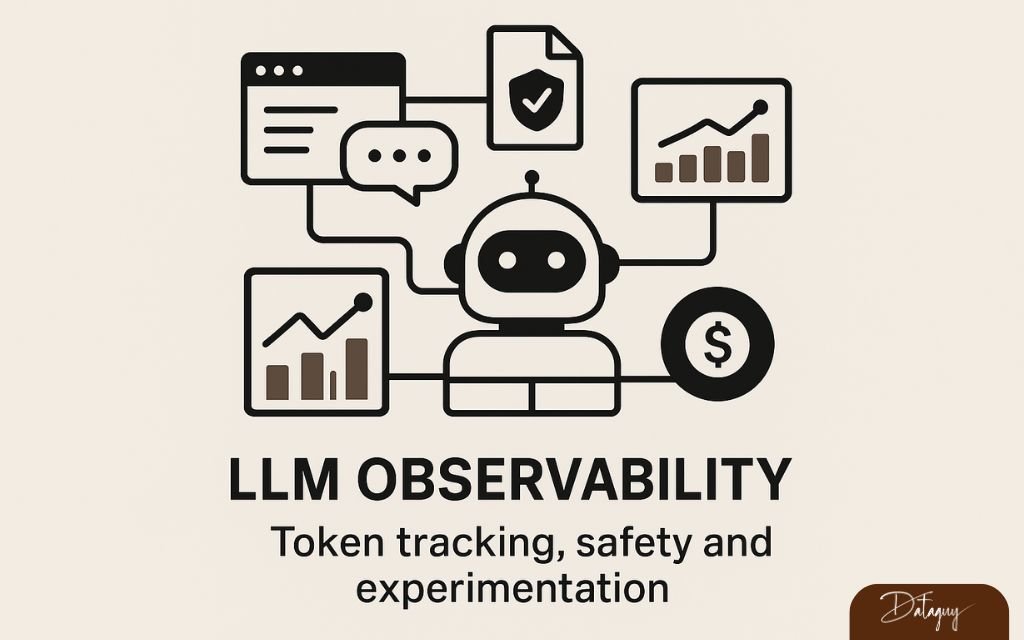
Datadog’s approach to LLM observability is unique. It captures traces of every operation inside an LLM workflow—from input prompts and API calls to guardrail activations. Teams can measure latency, token usage, and error rates while validating safety and compliance.
Bits AI acts as a virtual teammate: investigating anomalies, correlating telemetry, automating remediation, and even generating code patches. For SREs and SecOps teams, this cuts incident resolution from hours to minutes.
4. Pricing Tiers & Feature Differences
Understanding Datadog pricing is essential for budgeting observability. Plans are structured as Free, Pro, Enterprise, and Custom, with add-on pricing for specific features.
- Free — Up to 5 hosts, basic infra monitoring, limited retention.
- Pro — $15/host/month; includes logs, metrics, limited APM.
- Enterprise — $23+/host/month; advanced security, SLOs, extended retention, dedicated support.
- Custom — Tailored solutions with SLAs, consulting, and compliance extensions.
Costs also scale with usage: e.g., APM at ~$31 per host, logs at ~$0.10/GB, RUM at ~$1.50 per 1,000 sessions. For budget optimization, see our Data Stack Fundamentals cluster.
5. Glossary & Foundational Concepts
6. Mapping to SRE Responsibilities
Datadog aligns closely with SRE principles. From reliability metrics and error budgets to automation, it covers the full incident lifecycle.
- Reliability & SLOs — Latency/error monitoring via APM and RUM.
- Incident Detection — ML-driven anomaly detection and Bits AI triage.
- Root Cause Analysis — Tracing + logs + dashboards for rapid RCA.
- Capacity Planning — Continuous profiling + cost management.
- Change Management — CI visibility + synthetic monitoring.
- Security Integration — SIEM + RBAC policies for compliance.
7. Defining SLIs & SLOs in Datadog
Datadog supports metric-based, time-slice, and monitor-based SLOs. For example:
Good Requests: avg:trace.http.request.hits{service:web-app,!http.status_class:5xx}.as_count()
Total Requests: avg:trace.http.request.hits{service:web-app}.as_count()
SLO Target: 99.9% success rate over 30 days
Dashboards visualize these metrics, while error budgets help balance reliability vs. velocity. For best practices, see Datadog’s SLO guide.
8. Monitoring vs Observability
Monitoring answers what happened. Observability answers why. Datadog shifts teams from reactive alerting to proactive, data-rich insights that link system signals to user and business outcomes.
9. Resources & References
- Datadog Platform Overview
- APM Documentation
- LLM Observability
- Bits AI Suite
- Context Engineering (for LLM agent monitoring)