
By Prady K | Published on DataGuy.in
Modern enterprises demand unified visibility across applications, infrastructure, security, and increasingly, AI-driven workflows.
Datadog has emerged as a leading observability and security platform that
consolidates these capabilities into a single SaaS offering.
In this article (Part 1 of a two-part series), we’ll explore the
backbone of Datadog: its core modules, integrations, and observability fundamentals that differentiate it from both open-source
stacks and competing commercial solutions.
1. Introduction to Datadog
At its core, Datadog is a unified observability and security platform providing real-time visibility into infrastructure, applications, logs, and user journeys across cloud and on-prem environments (see how other AI suites integrate observability). With deep integrations (900+ technologies), Datadog supports operational, DevOps, SRE, and security teams in monitoring, troubleshooting, optimizing, and automating workloads ranging from legacy monoliths to large-scale AI systems.
2. Core Capabilities
Datadog’s value lies in unifying telemetry across metrics, traces, logs, and security signals. Its platform addresses all three pillars of observability and extends into governance, compliance, and cost efficiency.
Unified Observability
Centralized monitoring for infrastructure, cloud-native environments, applications, logs, security posture, and real user interactions — accessible through dashboards and AI-assisted analysis.
Application Performance Monitoring (APM)
Distributed tracing, code-level diagnostics, anomaly detection, and continuous profiling enable fast root cause analysis. APM is critical for microservices-heavy environments where latency and cost can quickly accumulate.
Infrastructure Monitoring
Monitors hosts, VMs, containers, and hybrid infra with auto-discovered dashboards and health checks.
Log Management
Aggregates and indexes logs at scale. Features include pipelines for parsing/enrichment and flexible retention (Datadog Logs Documentation).
Synthetic & Real User Monitoring (RUM)
Synthetic tests validate uptime and flows; RUM tracks in-browser and in-app experience. Together, they deliver Digital Experience Monitoring.
Security Monitoring & Posture
Threat detection, compliance checks, and live context across cloud environments integrate security into observability — aligning with modern data stack fundamentals.
Cloud Cost Management
Provides visibility into spend and allocates costs to services or teams, enabling informed optimization and chargeback.
Incident Response & Automation
Datadog integrates with on-call systems like PagerDuty and ServiceNow, automates remediation, and leverages AI to accelerate triage and resolution.
Dashboards & Alerting
Flexible, real-time dashboards with ML-driven anomaly detection. Alerts can trigger via email, Slack, Teams, or API.
OpenTelemetry Support
Datadog natively supports OpenTelemetry collection standards, easing migration from open-source tools and ensuring future interoperability.
3. Specialized Features
- Digital Experience Monitoring: correlates synthetic + RUM signals to pre-empt user-facing issues.
- Automated Recommendations: ML-based suggestions for CI reliability, latency reduction, and cost control.
- Product & Feature Analytics: feature adoption and event usage insights for SaaS teams.
- Governance & Compliance: SOC 2, ISO 27001, and regional storage to meet enterprise compliance mandates.
4. Core Modules & Their Roles

Datadog modules map to specific observability and security needs but integrate tightly for correlated analysis. Examples include:
- Infrastructure Monitoring — host/container health
- APM — distributed tracing and profiler
- Log Management — scalable ingestion & search
- RUM & Synthetic — user experience visibility
- Security Monitoring & Cloud SIEM — threat detection
- Network Monitoring — flow maps & latency detection
- CI Visibility — build/test analytics
- Product Analytics — usage trends
- Cloud Cost Management — spend tracking
- Bits AI Suite — AI-driven investigation & remediation
5. Integrations & Supported Technologies
Datadog boasts over 900 integrations, making it one of the most versatile observability ecosystems (full integrations list).
- Cloud Providers: AWS, Azure, GCP, Oracle, VMware, Red Hat OpenShift.
- Languages & Frameworks: Python, Java, Node.js, Go, .NET, Ruby, PHP, Scala, Kotlin, Elixir.
- DevOps & CI/CD: Kubernetes, Docker, Terraform, Jenkins, GitHub Actions, GitLab CI.
- Databases & Messaging: PostgreSQL, MySQL, MongoDB, Redis, Kafka, RabbitMQ.
- Security & IAM: Okta, Auth0, CrowdStrike, AWS Security Hub.
- Collaboration Tools: Slack, Teams, PagerDuty, ServiceNow, Jira.
- Business Apps: Salesforce, Shopify, Snowflake.
- OpenTelemetry & APIs: supports vendor-neutral collection.
6. Datadog vs. Prometheus & Grafana
While Datadog and the Prometheus + Grafana stack both provide robust observability solutions, they differ significantly in their approach, features, and target audience. The core difference lies in Datadog being a comprehensive, all-in-one SaaS platform, while Prometheus and Grafana are two distinct, open-source tools that are often used together to build a complete monitoring stack.
Key Comparison Points
Deployment & Model:
- Datadog: A SaaS (Software as a Service) platform. It offers a fast, simple setup with minimal operational overhead as data is sent to the cloud.
- Prometheus & Grafana: Open-source and self-hosted. This means you are responsible for installing, configuring, and maintaining the entire infrastructure.
Data Collection:
- Datadog: Uses an agent-based model and pre-built integrations to collect data. It relies on a push model where agents send data to the platform.
- Prometheus: Uses a pull-based model. It periodically scrapes metrics from instrumented targets at a specified interval.
Scope and Features:
- Datadog: A single, unified platform covering metrics, logs, traces (APM), Real User Monitoring (RUM), and security monitoring (SIEM). It provides a complete “turnkey” solution.
- Prometheus & Grafana: Prometheus is a time-series database and alerting system for metrics. Grafana is a data visualization tool. Achieving full observability requires integrating other tools like Loki for logs and Jaeger or Tempo for traces.
Cost:
- Datadog: Operates on a subscription-based pricing model that scales with data volume, which can become expensive.
- Prometheus & Grafana: Free and open-source. Costs are limited to the infrastructure and engineering resources required for hosting and maintenance.
Customization and Flexibility:
- Datadog: Offers excellent ease of use and pre-built dashboards, but can be less flexible for highly customized visualizations.
- Grafana: Renowned for its flexibility and customization, providing a powerful interface for building complex dashboards from various data sources.
Alerting:
- Datadog: Includes advanced, built-in alerting features with machine learning capabilities.
- Prometheus: Uses an Alertmanager component for handling alerts, which requires more manual configuration.
In short: Datadog is a turnkey solution for enterprises, while the Prometheus + Grafana stack is better suited for teams that want customization and can absorb operational overhead.
For a visual comparison, you can refer to this video: Prometheus vs Grafana vs Datadog vs New Relic.
7. Long-Term Metrics Storage & Retention
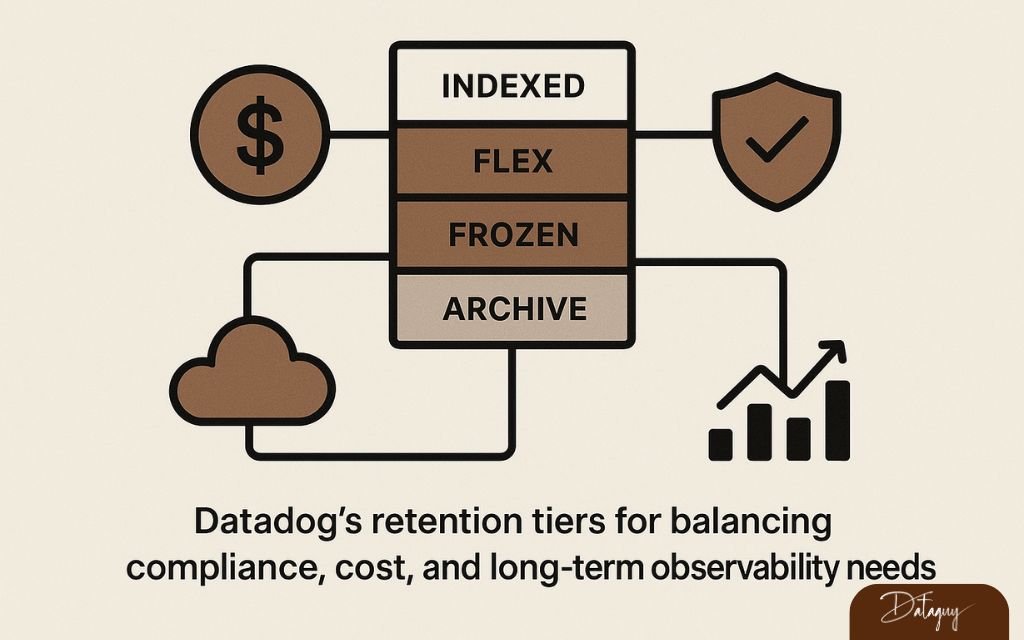
Datadog supports tiered retention for balancing performance, compliance, and cost (data retention docs):
- Indexed Logs: fast search for short-term high-priority data.
- Flex Logs: cost-optimized for medium-term retention.
- Flex Frozen: 7+ years of compliance-grade storage.
- Archive Search: query older data in S3 or other customer storage.
- Metrics Rollups: long-term trend analysis via aggregated summaries.
This strategy ensures organizations can meet compliance needs without uncontrolled spend — a key differentiator in enterprise environments.
Conclusion
Datadog provides the strongest foundation for unified observability and security in cloud-native and AI-driven ecosystems. Its modular design, deep integrations, and enterprise-ready compliance make it a top choice for organizations scaling across hybrid environments. In Part 2, we’ll explore advanced capabilities, including AI observability, Bits AI agents, and SRE workflow automation.